
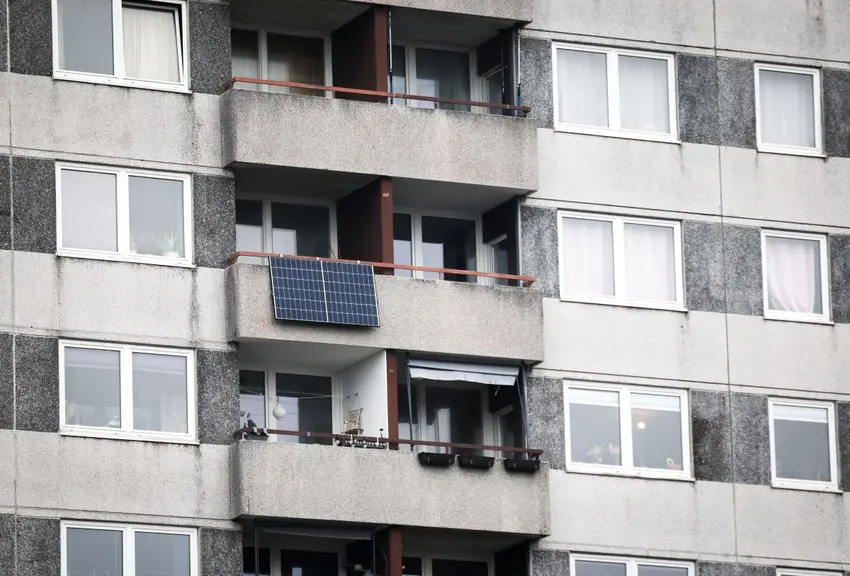
Solar power is booming in Germany, and interestingly it's not all big solar farm projects driving up the country's renewable power generation.
In recent years Germany has quietly become a world leader in balcony solar.
So-called balcony solar panels (Balkonkraftwerke) are plug-and-play solar systems that can be mounted on apartment balconies, as well as on exterior walls or windowsills, and allow homeowners and tenants alike to invest in their own cheap and renewable electricity supply.
Doing so, however, does require you to register your personal 'power plant' with Germany's Federal Network Agency.
Fortunately, this is one bureaucratic process that's easy to manage on your own and at home. Here's how to do so:
Registration required
If you intend to connect your solar panel to the grid in Germany it must be registered with the Federal Network Agency no later than one month after it is installed. This requirement applies whether you will use it to power your own electricity use or to feed surplus back into the grid.
The good news, however, is that since 2024 Germany has streamlined the process for registering balcony solar power units -- making it as easy as filling out a form online.
How to register:
- Visit the official registration website at www.marktstammdatenregister.de.
- Select "Registration of a plant, a plant operator or another market player" (Registrierung einer Anlage, eines Anlagenbetreibers oder eines anderen Marktakteurs).
- Then select "Solar system" at the top of the next page, and select the option "Plug-in solar system (so-called balcony power plant)" -- again the first option on the top of the next page.
- Then you'll need to create a user account (unless you already have one), and activate it via email.
- Finally you can log in and register the balcony power plant.
The Federal Network Agency asks for some important data about the system.
To complete your registration you'll want to have the following information on hand:
- Location with exact address
- Type of power plant -- "balcony power plant" is the default here
- The date of the first commissioning
- The number of installed modules, and their total power output
- The power of the inverter
- Your own electricity meter number
- If your system includes battery storage, you should specify the capacity of the batteries and the power in watts
When you've completed the registration successfully, you can expect a downloadable confirmation including the MaStR number.
Then you are done. If you change something about your system in future you can update this data with your user account on the same website.
Registration is free if you do it yourself. If it's done by a service provider -- such as a solar installation company -- they may charge a fee. The process is said to take about five minutes.
READ ALSO:
- How much money can you get towards buying an EV in Germany this year?
- German 'green village' rides out Mideast energy storm
With reporting by DPA.
Comments