
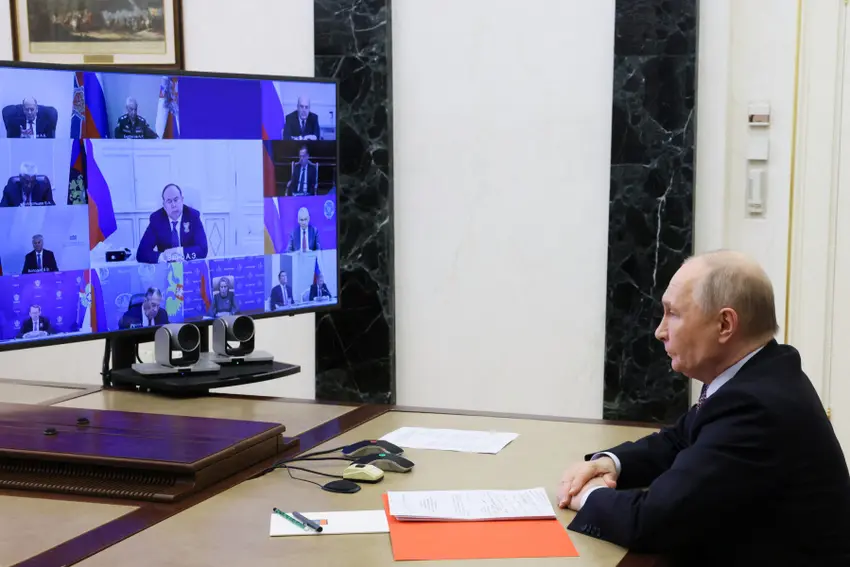
Russian President Vladimir Putin has proposed long-time ally and friend, former German chancellor Gerhard Schröder, as mediator in the Ukraine war -- an idea that has been met with scepticism in Berlin.
Putin surprised many by suggesting the war was "coming to an end" in a speech on Saturday -- and then adding that his friend, former German chancellor Schröder, would make a good mediator in talks with Europe.
Schröder, 82, led Germany from 1998 to 2005 and has remained close to the Kremlin leader long after leaving office, standing apart from most Western leaders since Russia invaded Ukraine in 2022.
German officials reacted cautiously, saying they had "taken note" of Putin's comments but viewed them as part of "a series of bogus offers" from Russia, government sources told AFP Sunday.
One source said a real test of Moscow's intentions would be to extend the current three-day truce.
Germany's defence minister said on Monday he suspected Russian President Vladimir Putin's remarks about the Ukraine war winding down were "just another deception".
"If he sees the end of this war approaching, couldn't he simply end it himself? Then he would have control over the timing," Boris Pistorius, the German defence minister, said in Kyiv.
"Instead, as always, he (Putin) sets conditions. It's to be feared -- and I hope I'm wrong -- that this is yet another deception. But it can't be ruled out, and it seems to be part of his hybrid war strategy."
Pistorius charged that Putin has a habit of "playing with a stacked deck" whenever a ceasefire has been discussed in Ukraine.
The Russian president, who is facing mounting military losses in Ukraine and meagre territorial gains, "was trying to divert attention from his own weaknesses", he added.
German government spokesman Stefan Kornelius, also speaking on Monday, said that he saw no "substantial progress" towards talks despite Putin's remarks.
Russia "knows who its interlocutors are in Europe if it is serious about negotiating", Kornelius said in Berlin in response to questions about Schröder.
Schröder's continued proximity to Putin has made him a controversial figure at home. He has never publicly condemned the invasion of Ukraine, costing him several privileges normally granted to former chancellors.
He previously held key roles in Russian energy projects, including work on the Nord Stream gas pipelines and a seat on the board of Russian oil firm Rosneft, which he gave up in 2022.
Some German politicians from Schröder's own SPD party -- a junior partner in Germany’s coalition government -- say this makes him unsuitable for any mediator role.
Michael Roth, former SPD lawmaker and chair of the foreign affairs committee, said a mediator "cannot be Putin's buddy", in an interview with Tagesspiegel.
He stressed that any mediator must above all be accepted by Ukraine. "Neither Moscow nor we can decide that on Kyiv's behalf."
Others within the party, however, have been more open to Putin's suggestion.
Quoted by Der Spiegel, the SPD's foreign affairs spokesman in parliament, Adis Ahmetovic, said the proposal needs to be "carefully considered" with European partners.
SPD lawmaker Ralf Stegner argued, in the same magazine, that "if we don't want Putin and (US President Donald) Trump to decide Ukraine's future" alone, Europe should seize every possible chance -- however small.
"We should turn to the former chancellor. What do we have to lose?" said Fabio De Masi, leader of the pro‑Russia left‑wing BSW party, speaking to AFP on Sunday.
Others remain unconvinced, with Marie‑Agnes Strack‑Zimmermann of the liberal FDP warning there were "serious doubts" that the ex-chancellor was the right choice as a go-between.
Comments