
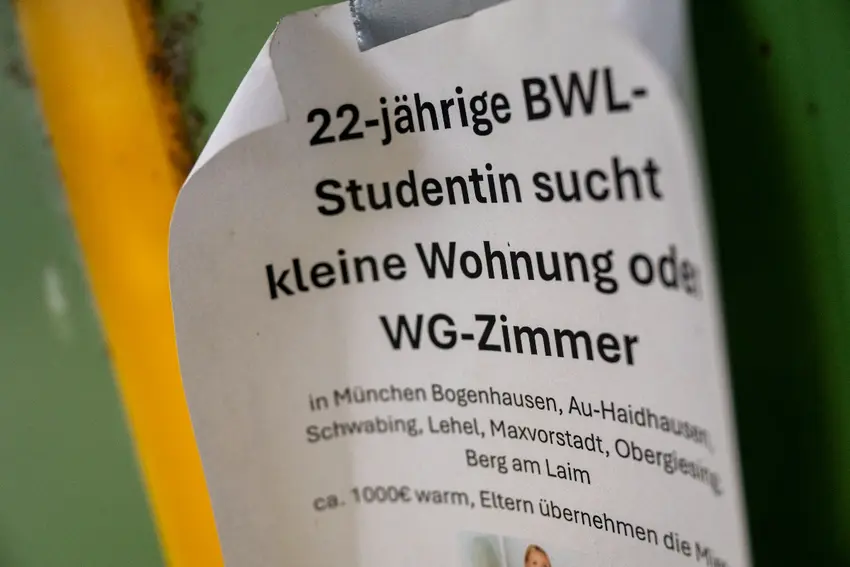
Germany's affordable housing shortage and ever-rising rents continues to heavily affect students, with prices rising faster than inflation.
The average monthly rent for a room in a Wohngemeinschaft – often simply called a 'WG' or, in English, a shared flat – increased by 3.9 percent last year to €512, according to a new analysis by the Moses Mendelssohn Institute.
Although the pace of rent hikes has slowed in recent years, the institute warned that "prices remain at a very high level and are rising faster than general inflation".
The study included all of Germany's nearly 90 university locations home to over 5,000 students.
READ ALSO: Which German cities are the most expensive for international students?
How much do students pay for housing across Germany?
Rental costs for students vary considerably depending on the city and region.
Munich remains the most expensive student city in the country, where a room in a shared flat costs around €800 per month on average. In the city states of Hamburg and Berlin, students typically pay about €650 per month for similar accommodation.
Other large cities also rank among the pricier locations. Monthly rents average roughly €630 in Düsseldorf, €620 in Cologne, and €510 in Bonn.
By contrast, more affordable university cities such as Bielefeld and Bochum see average rents of €375 and €385 respectively.
Looking at regional averages, Bavaria stands out as the most expensive state, with students paying around €605 per month for a room in a shared flat. In North Rhine-Westphalia, it drops to €485, while in Lower Saxony a room in a WG costs on average about €431 – figures that reflect the wide range of university locations and local housing markets.
An east–west divide in rental costs persists, though it is gradually narrowing. In eastern states such as Saxony-Anhalt and Saxony, students still pay significantly less, with average monthly rents of €358 and €372 respectively.
The study authors point out that the rental market structure in Germany is changing. While average rents are stabilising somewhat, more affordable options are increasingly hard to find in major cities.
"The situation is becoming more difficult for many people searching for housing," said institute director Stefan Brauckmann. "Especially in the lower price bracket, the margin for manoeuvre is shrinking. This affects not only students, but also apprentices and others with a limited housing budget."
READ ALSO: Which German cities are the most expensive for international students?
Financial assistance not keeping up
Students in Germany can apply for financial help through what's known as BAföG assistance.
But the report highlights that the current BAföG housing allowance of €380 falls well short of covering average rents, even with a planned increase to €440, which is due to kick in for the coming winter semester 2026/27.
"A significant proportion of students would still be affected by housing costs exceeding the allowance," said the institute. "The problem is therefore not limited to BAföG recipients."
Overall the study found 83.4 percent of students in Germany are enrolled in cities where the average cost of living exceeds the BAföG allowance.
READ ALSO: Everything that changes for international students in Germany in 2026
Experts said rising utility and energy costs are also putting pressure on students, apprentices and others seeking flatshares due to their limited budgets.
Annegret Mülbaier from the housing site WG-Gesucht.de said people searching for a shared room in Germany face a difficult situation: "We can see on our platform that demand is heavily concentrated on shared flats, which are still relatively affordable."
"Many of these listings are often snapped up on the very same day – for students, the search for accommodation is thus increasingly becoming a race in which only those who react quickly and apply straight away stand a chance," she added.
"At the same time, we are observing that many are having to be more flexible in their search and make greater compromises on location or size in order to find suitable options."
READ ALSO: The essential guide for anyone who's just moved to Germany
The Moses Mendelssohn Institute said to ease pressure on the market, the supply of affordable housing and places in halls of residence must be increased.
"Ultimately, it is the available supply that will determine whether the situation eases or the pressure continues to mount," said Brauckmann.
Comments