
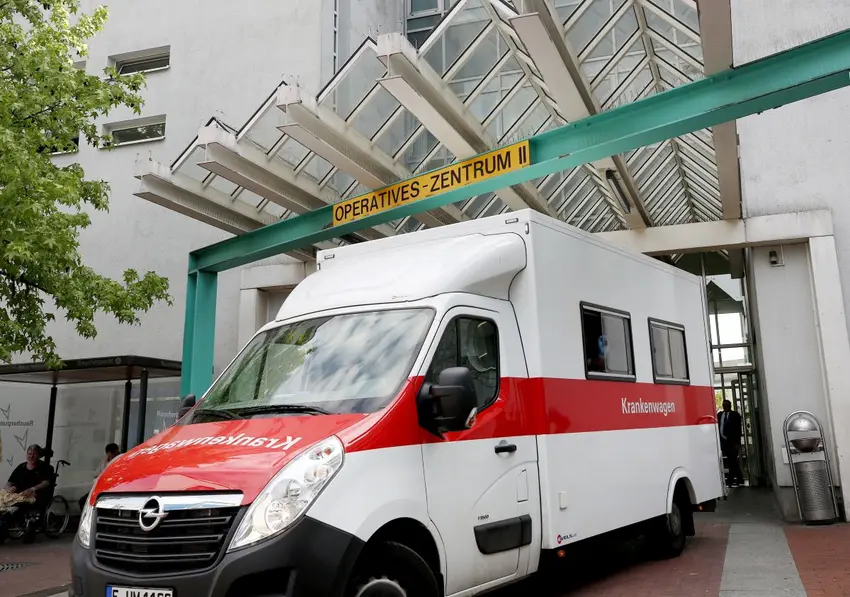
Residents of Essen can breathe a sigh of relief, the city has scrapped a plan to introduce co-payments for patients who are picked up by an ambulance.
Previously it had been reported by regional news outlets that patients in North Rhine-Westphalia's fourth largest city would be billed a co-payment of €267 for a trip to the clinic by ambulance starting in 2026. Doctors warned that the policy came with real dangers for patients.
Similar proposals were reportedly discussed in the Ennepe-Ruhr district and in Hattingen, Sprockhövel and Witten.
Now the city of Essen has scrapped the co-payment for patients from January and is instead waiting for a nation-wide solution to be agreed in the coming year.
'Incorrect' trips
Part of the problem, from the city's point of view, is that so-called incorrect trips by ambulances -- i.e. cases where an ambulance is called but the patient does not actually require hospital care -- are particularly costly.
According to current rules, public health insurance companies are not responsible for the costs in these cases, which means payment for these trips may be borne by the city.
This means that a high number of unnecessary emergency calls through the course of the year leaves cities with a high bill for ambulance services. These incorrect calls also cause problems for patients dealing with real emergencies, because they take time and contribute to excessive demand for response services.
In an effort to cut down on unnecessary ambulance calls, and also facing municipal budget constraints, Essen had proposed that public health insurance patients who receive care in an ambulance should make a co-payment toward that service.
Alternatively in the Ennepe-Ruhr district, the plan was to charge patients only when the ambulance ride was deemed to be unnecessary, according to a report by WAZ.
Budget problems for healthcare in German cities
This comes as federal and state government representatives have just reached an agreement on the federal government's austerity plan for hospital costs.
Health care costs have steadily risen across Germany, and insurance providers have increasingly warned that the current system is not sustainable.
For people living in Germany, this has amounted to health insurance payments being raised over time, with another jump in contributions expected from the start of the coming year.
But it also means that city and state governments have to increase their own budgets to maintain health care services in many cases. Hence, the resistance to a federal austerity measure that had aimed to save €1.8 billion at the hospitals.
READ ALSO: Is Germany headed for a period of austerity?
However, a compromise on that plan has reportedly been reached and is set to be passed by the Bundestag and Bundesrat on Friday.
What's next for ambulance services?
Having scrapped its plan to introduce co-payments in January, city of Essen announced that a law to reform emergency care will soon be sent to the federal cabinet.
A decision on that may be expected by summer 2026.
Comments