
Germany’s civic freedoms have taken a dramatic hit, according to CIVICUS, a global alliance of civil society organisations and activists. Each year CIVICUS tracks freedom of association, peaceful assembly and expression across 198 countries in its global monitor report, rating each as 'Open, Narrowed, Obstructed, Repressed or Closed.'
What makes Germany’s case stand out is how quickly the situation has deteriorated from a high starting point, according to Tara Petrović, a Europe researcher for CIVICUS. In 2022, Germany held the highest possible ranking of ‘open’.
In the wake of the report's publication, she told The Local that, “Germany hasn’t had the sharpest decline in civic freedoms, nor the fastest, but it’s the only country to fall from ‘open’ all the way to ‘obstructed’".
Just three years ago, Germany was at the top of the table. In 2023, it slipped to ‘narrowed’, and now, in 2025, it’s fallen further to ‘obstructed’. This reflects restrictions imposed on civic space in the country, with authorities imposing legal and practical barriers that make it much harder for people to exercise their rights.
Germany joins 39 other countries in this category, including Hungary, Brazil and South Africa. It is not alone in this downward spiral. France and Italy have also been downgraded to ‘obstructed’ this year, and the United States joined them in the same tier.
“Germany’s downgrade reflects a broader global trend,” explained Petrović. “More and more countries, including some within the EU, are shifting from environments where fundamental freedoms are generally respected, despite challenges, to ones where authorities increasingly treat dissent as a threat.”
Why has Germany been downgraded?
The CIVICUS Monitor 2025 report, People Power Under Attack, paints a stark picture. The most significant factor has been the German authorities’ response to pro-Palestinian demonstrations.
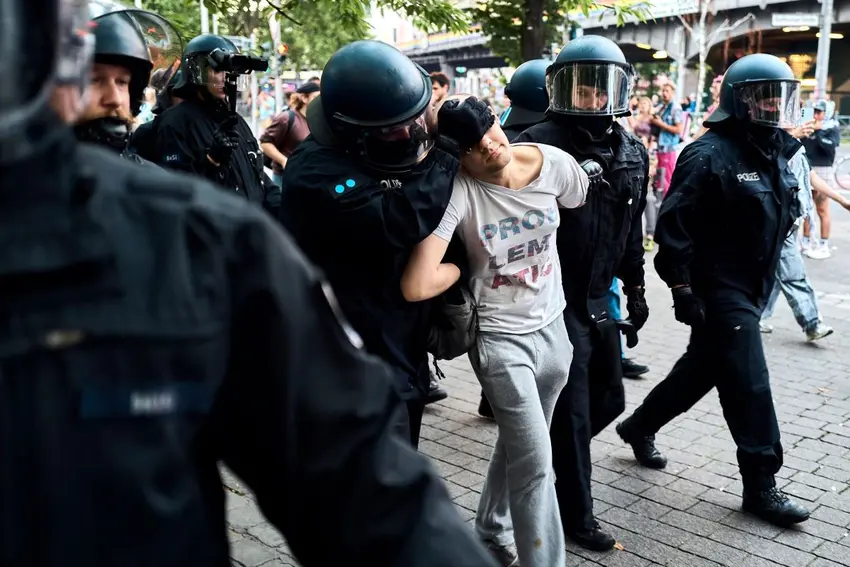
Since October 2023, Berlin police have filed nearly 9,000 criminal charges linked to these protests. Participants, journalists and even parliamentary observers have faced severe police brutality – including documented cases of kettling, pepper spraying, punching and choking.
READ ALSO: What to know about talking to the police in Germany
But the crackdown goes beyond Palestine solidarity.
“There has been a hardening of attitudes towards civil society groups both before and after October 7th,” said Petrović. Germany was downgraded from ‘open’ to ‘narrowed’ in 2023 due to “harsh and disproportionate” measures against climate protesters.
“These included raids on members of Last Generation as an alleged organised criminal group, surveillance of their phones and emails, and the consistent use of pain grips and preventive detention against peaceful sit-down protests,” said Petrović.
This year, as protests against the far-right surged, police violence at these demonstrations made headlines.
In October, it was also revealed that The Federal Office for the Protection of the Constitution had increasingly been vetting NGOs and individuals who apply for government funding.
Petrović highlighted the government’s approach: “We can see that the authorities’ priority is clamping down on dissent rather than addressing the grievances driving mass mobilisation.”
READ ALSO: What is Palantir's Gotham software and why do German police want it?
The report also points to a pattern of selective enforcement. Civil society organisations linked to Palestine solidarity and the BDS movement have faced raids, funding cuts and “extremist” labels, while immigration law has been "weaponised" to deport activists and restrict citizenship, making immigrants especially vulnerable.
“People with an immigration background who participate in pro-Palestine activism are particularly targeted,” said Petrović, adding: “Six UN special rapporteurs and the Council of Europe’s Commissioner for Human Rights have raised concerns about the German state’s targeting of pro-Palestinian protests and solidarity.”
The chilling effect – and why protest still matters
“Germany still has a vibrant civil society, and protests take place freely on a variety of topics,” stressed Petrović. "But police violence, surveillance and overreach have become normalised."
What does this mean for people on the ground? The answer is a growing "chilling effect".
"In addition to the many people across Germany who’ve already been unjustly punished, brutalised or criminalised for their peaceful civic engagement, others will now think twice before coming out to a protest," said Petrović.
READ ALSO: Widespread pushback to Alternative for Germany as party calls for more 'remigration'
Citing fears over police violence, arbitrary arrest or immigration status, Petrović also noted the power of “extremism designations", which can criminalise entire movements and expose anyone associated with them to surveillance and reprisals.
"Despite this," she concluded, "people continue to mobilise: in solidarity with Palestine, for the environment, against the far-right, against increased police powers. This persistence matters, since it’s the only way to defend our rights and stop civic space from closing even further.”
Comments (1)