
Erlangen, the middle Franconian university city near Nuremberg, is rated as the best city to move to in Germany at the moment, according to a recent evaluation.
BOXIE, a Germany-based storage company, recently compiled the ten best German cities to move to in the coming year based on a number of statistics, including; cost of living and average monthly rents, perceived level of crime, average internet speed, average commuting time to work or school and more.
Of course, no one really ups and moves to a new city based on internet speeds, crime stats or the latest rent prices. But if you have any flexibility around your move to, or within, Germany in the coming year for work, school or other reasons, you might consider if one of the following cities would be a good fit.
The best German cities to move to now
With a near perfect "moveability score", Erlangen claimed the top spot as the best city to move to in Germany in the coming year, according to the results of the evaluation which was shared with The Local.
Home to industrial giant Siemens and the Friedrich-Alexander-University, the city attracts engineers and academics from around the world. Erlangen is on the smaller side -- it's Germany's 69th largest city with a population around 115,000 at the end of 2024 -- but is home to a vibrant foreign community.
It claimed the top spot among the best cities to move to in 2026 thanks to having the lowest cost of living and a low average rent price for 1-bedroom apartments -- around €740.
It also had a low reported crime level, the shortest commute time to get to work or school (at an average of 8.83 minutes each way, according to Numbeo figures), and scored well for green space.
Additionally, its close proximity to Nuremberg and Fürth means residents of Erlangen are well connected to a decently sized metropolitan area. The three cities together form one of just three metropolises in Bavaria.
READ ALSO: Five reasons foreigners should move to Nuremberg
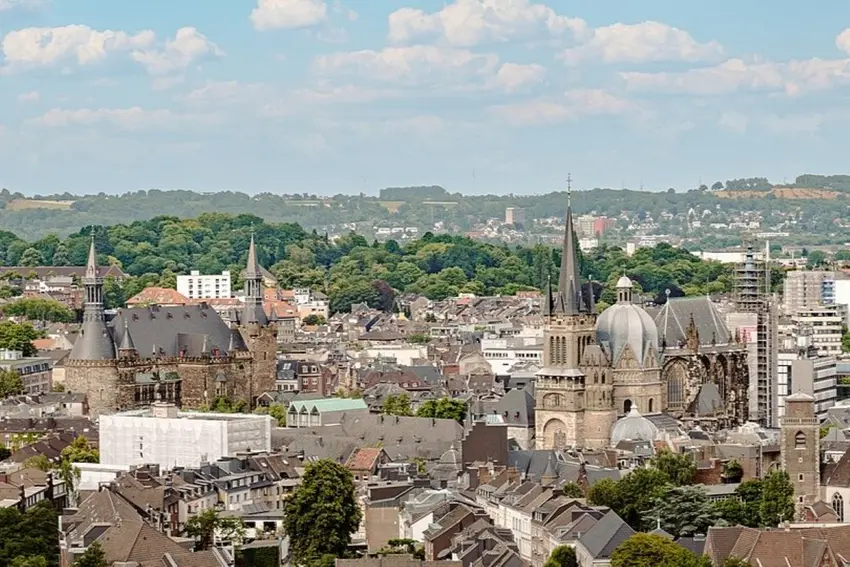
Aachen, another university city which sits on the west edge of Germany, directly bordering Belgium in the southwest, was ranked the next best city to move to.
Slightly larger than Erlangen, Aachen is also home to several universities such as RWTH Aachen and FH Aachen as well as the biggest single building hospital in Europe (Klinikum Aachen).
The city's history dates back to a Celtic settlement, and it was equipped with several hot spring bathhouses (Thermen) during its initial colonisation by the Romans.
Similar to Erlangen, Aachen also ranked highly for its low cost of living and low rent prices. Its residents also tend to enjoy short commute times to school or work and a high number of green spaces.
READ ALSO: 'Klenkes' - The strange hand gesture you need to know in the German town of Aachen
The larger cities of Hanover and Düsseldorf share third place in the movability ranking for 2026.
Hanover boasts some of the fastest average internet speeds among the cities ranked and a short average commute time.
Meanwhile Düsseldorf, the capital of North Rhine-Westphalia, has the highest concentration of real estate businesses and relocation service providers - which may help make the move easier. It also has one of Germany's largest Japanese communities, and therefore some of the best quality Japanese and Asian food.
Both Hanover and Düsseldorf have high university densities (with nine campuses per 100 square kilometres) and relatively low rents compared to Germany's larger cities.
READ ALSO: Weimar to Heidelberg - The best German university towns for foreign students
The top ten best cities to move to move to in Germany, according to the study were as follows:
1. Erlangen
2. Aachen
3. Hanover
4. Düsseldorf
5. Munich
6. Karlsruhe
7. Dresden
8. Mannheim
9. Bonn
10. Mainz
READ ALSO:
- Five surprising things about Dresden, a gem on the Elbe River
- Ten of the best German cities for foreigners to retire
To create the ranking Germany's major cities were given a score based on data collected from Numbeo (cost of living, rental prices, travel time, and crime statistics), as well as internet speeds from the Fair Internet Report, the number of relocation services and real estate businesses according to Gelbeseiten.de, the proportion of green space according to isglobalranking.org and university density according to My German University.
Comments