
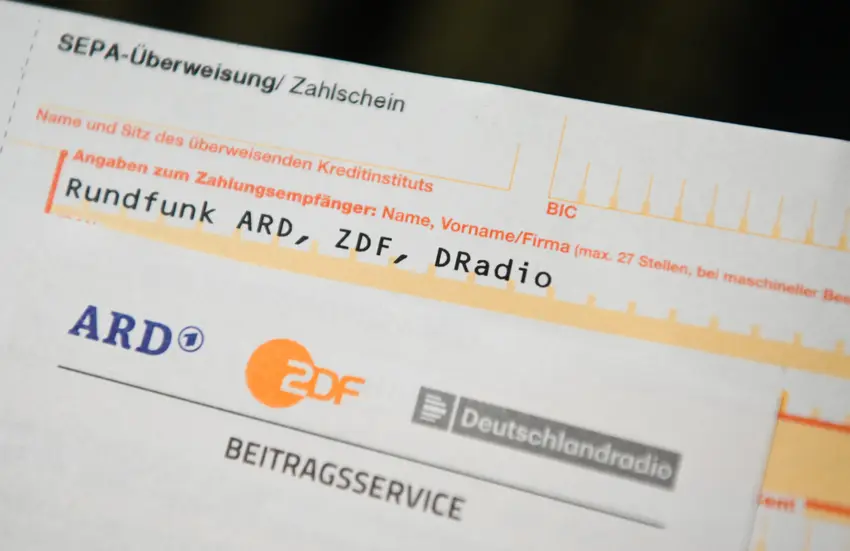
There's no escape: every household in Germany receives a letter from the Rundfunkbeitrag.
This licence fee – sometimes referred to as "Radio tax" or "TV tax" – involves a mandatory payment towards the Beitragsservice, which is the public service institution in charge of German public broadcasting companies, ARD, ZDF, and Deutschlandfunk.
The fee, equivalent to €18.36 per month, has to be paid by all households with few exceptions.
But one group of young people are on that short list of exceptions.
Some students to be exempt from Rundfunkbeitrag payments
Students who receive BAföG financial aid to help cover the cost of their education, or apprentices who receive vocational training assistance are exempt from paying the broadcasting licence fee.
The other prerequisite is that they must no longer live with their parents.
Shared apartments where only BAföG recipients live are therefore be entirely exempted from paying the fee. However, an application is required for the exemption.
The exception is expected to apply to tens of thousands of students in the coming winter semester.
A spokesperson from the Beitragsservice told The Local, "Students who receive BAföG and do not live with their parents can apply for exemption from the broadcasting contribution.
"The exemption also applies to spouses or registered partners, but not to other flatmates. Erasmus students or other scholarship holders are generally subject to the contribution.”
More information about who is exempt and how to apply for an exemption is found on the Rundfunkbeitrag website.
Who else doesn't have to pay the broadcasting fee?
A few other groups are entitled to a reduction of the licence fee, or they may not have to pay it at all.
Those receiving certain social security benefits from the state do not have to pay it. This includes people receiving long-term unemployment benefits (Bürgergeld) and disability benefits Asylum seekers are also not required to pay it.
Furthermore, people with vision or hearing impairments can apply to have the fee reduced or removed.
Others can also apply for an exemption or to pay a reduced fee if they have sufficient justification, such as a health condition.
Notably, the fee is applied per household, not per person. So if you move in with your partner, or into a shared flat, you can avoid paying the fee yourself - or more accurately, you can instead share the fee among your household.
As is the case with the other exemptions, residents have to apply for it manually. (You'll still receive a letter from the Rundfunkbeitrag, which will require you to take action to show that the fee is already registered for your household.)
What else has changed?
Changes to the way the broadcasting fee is collected started in June this year.
Households no longer receive regular payment reminders by mail.
Instead of the quarterly payment reminders, residents now receive one letter that shows their personal payment plan for the year.
READ ALSO: How you'll be affected by a change in Germany's broadcasting fee
Anyone who has not set up a direct debit payment will have to make the manual payment via bank transfer themselves without any reminders.
Put payment reminders in your calendar or set up a SEPA Lastschrift to make sure you don't get a late fee!
Comments