
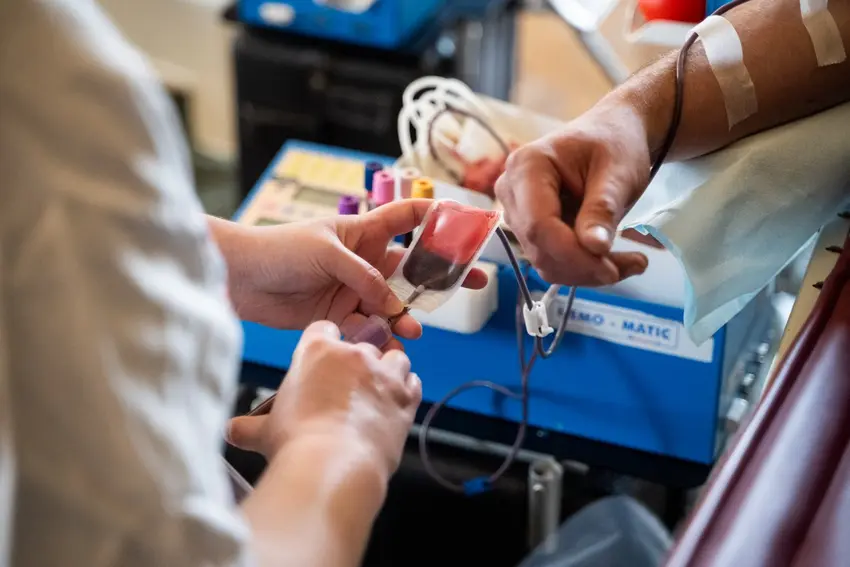
Donated blood saves lives every day.
Whether after accidents, operations or serious illnesses, a blood transfusion is needed every seven seconds in Germany.
Besides potentially saving lives, the act of periodically donating blood has been shown to have some positive health benefits, including improved heart and circulatory health and helping to get rid of certain toxins that build up in your system.
There are no restrictions on foreign residents giving blood that don't also apply to German citizens, but blood donations are strictly regulated, and these regulations can prevent potential donors in come cases. So what are the rules around donating blood in Germany?
The rules defining who can donate blood in Germany are defined by the Transfusion Act (TFG) which has been in force since 1998.
The TFG was introduced after a wave of infections caused by blood transfusions in the 1990s showed that the donation system needed legal regulations in place. It regulates policies and protocols for the collection of blood, the use of blood products, the tracing of donations and the reporting system.
Whole blood donation is the most common type of blood donation, which involves a half-litre of blood being collected from a vein in the arm.
At the most, healthy men can donate blood every two months and healthy women can donate once every three months. (Women are prevented from donating more often due to loss of blood and iron during menstruation.)
Who can donate blood in Germany?
Healthy adults are usually eligible for blood donation in Germany, according to information on the Federal Ministry of Health’s website.
Donors must be at least 18 years old and weigh more than 50 kilograms. Additionally they must be in good health and not have had a recent infection.
If there is any suspicion that a potential donor may be infectious they must be deferred, or made to wait until a certain amount of time has passed without symptoms. Common reasons for deferment include recent infections, recent operations or dental procedures, or risky sexual behaviour.
For example, if you have an uncomplicated infection, like a common flu or cold, you would typically be prevented from donating blood for one week following recovery. If you were infected with Covid19, you would be deferred for at least four weeks after recovery.
Pregnant women and new mothers are also prohibited from giving blood during the pregnancy and for six months after, and during breastfeeding.
Reasons you could be prevented from giving blood
There are some infections and medical conditions that permanently exclude affected people from ever being eligible to donate blood in Germany (and in many other countries).
People who have been in an area that is considered high risk for malaria will generally result in a deferment of at least six months, according to information shared by the Centre for Clinical Transfusion Medicine Tübingen.
People with the following conditions are permanently excluded from donating blood:
- People with hepatitis B or C or HIV
- People considered high risk for those diseases (specifically prostitutes, IV drug users, and immigrants from areas with a high rate of infections)
- People with severe neurological diseases
- People with severe cardiovascular and vascular diseases
- People who have or have had cancer
- People who have been treated with hormones from the human pituitary gland (such as growth hormone)
- Alcoholics and people addicted to drugs
- People with chronic illnesses or constant medication use (up to the discretion of the the donor doctor)
Until recently, anyone who had spent more than six months cumulatively in the United Kingdom between 1980 and 1996 was prevented from donating blood in Germany because of risks associated with Creutzfeldt-Jakob disease (vCJD). No blood transmission cases of vCJD have been found in the UK since 1999, however, and these rules were finally changed in May 2025.
Germany’s blood donation rules were also updated at the beginning of 2023 to lift restrictions on gay donors. Official guidelines were then adapted so that potential donors are no longer assessed differently based on their sexual orientation.
Previous rules, which dated back to the 1980s and the outbreak of the HIV/AIDS epidemic, had assessed gay men differently – preventing them from donating blood in many cases, because they were considered higher risk for HIV.
According to current guidelines from the German Medical Association (BAK), men who have sex with men are only allowed to donate blood if they have not had "more than one sexual partner" in the past four months.
Anecdotally, some foreigners also report that language issues have prevented them from donating blood in Germany. While there is no formal ban on non-German speakers donating, medical practitioners aren't allowed to take blood unless they can be sure the donor has understood the donor questionnaire and related health questions.
Comments