
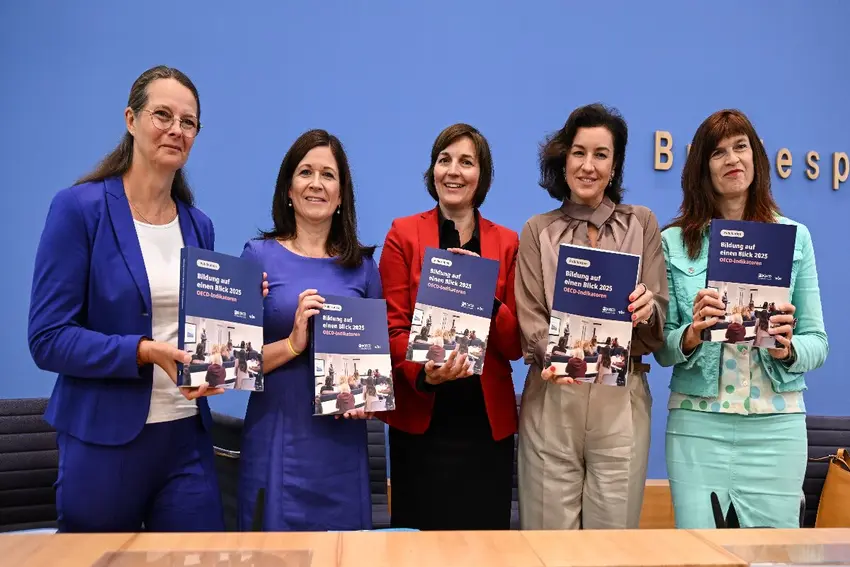
While more young adults in Germany have attained university degrees or master craftsman certificates since 2019, there is also a growing number of people in the country who lack basic qualifications.
These were among the issues highlighted by a new OECD report, called “Education at a Glance 2025”, which was released on Tuesday.
The study, which compared education systems across 38 OECD countries and partner nations, also revealed that Germany leads the way in STEM degrees.
Growing inequality
Between 2019 and last year, the share of young Germans aged 25 to 34 holding higher education degrees or master craftsman certificates rose from 33 to 40 percent. While this represents a significant improvement, the figure remains below the OECD average of 48 percent.
Over the same period, the proportion of low-skilled young adults increased from 13 to 15 percent, placing Germany among the European countries with the highest share of young people without university entrance qualifications or vocational training – alongside Italy, Portugal, and Spain.
READ ALSO: The best German university towns for foreign students
Social background remains a significant factor influencing educational outcomes.
The study found striking skill gaps in reading and numeracy between university graduates and those without a secondary school diploma – the largest internationally.
Only about one in five young adults from disadvantaged households earn a university degree, compared to roughly 60 percent of children from academic families.
"Too many young people are still leaving school without qualifications, and social background continues to have too great an impact on educational success," said Berlin's Senator for Education, Youth, and Family Affairs, Katharina Günther-Wünsch.
Strong in vocational training and STEM
At the same time, the report confirms Germany’s continuing excellence in vocational training and youth employment.
Approximately 59 percent of 18- to 24-year-olds in the country are engaged in education or training, well above the OECD average of 53 percent. Youth unemployment remains comparatively low at 2.7 percent.
Another feather in Germany’s cap is the fact that 35 percent of university graduates in the country earn degrees in STEM subjects (science, technology, engineering, and mathematics) – the highest percentage among OECD countries and far above the international average of 23 percent.
READ ALSO: What to study in Germany to land a high-paying job
A leading destination for international students
The share of international students enrolled in German universities has risen sharply over the past decade.
According to the report, around 13 percent of students in German universities and colleges come from abroad – led primarily by students from Asia (44 percent) and Europe (31 percent) – placing Germany fourth globally and first among non-English-speaking nations as a choice for international study.
Recent figures from Germany’s Statistical Office show this upward trend continuing. In the last winter semester, around 492,600 foreign students were enrolled across Germany – nearly 17 percent of the total 2.87 million students.
READ ALSO: How much money do international students need to study in Germany?
The OECD report highlights the “strategic importance” of this trend, suggesting that foreign students can make a key contribution to Germany’s economy and future prospects, especially if they go on to live and work here following their studies.
How much does Germany invest in education?
According to the report, Germany invests more per student in its education system than the average for industrialised countries.
But measured against the country's gross domestic product, education spending is below average at 4.4 percent. This is significantly lower than in Norway or the United Kingdom, which invest more than 6 percent of GDP in education.
READ ALSO: The best German university towns for foreign students
Comments