
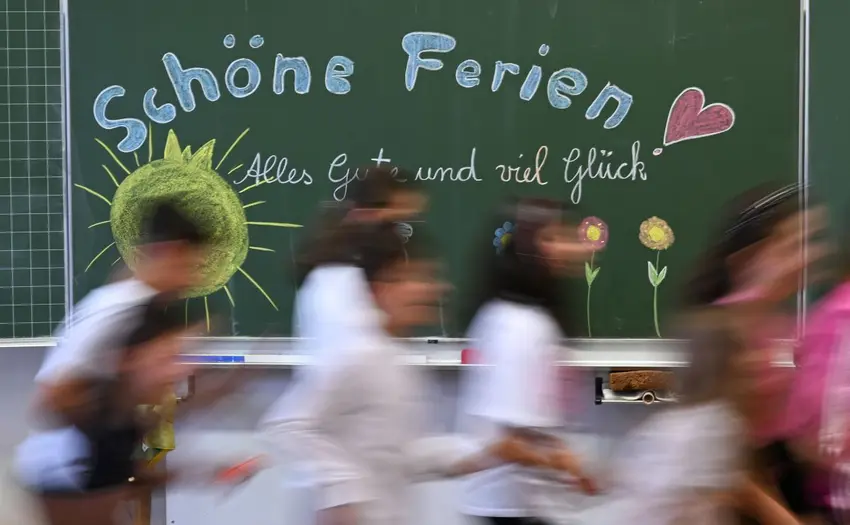
Every summer, while most German children, parents, and schools juggle a rotating schedule for their summer holidays, the southern states of Bavaria and Baden-Württemberg invariably enjoy the last slot in the sought-after month of August.
Now this long-standing exception and source of widespread irritation has sparked a war of words between northern states, who say it's time for change, and the two southern states determined to hold on to their privileges.
How are summer breaks scheduled?
The current rotating summer break schedule, which was put into place around 50 years ago, is designed to avoid travel chaos in Germany by staggering the six-week summer holidays across the states between mid-June and mid-September.
The first slot is the least popular because it means that the summer holidays seem to start almost immediately after Easter, that children (and their parents) are obliged to work through the hottest weeks of the year, and that the autumn term becomes almost unbearably long.
READ ALSO: When do school holidays begin across Germany this summer?
As a result, 14 of the 16 states agree to rotate, starting with the earliest slot and then beginning their summer holidays a week later each year until they reach the final slot and return to the beginning. These “whiplash” shifts have a habit of wreaking havoc on family schedules, childcare arrangements, and travel plans.
The system is generally unpopular but widely accepted on account of the fact that it distributes its imperfections equally – or would, if the two southern states didn’t claim exemptions.
Why are Bavaria and Baden-Württemberg exempt?
Most states rotate, but Bavaria and Baden-Württemberg have always claimed a privileged slot. Originally, this was justified on the basis that children in the south couldn’t work in August because they needed to help bring in the harvest.
More recently, the two states have started claiming they can’t begin the summer holidays any earlier because their schools all close for two weeks over Whitsun (Pentecost) in June.
Why has a fight broken out now?
The current spat flared up when North Rhine-Westphalia’s education minister, Dorothee Feller (CDU) pointed out that families in her state would also like a later holiday period.
Feller told the Westdeutsche Allgemeine Zeitung that arguments that children in the south need to help with the harvest no longer hold water.
Politicians from multiple German states were quick to show their support for Feller’s position.
In Lower Saxony, the state education ministry posed a question that was widely reported across German media: “The two southern states should ask themselves why they don’t participate in the rolling system of summer holidays”.
READ ALSO: Why Bavaria is one the world's top travel destinations for 2025
Thuringia’s CDU parliamentary group leader, Andreas Bühl, said the current system was “from another century", adding, "We need a modern, fair system that is geared to the needs of families, schools and the economy – not to decades-old traditions.”
Hamburg’s school senator, Ksenija Bekeris (SPD), also spoke out in favour of “joint, consensual regulation for all states.”
How have Bavaria and Baden-Württemberg reacted?
Markus Söder (CDU), Prime Minister of the Free state of Bavaria, flatly rejected any change, saying the state would not swap slots even if Baden-Württemberg did.
“We have our holiday rhythm, which is, so to speak, firmly embedded in Bavarians’ DNA,” Söder said.
Anna Stolz (Free Voters), Bavaria’s education minister, backed Söder and further justified the state’s position with an appeal to religion. She said that the total number of holiday days is the same nationwide, but that Bavaria and Baden-Württemberg "base their timing on Christian public holidays".
Are the current arrangements likely to change?
Karin Prien, Germany's federal Education Minister, has called on the Conference of Ministers of Education and Cultural Affairs (Kultusministerkonferenz) to find a "modern solution" which nonetheless respects the "historical and structural traditions" of Bavaria and Baden-Württemberg, which doesn't sound like the most helpful of interventions.
Prien can afford to play for time, however, as school holidays across Germany are currently fixed until 2030/31, which is therefore the earliest point at which a new system could be introduced.
READ ALSO: Backlash after German minister suggests cap on immigrant students in schools
For the next few years at least, it seems that parents and children in the north and east of Germany will have to continue managing the whiplash shifts, while families in the south enjoy predictability and the opportunity to take their holidays in the cheaper post-peak season.
Even beyond 2030, reform remains a distant hope with Bavaria in particular in no mood to compromise.
As demands for fairness from the rest of the country grow louder, however, and the practical need for modern solutions mounts, pressure for a broader agreement is unlikely to subside.
With reporting by DPA.
Comments