
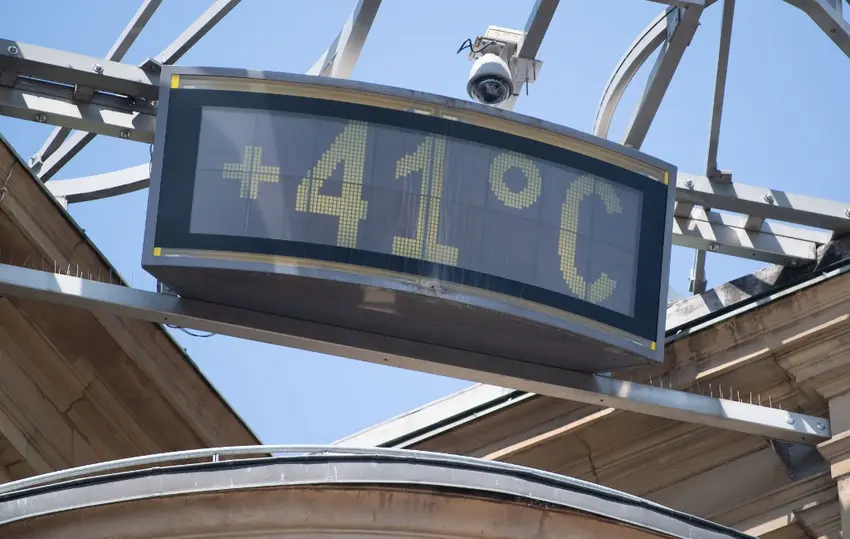
The whole of Germany is expected to see widespread highs of over 30C during the coming week, with temperatures in the southwest set to reach 37C on Tuesday.
DWD meteorologists expect the current heatwave to peak on Wednesday with temperatures of up to 39C.
Parts of Baden-Württemberg, the Saarland, and western Hesse are likely to see the highest temperatures, but highs of 40C are also possible in Berlin and Dresden. Temperatures are unlikely to fall below 20C at night.
Meteorologists are warning people in Hamburg to prepare for temperatures of 36C in the middle of the week and around 39C in the Ruhr area.
Hesse and Lower Saxony could also see extreme temperatures on Wednesday.
Rain is expected on Thursday, but no significant drop in temperature is foreseeable after that, according to the DWD.
Is there an explanation for the heatwave?
This week’s forecast is the result of a persistent and intense heat dome over Europe, which has already led to record-breaking temperatures in Spain.
On Saturday, a new heat record for a June day was set with 46C in the southern Spanish town of El Granado (breaking the previous record of 45.2C set in Seville in 1965).
The highest temperature ever recorded in Germany is 41.2C, measured on July 25th 2019 at the weather stations in Tönisvorst and Duisburg-Baerl (North Rhine-Westphalia).
READ ALSO: How to stay safe while swimming outdoors in Germany this summer
What is a heat dome?
A heat dome is a weather phenomenon in which a strong area of high pressure stays over the same region for days or even weeks, trapping hot air underneath it like a lid on a pot of boiling water. The phenomenon shuts out cooler air and stops warm air from rising, causing temperatures at the surface to rise.
The lack of clouds and precipitation creates the conditions for intense sunshine, heating the ground even more and often leading to drought and an increased risk of wildfires (as well as extreme heat).
As a result of the current dry conditions in Germany, the DWD expects the risk of wildfires to reach the highest or second highest level by Wednesday in many regions across Germany.
This is particularly the case for Brandenburg, where the state environment ministry has already issued the highest risk level for the districts of Dahme-Spreewald, Elbe-Elster, and Teltow-Fläming.
Due to the ongoing drought, a ban on water extraction from surface waters has also been put in place in several regions of Germany.
Health implications
The health risks associated with severe or extreme heat should not be underestimated, especially for older people and young children.
The DWD warns of “severe heat stress” when temperatures feel above 32C (with little cooling at night) and “extreme heat stress,” when the temperature rises above 38C.
READ ALSO: Which German cities are best prepared for extreme heat?
Medical professionals recommend that people should stay in cooler indoor areas during the afternoon heat and avoid physical exertion. Churches and museums in particular are suitable places to escape the heat.
Comments