
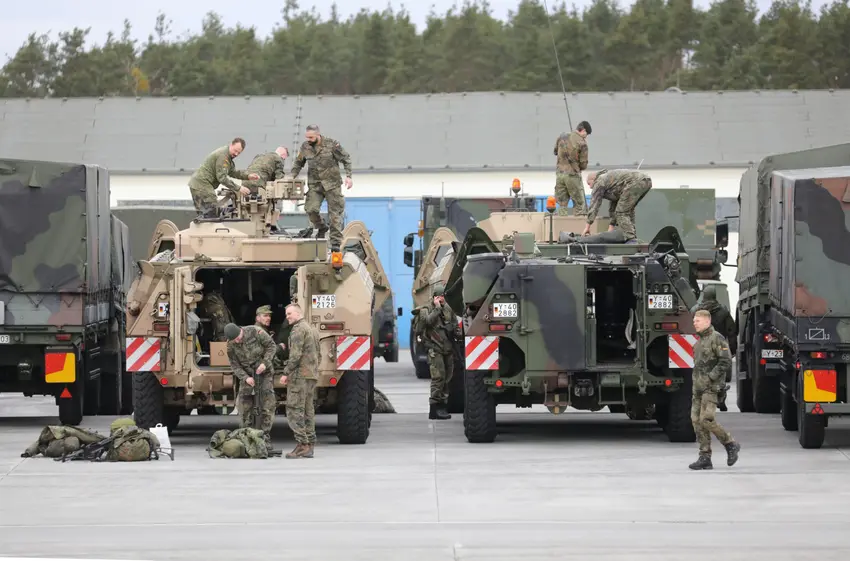
Germany had mandatory conscription between 1957 and 2011, when it was suspended by then-Chancellor Angela Merkel’s government.
In June 2025, the new government has said it will introduce a bill which could reintroduce a form of mandatory military service if too few volunteers sign up. The German public appear to be in favour of the move.
The aim is to increase the size of the armed forces from 180,000 to up to 260,000. The government also wants to double the number of reservists.
READ ALSO: Majority of Germans favour a return to conscription
Specific details of the bill have yet to be worked out, so the precise rules for any future conscription aren’t yet known.
Nevertheless the provision in the constitution which allows for conscription was only suspended by Merkel, meaning the government could reintroduce the previous system relatively straightforwardly, albeit with a change to the law.
What were the previous rules on conscription?
Germany’s Basic Law (constitution) allowed for men turning 18 to be conscripted into the Bundeswehr (armed forces), Border Force, or civil defence, for six months.
Conscientious objection was explicitly permitted. Anyone who refused to serve had to be offered alternative non-violent service.
In most cases, only residents of Germany were liable for conscription. Germans living abroad weren't generally obliged to participate.
The new bill proposed by the government will focus first on boosting the size of the army by recruiting more volunteers. But some members of the government, including Defence Minister Boris Pistorius, back conscription if there are too few volunteers in a given year.
Under the rules, if the government declares a so-called “state of tension” or “state of defence” (when Germany is likely to or has already come under armed attack), every male German between 18 and 60 is eligible for military service.
Who could be conscripted?
Under the previous system, which could be reintroduced straightforwardly, all German men turning 18 were eligible for conscription.
The provision did not include women. The government has not suggested that any new bill would amend the Basic Law, so iit seems likely women would continue to avoid conscription.
The government currently plans to introduce “Swedish-style” conscription, meaning that school leavers could be asked to fill in a questionnaire covering questions like their level of fitness and willingness to join the military. Answering would be compulsory for men and optional for women.
Answers would help determine who is then ordered to join the military.
What about foreign residents and those with dual nationality?
In general, dual citizens can expect to be treated like any other German when it comes to military service, according to Professor Walther Michl, chair of public law at the University of the Bundeswehr in Munich.
“Dual citizenship does not change the obligation to serve in the armed forces,” he told Frankenpost in 2023.
“If discrimination is applied, it is usually based on objective criteria such as the level of fitness determined during the medical examination, age, or experience of basic military training, not on dual nationality,” he added.
READ ALSO: Military service 'could be made mandatory' says German Defence Minister
Boys born in Germany to foreign parents, for example, would have to fill out the questionnaire and could be conscripted.
Under the previous law, Germany had agreements with a number of third countries such as Switzerland and Turkey to avoid dual citizens having to do military service twice. Citizens of two or more countries are generally conscripted in the country in which they are resident when they turn 18.
Under the Basic Law, only German citizens were eligible for conscription; so foreigners who are permanent residents could not be conscripted without a change to the constitution.
Could my child be forced to serve in the army?
The number of people who are conscripted is likely to be fairly low.
Military authorities prefer an army staffed by volunteer soldiers, considered more effective than conscripts who only serve for a short time. Recruitment efforts are likely to focus on them first, then on school leavers who’ve expressed interest in joining the army.
If your child is ordered to join the army but doesn’t want to serve, he can register as a contentious objector. This right is protected by the Basic Law, meaning that the authorities are legally obliged to offer your child alternative, non-violent service – such as working for a charity or the emergency services.
In summary...
If you’re a woman, you’re unlikely ever to be conscripted without a change to the Basic Law.
If you’re a male German citizen, including dual nationals, between the ages of 18 and 60, you could be conscripted during a “state of defence” or “state of tension”.
READ ALSO: German military sees Russia as 'existential risk' to Germany and Europe: report
These "states" can be declared by the government during times of heightened international tension, or when Germany has come under armed attack.
Even in these cases, your right to object will still be protected under the constitution. If you do not want to serve in the army, you have to be offered an alternative.
Foreign permanent residents who are not German nationals would not be conscripted.
Comments