
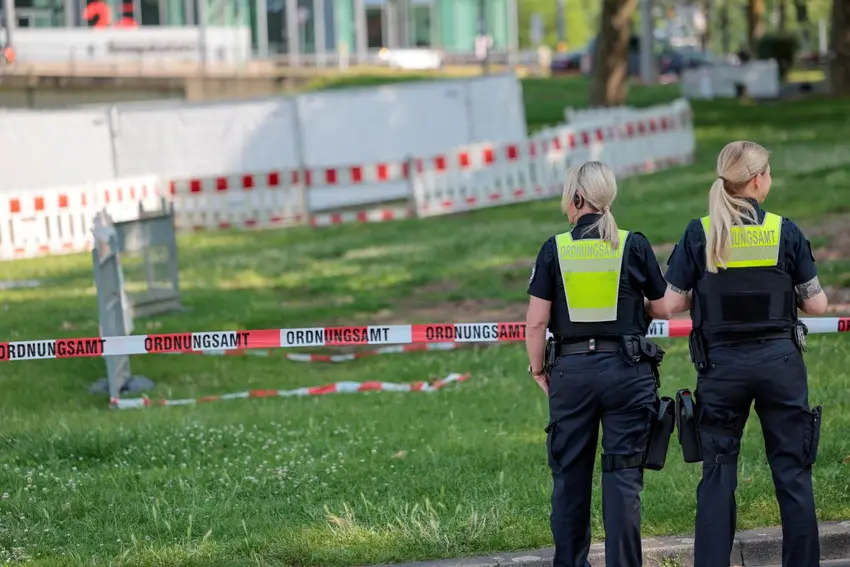
The largest evacuation for a bomb defusal since 1945 began in Cologne on Wednesday morning.
A large part of the city centre was closed off so that three American World War II bombs could be defused.
According to reporting by the German Press Agency (DPA), more than 20,000 people have been evacuated from their homes -- including all residents within a 1,000-meter radius around the site in the Deutz district.
The city of Cologne announced on its website, "The evacuation is the largest measure after the end of the Second World War. All those involved hope that the defusal can be completed in the course of the day on Wednesday."
A city spokeswoman told DPA that it's not yet possible to say when the defusal will begin. City officials must first check that all people have been evacuated, which could take several hours.
Kai Kulschewski, head of the department for explosive ordnance disposal at the Düsseldorf district government, told WDR that the duration of the operation "depends on how successful the evacuation is, and whether the population adheres to the rules...only when there is no one left in the radius, then we can start working."
Roadblocks have been erected around the containment area since 8 am on Wednesday morning.
In the state of North Rhine-Westphalia, 1,500 to 2,000 bombs from the Second World War are found per year, of which around 200 are as large as those that are set to be defused in Cologne.
Cologne has the most densely populated city centre in all of Europe, said Ralf Mayer, head of the Cologne public order office, in ARD's Morgenmagazin.
EXPLAINED: How many WWII bombs are still being found in Germany?
Disruptions in Cologne and in regional railway traffic
The potential blast zone in this case includes a hospital, two retirement and nursing homes, museums and the television station RTL as well as the Hohenzollern Bridge, which is the busiest German railway bridge.
Deutsche Bahn expects "considerable restrictions in local and long-distance traffic in North Rhine-Westphalia", especially since the Cologne-Messe/Deutz station is also closed.
Passenger trains were initially allowed to continue over the Hohenzollern Bridge after 8 am, but did not stop at Cologne Messe/Deutz station, the railway announced.
From the start of the defusal, the Hohenzollern Bridge is to be temporarily closed to passing traffic.
Some trains may have to be diverted, and individual train cancellations are also possible. From this point on, Cologne Central Station can no longer be approached from the direction of Deutz.
Shipping on the Rhine is also set to pause temporarily, and the airspace overhead will be closed for a short time.
With reporting by DPA.
Comments