
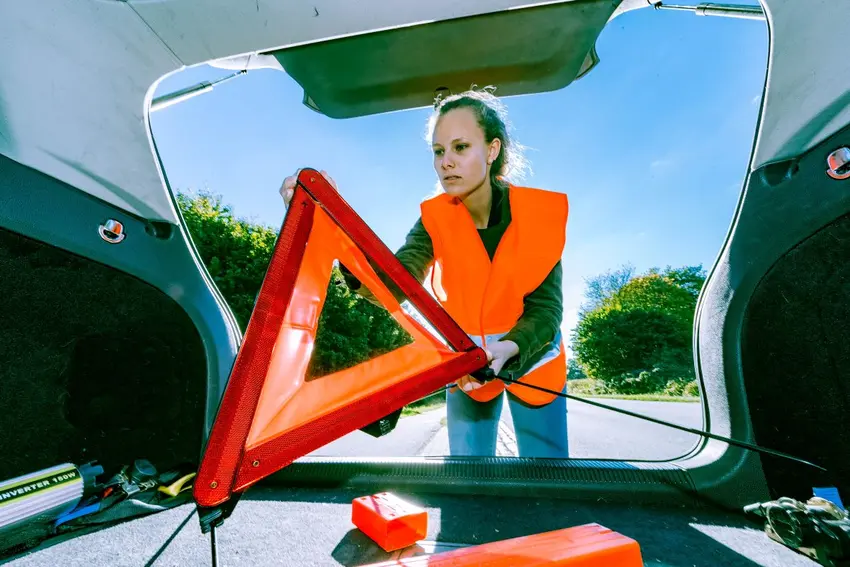
Beside your driver’s licence and vehicle registration document, there are a few more items that you are legally required to have in your vehicle while driving in Germany.
In fact, failing to have any of the required items on hand if you are checked would be considered a traffic violation and could result in a fine.
While the list of requirements is quite similar to those in many neighbouring European countries (like France), some required items might come as a surprise to drivers who originally got their licences in countries that don’t enforce these rules.
Here’s what the law says you need in your car in Germany at all times:
Licence and vehicle documents
Starting with the obvious first, in Germany – as in most countries – you must have your driver’s licence and your vehicle registration documents (Zulassungsbescheinigung Teil I) with you at all times while driving.
According to Germany’s largest auto association (ADAC), if you are unable to produce your documents when asked by authorities you can be fined €10. Of course, if you were caught driving without having a driver’s licence at all, that would be a much more serious offence.
First aid kit
In most cases ‘better safe than sorry’ is just a good rule of thumb, but in Germany sometimes it's enshrined in law. For example, every vehicle on the road in the Bundesrepublik should have a first-aid kit in tow.
This is established in both Road Traffic Licensing Regulations (StVZO) and Deutsches Institut für Normung (DIN) regulations.
A standard small first aid kit containing bandages and disinfectant will suffice. Failing to have a first aid kit can result in a €10 fine.
High-visibility vest
Due an EU-wide regulation, you’ll also need at least one high-visibility vest in your car. (Specifically, the vest needs to meet the European standards EN 471 or EN ISO 20471).
This requirement applies to all cars, trucks and buses registered in Germany, but motorcycles and motorhomes are exempt.

It’s advisable to have an extra vest for each passenger in your vehicle, but having at least one for the driver will satisfy the minimum requirement.
If you are caught without one, you could be fined €15.
Remember to put the vest on before stepping out of the vehicle when you are parked on the shoulder of a high-traffic road, especially on the Autobahn or other high-speed motorways.
Warning triangle
A reflective warning triangle can help prevent rear-end collisions when your car breaks down or must be parked on the side of busy roads and highways.
In Germany most drivers carry a reflective, red triangle. According to ADAC it needs to be “reflective, portable, stable and designed to be seen from a distance”.
There is also a rule about where to place the triangle when you need to use it: in fast traffic the triangle should be set up around 100 metres before your vehicle, while on the Autobahn it should be around 150 metres back. (That’s about 200 steps.)
Should you break down on the Autobahn, the suggested procedure is to pull over on the right shoulder, put on your reflective vest, and then put the triangle in place before doing anything else.
Failing to carry a warning triangle could result in a €15 fine.
READ ALSO: Why it's illegal to run out of fuel on the German Autobahn
Items required at certain times
Beyond the strictly required items above, the following items are required in some situations:
Snow / winter tyres
Winter tyres (or those certified for snow and ice) are required in Germany when you are driving in freezing conditions.
If you are caught driving in freezing weather without proper tyres, you can be fined up to €120 or face more serious sanctions. For this reason many Germans swap the tyres on their car to winter ones around October, and then back to summer tyres around Easter - a system known as 'Oktober bis Ostern' or 'O bis O' for short.
READ ALSO: O bis O - What you should know about changing tyres in Germany
Emissions Sticker
Most registered cars in Germany will have an emissions sticker, or Umweltplakette, placed in the corner of the driver’s side of the front windshield.
This is required to drive in certain low-emission zones (Umweltzonen), which are enforced in certain cities.
Beam deflectors
If you’re driving a vehicle with headlights that are not set for driving on the right side of the road – if you’ve come from the UK in a car that doesn’t have adjustable lights, for instance – then you need to have headlamp beam deflectors.
LISTED: The items you can't carry in your car in Germany
Recommended extras
The following are not required by German law, but you may want to consider keeping them for emergency situations:
- Fire extinguisher
- Spare tyre and jack
- Jumper cables
- Tow rope
- Bottles of water and non-perishable snacks
- Flashlight
- Mobile phone charger
Comments