
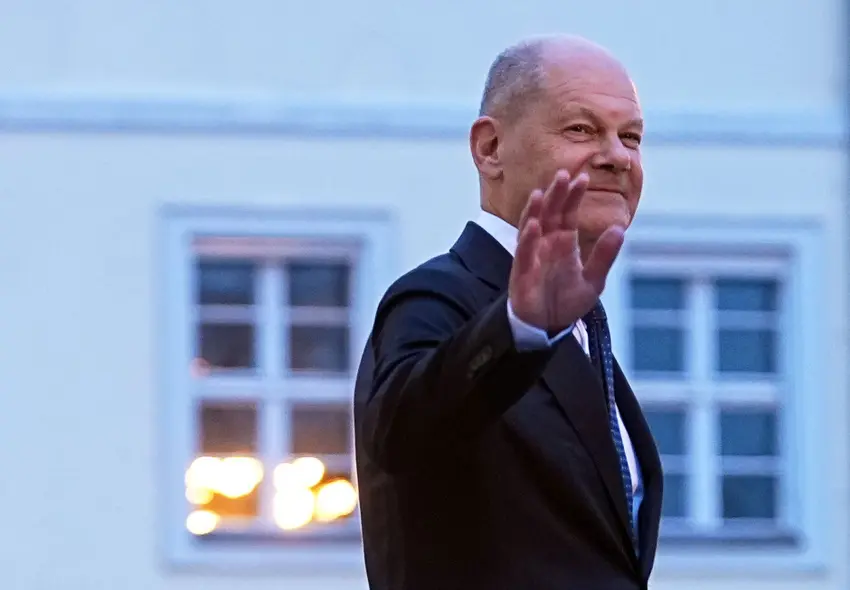
SPD to announce ministers as Scholz receives official send-off
Germany is facing a change of government and the handover of the reins from chancellor Olaf Scholz to his successor Friedrich Merz consists of a clear sequence of steps.
The SPD is due to present its ministerial picks to the public at 11.30am on Monday, with SPD leader Lars Klingbeil set to become vice chancellor and finance minister and Boris Pistorius tipped to stay on his role as Defence Minister. The CDU and CSU have already announced their respective choices for cabinet.
Once the cabinet is complete, coalition party leaders from the CDU, CSU and SPD will ceremoniously sign the coalition agreement at the Gasometer in Berlin Schöneberg at around noon.
At 9pm the same day, the army will hold a one-hour ceremony in Berlin to bid a formal farewell to Scholz with Defence Minister Boris Pistorius and Scholz himself giving speeches.
On Tuesday morning, the Bundestag will meet at 9am to elect the new chancellor.
READ ALSO: The five big challenges facing Germany's next chancellor Friedrich Merz
If Merz receives the required 316 votes (from a total of 630 representatives), he will travel to Bellevue Palace at 10.30am where Germany's president Frank-Walter Steinmeier will appoint him Chancellor and present him with his certificate of appointment, completing the official transfer of power.
Ministers are expected to be sworn in on the same day.
Police union warns of staffing problems with tighter border controls
Responding to the announcement that stricter border controls would start this week, the Police Union (GdP) has warned of potential staffing issues.
According to information from Bild am Sonntag, several thousand additional officers would be deployed to reinforce border controls in addition to the currently deployed 11,000 federal police officers.
"We must be careful that the other tasks of the Federal Police, such as protecting rail traffic or aviation security, are not neglected in all of this," union boss Andreas Roßkopf told the Funke newspapers on Saturday.
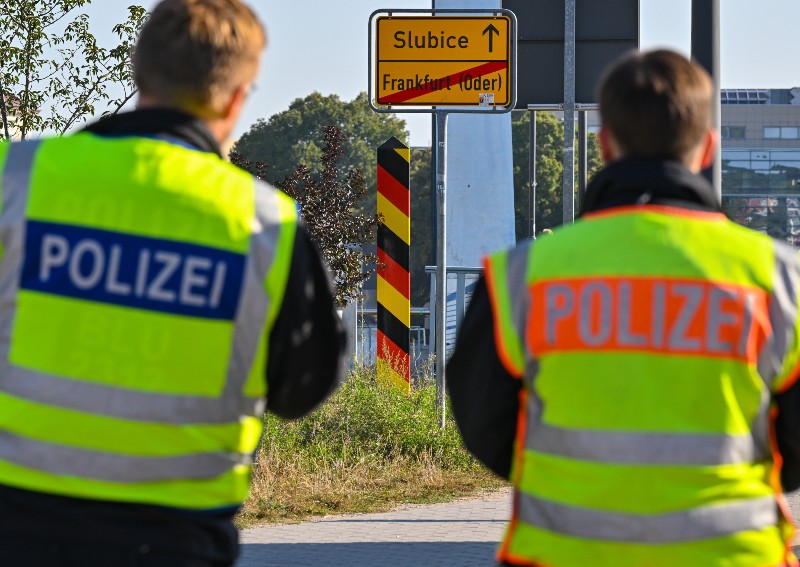
Currently, the Federal Police can only guarantee the necessary presence at national borders "because, in addition to regular officers, hundreds of riot police colleagues are helping out there," he added.
While border tasks were "still manageable with the existing personnel," they become more difficult whenever the intensity of checks are increased, the GdP head said, calling for more staff and better equipment for the police.
The designated Federal Minister of the Interior, Alexander Dobrindt (CSU) told Bild am Sonntag that he wanted to order tightened controls and the rejection of asylum seekers at Germany's external borders as soon as he took office on Wednesday.
READ ALSO: How is Germany's future government planning to shake up immigration?
Germans mark liberation of Ravensbrück Nazi camp
Holocaust survivors on Sunday urged the world not to forget the atrocities committed by the Nazis, during a ceremony to mark 80 years since the liberation of the Ravensbrück concentration camp.
Nine men and women who survived the camp, now in their 80s and 90s, relatives of former prisoners and senior officials were among about 1,200 people attending the event in northern Germany.
Lili Keller Rosenberg, a Jewish Frenchwoman deported to the camp at the age of 11, told AFP she believed her survival was "exceptional", and a "great revenge on the Nazis".
She said she was determined to keep recounting her experiences to young people to avoid a repeat of the past: "These young people must fight racism, which is a scourge, and fight against anti-Semitism."
About 130,000 people were sent from all over Europe to Ravensbrueck, the Nazi's biggest camp for women and children, north of Berlin. A small adjacent camp was also constructed for male inmates.
Union sceptical over ban of 'extremist' AfD
Leading figures from Germany’s conservative CDU/CSU Union have voiced strong scepticism over pursuing a ban on the far-right Alternative für Deutschland (AfD), despite the party being officially classified as extremist. “I’m very sceptical,” said incoming Interior Minister Alexander Dobrindt (CSU) on ZDF’s Berlin direkt. “You can’t just ban the AfD - you have to defeat them politically.”
CDU General Secretary Carsten Linnemann echoed this view in Bild, arguing that many AfD voters cast protest ballots: “And you can’t ban protest.” Dobrindt warned a legal ban would only feed into AfD narratives: “It plays into their claim that they are being silenced rather than politically debated.”
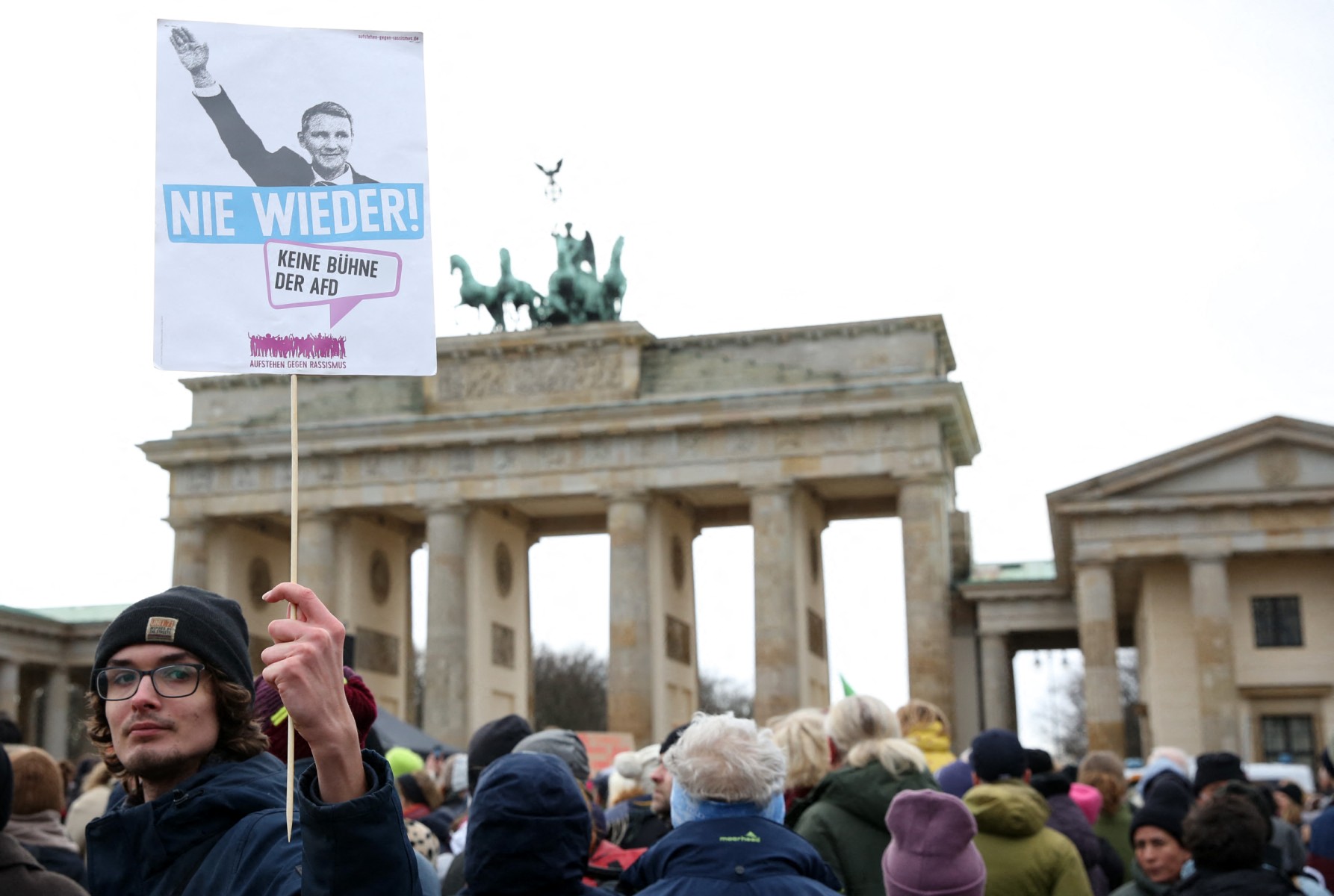
Meanwhile, Jens Spahn (CDU), soon to be elected as Union’s parliamentary group leader, emphasised aligning with the SPD on a united strategy. Writing on X, he ruled out supporting AfD lawmakers for parliamentary committee chair positions. Spahn had previously caused controversy by suggesting that the AfD should be treated like any other opposition party in parliament.
Calls for a ban on the far-right party have been growing since Friday, when Germany's domestic intelligence service labelled the AfD a "confirmed right-wing extremist" group.
The BfV agency, which had already designated several local AfD chapters as right-wing extremist, said it decided to give the entire party the label due to its attempts to "undermine the free, democratic" order in Germany. It also cited "xenophobic, anti-minority, Islamophobic and anti-Muslim statements made by leading party officials" in recent years.
READ ALSO:
- Will Germany's Merz try to ban the far-right AfD?
- Germany's AfD labelled right-wing extremist group in blow to party
Almost 200 police officers suspected of extremism
Almost 200 police officers nationwide are suspected of right-wing extremism or conspiracy ideologies, according to reports by Stern magazine and broadcaster RTL on Saturday.
According to the reports, which were based on requests to the interior ministries of all 16 federal states, disciplinary proceedings or investigations are currently underway against at least 193 state police officers.
North Rhine-Westphalia and Berlin each reported around 80 ongoing disciplinary proceedings, but according to their own statements, they were sometimes unable to assign them to political categories such as 'right' or 'left'.
According to research by Stern and RTL, a total of more than 571 disciplinary proceedings or investigations against police officers in the states are underway or have been underway since 2020 on suspicion of right-wing extremist views and/or conspiracy ideology.
With additional reporting by AFP
Comments