
Why do I need to know Osterfeuer?
This word may come up as you make plans for a spring vacation or Easter celebrations in Germany.
The tradition that the term refers to is particularly popular in some regions, but most of your German friends and colleagues will be familiar with the custom, whether or not they've been to one themselves.
Origins of the German Osterfeuer tradition
Oster is the adjectival form of Ostern - the German word for Easter - and, as you may have guessed, feuer means fire. Put together, an Osterfeuer (pronounced like this) is the name of an Easter bonfire.
In particular, it refers to the tradition of having a bonfire during the Easter holiday where groups of people gather to celebrate either the Christian holiday or the changing of the season.
In fact, the English word 'Easter' comes from the German word Ostern.
One common theory is that the German word was derived from the name Eostre (also sometimes spelled Ostara), who was an Anglo-Saxon goddess thought to have been associated with the spring season and fertility.
In pre-Christian times, Germanic peoples are thought to have celebrated the end of winter around the spring solstice by lighting bonfires as well as engaging in feasts and dancing. In the days leading up to Easter, locals would gather branches and twigs to build a bonfire. After the fire, ashes were scattered on fields to make them fertile for the coming season.
When Christianity was established in Germany, it's thought that many of the springtime celebratory traditions were essentially co-opted by the church and simply took on new symbolic meanings. In the case of Easter bonfires, the fire which had once been seen as chasing away the dark winter spirits instead came to be representative of Jesus Christ.
READ ALSO: What's on over the Easter holidays in Germany in 2025
How the Osterfeuer tradition lives on
For many people today, Easter bonfires have lost their religious significance and simply offer a chance to father with friends and family around the turn of the season.
The bonfire is typically lit on either Good Friday, Holy Saturday or Easter Sunday, and the community gathers in the evening to enjoy food and drink around the fiery glow.
This practice is especially popular in northern Germany, with the region around Hamburg having a large number of Osterfeuern. Parts of western Germany, such as in and around North Rhine-Westphalia also have a fair amount of bonfires, and one particularly famous one if the Osterräderlauf (Easter wheel run) in Lügde, which sees burning wheels of oak and straw sent down a hillside.
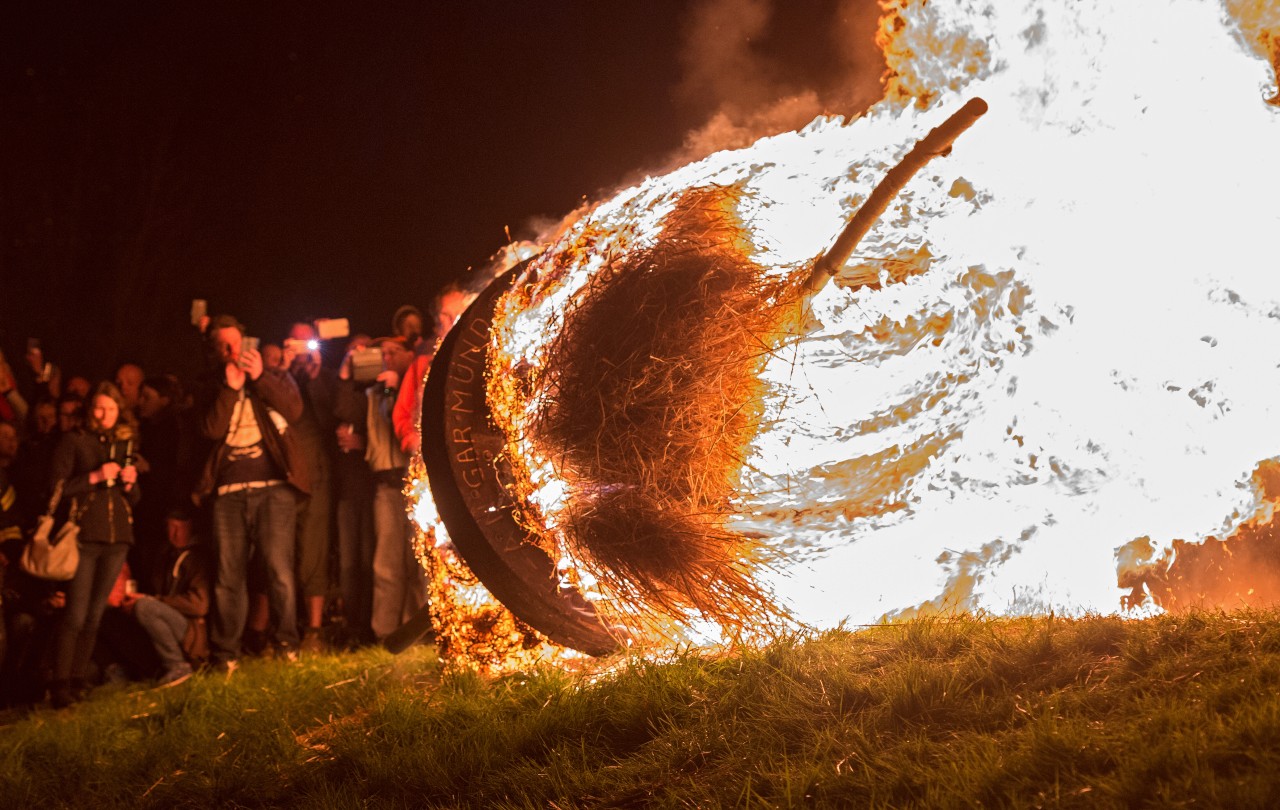
That said, you can likely find an Osterfeuer somewhere nearby in most places in Germany. Here's a list of some to be found in Berlin, for example. (For other places try searching 'Osterfeuer + your city or region name'.)
Germany's Federal Environment Agency estimates that between 10,000 and 20,000 Easter fires are lit each year in Germany, and warns that the fires can create high levels of particular pollution in the air in certain regions.
This year, some bonfire events may be cancelled, as large parts of Germany are at a heightened fire risk due to an ongoing drought.
Use it like this:
Dieses Jahr wollen wir am Sonntagabend zum Osterfeuer gehen.
This year we plan to go to the easter bonfire on Sunday evening.
Am liebsten esse ich am Osterfeuer Stockbrot.
My favourite thing to eat at the Easter fire is bread on a stick.
Comments