
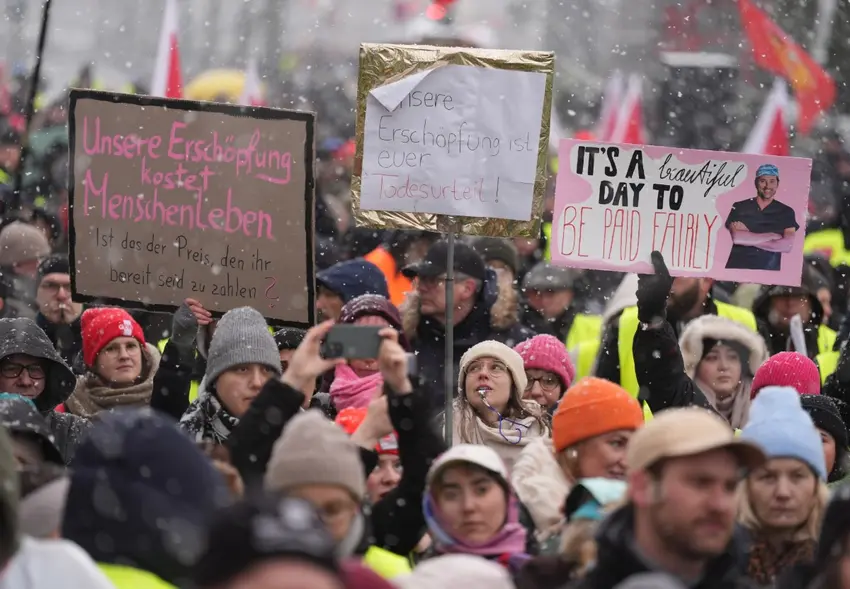
Trade unions, the federal government and employers were gathering at the negotiation tables again on Monday for two days of talks.
Verdi and the the Civil Servants' Union (dbb) are fighting various employers for better pay and conditions for more than 2.5 million local and federal government workers.
In the last weeks there have been several transport strikes, including two in Berlin and one in Frankfurt as well as other German cities. We've also seen work stoppages across German regions, hitting essential services like garbage collection, childcare and hospitals.
And further 'warning' strikes by frontline workers - even at the nationwide level rather than in specific regions - cannot be ruled out, according to Verdi.
READ ALSO:
- How strikes in the public sector will affect life in Berlin this week
- Frankfurt to see public transport disruption as strikes continue across Germany
What is happening now?
After weeks of industrial action, the key players in the collective bargaining dispute are getting together to try and find a solution. They met for a scheduled round of negotiations in Potsdam, Brandenburg at the start of this week.
But even before the talks started, things looked rocky. Local authorities warned that union demands may be too high.
"More free time" for employees cannot be the solution, warned Gelsenkirchen mayor Karin Welge (SPD) on broadcaster WDR 2’s ‘Morgenmagazin’ programme.
Which services are being hit in the strikes?
Warning strikes are a common tactic used by unions in Germany to put pressure on employers to encourage them to meet their demand.
The employees affected in this particular collective bargaining dispute work in various sectors such as daycare centres, schools and universities, administration, in local transport, at waste management companies and airports.
The majority of them are employed under the collective agreement for the public sector (TVöD). State employees are not affected as separate negotiations are being held for them.
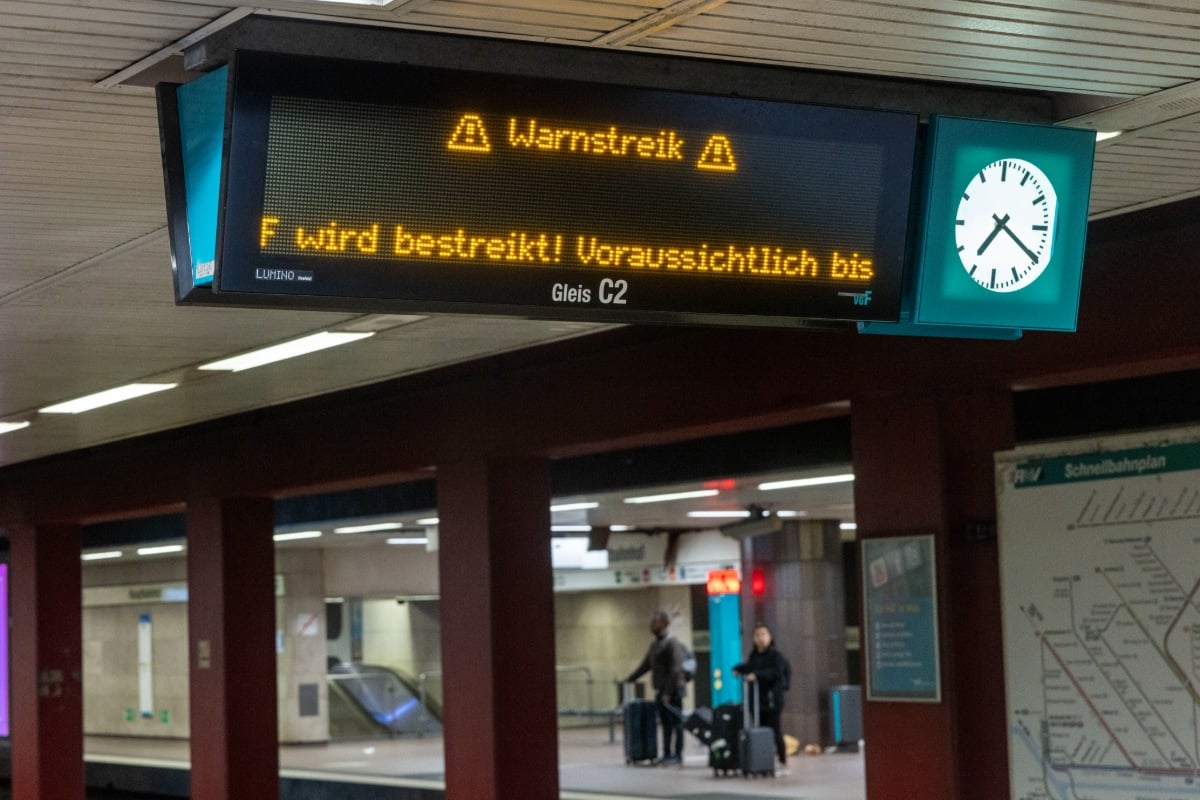
Several key services are hit when these employees stage a walkout. When it comes to essential care, such as in clinics or nurseries, only emergency services are offered.
What are the unions demanding?
In view of the rising cost of living in Germany, Verdi and dbb are demanding eight percent more income or at least €350 more per month, plus three additional vacation days off for workers. Trainees should receive €200 more per month.
There should also be higher bonuses for particularly stressful jobs, such as in the healthcare sector with rotating shifts, and all of this should be managed in flexible working time accounts so that employees can decide for themselves whether they want to be paid out overtime or accumulate it.
What do the employers want?
The employers have not yet presented an offer. Interior Minister Nancy Faeser (SPD) emphasised at the beginning of talks that the financial situation at the federal and local level was tense.
However, Faeser said she saw potential for a fair solution that could partially meet the trade unions' demands.
Whether the employers will make a counter-offer this week remains to be seen. Although an agreement is theoretically possible in the current second round, it is considered very unlikely.
For this reason, a third round of negotiations has already been scheduled for next month.
How likely is further strike action?
Experts say it's very likely that the unions will call for larger warning strikes - especially if employers do not present an offer.
And that action could come this week - ahead of the federal election on Sunday, February 23rd.
"If nothing comes of it, there will certainly be a significant expansion before the general election," said Verdi deputy chairwoman Christine Behle.
This time, however, it could be longer strike action - and even coordinated nationwide walkouts.
Regional newspapers reported that a fresh strike affecting transport run by BVG may be announced in Berlin on Monday afternoon.
Verdi has promised that every strike will be announced "at least one day in advance" so that passengers can prepare for it.
Meanwhile, if no agreement is reached for employees, the next round of talks is scheduled for March 14th-16th.
At this point the future coalition government could be starting to shape up, but the outgoing minority government of the Social Democrats and Greens will still likely be in office in a caretaking capacity.
Is there any good news regarding strikes?
Yes, there will be no strikes on regional or long-distance rail services because Deutsche Bahn and the railway and transport union EVG agreed on a collective agreement for over 190,000 employees on Sunday.
Comments