
What's going on?
Though consumers in Germany have been hit by high interest rates recently, the opposite used to be true.
As recently as 2022 and for around a decade before, banks were offering their consumers rock-bottom interest rates on mortgages and other forms of credit.
For savers, meanwhile, interest rates even fell below zero.
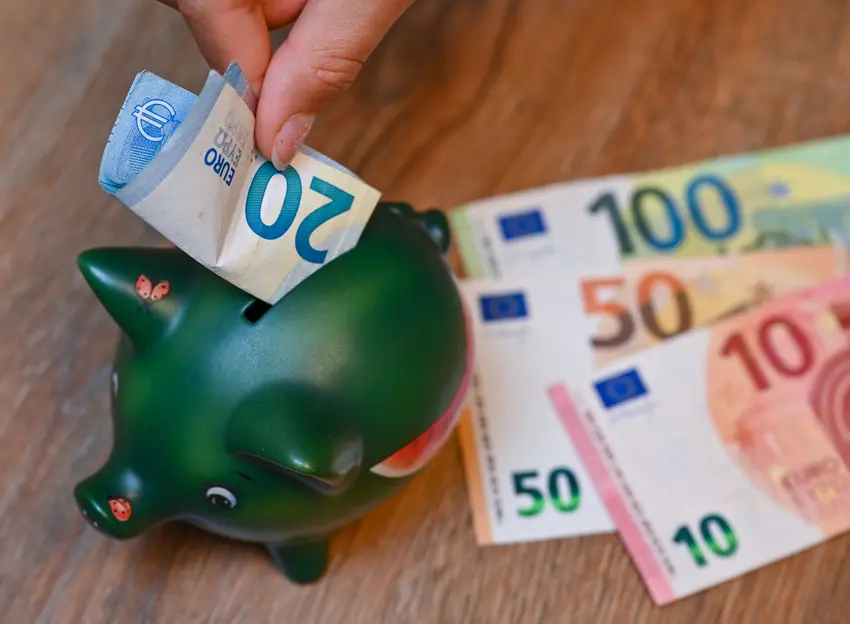
These negative rates meant that, instead of seeing their money grow, some customers would have to pay a fee in order to deposit large sums in a savings account. This was to compensate for the money that banks would have to pay to the European Central Bank (ECB) in order to store their own deposits.
According to a landmark Federal Court of Justice (BHG) ruling, this practice was entirely illegal.
Announcing the decision on Tuesday, BGH vice president Jürgen Ellenberger said the practice of levying negative interest rates or so-called safekeeping fees was "diametrically opposed" to the goal of opening a savings account.
READ ALSO: How to grow your savings in Germany during high inflation
"The purpose of savings deposits is to build up the assets of individuals in the medium to long term and to protect them against inflation through interest," Ellenberger declared.
"This part of the savings contract is changed by the levying of a safekeeping or credit balance fee - so-called negative interest - contrary to the requirements of good faith."
Does the ruling also apply to checking accounts?
No. In the eyes of the judges, a checking account fulfils a different function from a savings account or call money account.
Rather than solely being intended to grow savings, a checking account is primarily to ensure safe storage of money and easy access to it, for example through bank transfers or withdrawals.
So if a customer is charged a "safekeeping fee" that amounts to negative interest, it doesn't directly contradict the purpose of the account.
Nevertheless, the BGH insisted that negative interest rates always have to be transparent. In many cases, German banks aren't being clear enough in their contracts, which effectively renders their fees invalid, the court said.
The Consumer Advice Centre (VBZ), which brought the original case against the banks, said they were largely satisfied with the decision.
"With regard to current accounts, the court does not go quite as far as we do, as we consider custody fees to be unlawful per se," said VBZ's David Bode. "But in any case, the court does see a violation of the principle of transparency here."
READ ALSO: 'Move into this century' - How Germany could improve its banking system
The banking industry, meanwhile, responded in muted tones.
"A more detailed assessment of the content of the judgement will inevitably only be possible after the reasons for the decision have been evaluated," the association told Tagesschau on Tuesday.
How does this affect customers?
Essentially, the decision gives customers extra peace of mind when opening a savings account - particularly if interest rates sink dramatically again.
In future, banks will no longer be able to charge their customers fees for depositing money in any type of savings account.
For current accounts, meanwhile, they will have to be fully transparent about their terms and conditions.
For customers who have been unfairly charged in the past, the ruling means they could get their money back. However, it's still unclear how far back these claims can go.
According to Michael Hummel from the Saxony Consumer Advice Centre, consumers should be able to make a claim as far back as 2022 - and possibly longer.
"Claims that arose in 2022 are not yet time-barred until the end of 2025," he told Tagesschau. "Even older claims may not be time-barred if customers have already taken measures to prevent the statute of limitations from running out."
That could include arguing with their bank about the fees, opening court proceedings, or other means of raising a dispute.
Hummel recommends that any customers who have been charged negative interest rates seek advice from their local consumer advice centre.
"We won't leave anyone on their own," he said.
READ ALSO: Why a German court decision means you could get compensation from your bank
Useful vocabulary:
Negative interest rates - (die) Negativzinsen
Safekeeping fee - (das) Verwahrentgelt
Customer advice centre - (die) Verbraucherzentrale
Savings accounts - (das) Sparkonto
Call money account - (das) Tagesgeldkonto
We’re aiming to help our readers improve their German by translating vocabulary from some of our news stories. Did you find this article useful? Let us know.
Comments