
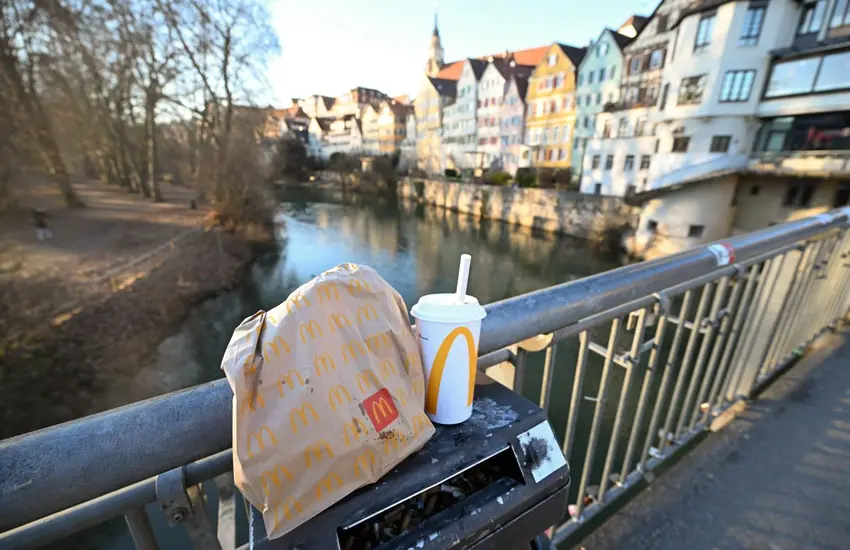
Judges of the constitutional court in Karlsruhe ruled that a consumer tax on disposable food and beverage packaging in the city of Tübingen is legal.
The court ruling effectively rejected a legal complaint raised by a McDonald’s franchise in Tübingen.
The city’s mayor, Boris Palmer, believes that the decision by Germany’s highest court has effectively put an end to the legal dispute – the tax will remain in place in Tübingen and may soon be adopted by other cities in the state of Baden-Württemberg.
What is Tübingen’s packaging tax?
The packaging tax has been in place in Tübingen since the beginning of 2022.
It mandates a tax on certain disposable packaging items: 50 cents for disposable coffee cups, 50 cents for disposable food trays or takeaway boxes, and 20 cents for disposable cutlery or straws.
The aim of the city is to reduce litter in public spaces and fund clean up efforts through the tax.
According to a press release on the city of Tübingen’s website, packaging waste seen in the cityscape has been reduced since the tax was implemented and the number of restaurants offering reusable packaging has quadrupled.
The city administration also expects revenues of €800,000 per year.
What are people saying about the tax?
The biggest complaint about the tax came from a McDonalds restaurant based in the city, which tried to challenge the legality of the tax in court.
The restaurant argued that the tax interfered with the freedom to operate as a vendor, which is protected by German law.
McDonalds had initially prevailed in a hearing before the Baden-Württemberg administrative court, but the higher court ultimately found the tax legal, clarifying that municipalities have the right to impose local consumption taxes.
The McDonalds restaurant suggests that the tax causes excessive bureaucracy and financial burden "both for the catering industry and for the people for whom a restaurant visit has become a luxury", according to reporting by DPA.
Meanwhile, Tübingen mayor Boris Palmer, reportedly celebrated the court's decision to uphold the tax with a glass of sparkling wine in a reusable glass.
He told SWR Aktuell that the ruling was a victory for cleanliness in the city and environmental protection.

The German Association of Cities and the Environmental Action Germany organisation both welcomed the ruling as well.
Will other cities soon be following suit?
Now that the legality of the tax is more firmly established, it’s believed that several cities in Baden-Württemberg may introduce packaging taxes of their own.
In fact, the city of Konstanz already implemented its own 50 cent tax on disposable packaging, as of January 1st.
The cities of Freiburg and Heidelberg are also reportedly considering implementing similar taxes.
Meanwhile the Association of Municipal Enterprises (VKU) and the German Trade Association suggested there should be a federal solution. They warned that a patchwork of individual local packaging taxes would create a burden for businesses that have various locations across the country.
Comments