
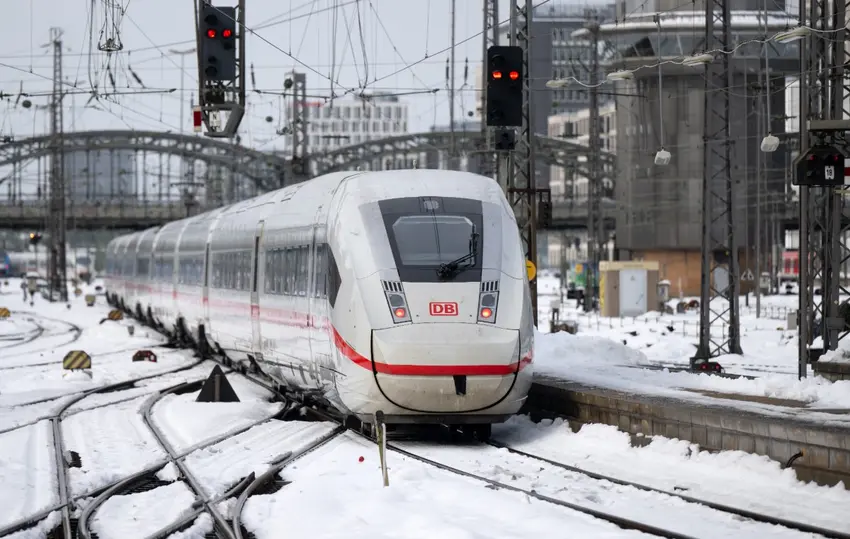
German rail operator Deutsche Bahn has launched its winter timetable, with some tickets getting more expensive.
Customers can book tickets up to 12 months in advance instead of the previous six months.
How expensive will tickets be from mid-December?
After the timetable change, travellers will have to dig deeper into their pockets when booking long-distance tickets. The price hikes will mainly affect Flex fares, commuter season tickets and the BahnCard 100.
The price for Flex tickets, which offer flexible travel times, will rise by an average of 5.9 percent.
Deutsche Bahn (DB) said prices for commuters will also go up by an average of 5.9 percent, although flexible offers will still be available with the 10 and 20-journey tickets.
When it comes to railcards, the BahnCard 100, which offers unlimited train travel through Germany for a year, will see an average price hike of 6.6 percent. This also takes in the anticipated increase of the Deutschlandticket, from €49 to €58, DB said.
However, there is some relief. Prices for the BahnCard 25 and 50 - which offer 25 and 50 percent off train travel, respectively - will remain unchanged.
DB says that the popular Sparpreis and Supersparpreis (saver and super saver) tickets will also stay at their current rates of €17.99 and €21.99, respectively.
READ ALSO: Deutsche Bahn to increase ticket prices from December
What should I know about timetable changes?
Deutsche Bahn will expand its range of Sprinter services within Germany.
Six extra ICE Sprinter services will run between Berlin and Frankfurt am Main every day from mid-December. There will be 11 services per day in each direction, with a journey time of around four hours. Of these, three services will travel non-stop and two will continue directly to and from Saarbrücken
"We are expanding our timetable in Germany with a sense of proportion - where there is a corresponding demand from our passengers," said DB board member Michael Peterson, explaining the Berlin-Frankfurt changes.
There will also be more direct high-speed direct connections across Germany.
A second daily direct ICE connection between Bremen and Berlin and between Basel and Stuttgart is planned for mid-December.
Trains for the outward and return journey between Hamburg, Bremen, Osnabrück and Cologne will be converted from Eurocity to ICE services and linked through to Basel via the Cologne-Rhine/Main high-speed line with a stop at Frankfurt Airport. This will also give cities such as Osnabrück and Münster another direct connection to southern Germany.
Some services are being dropped, which Deutsche Bahn says is down to insufficient demand. For example, in Baden-Württemberg some of the ICE connections from Karlsruhe to Stuttgart are being cut, while ICE services from Kassel to Karlsruhe via Marburg, Gießen, Frankfurt, Darmstadt, Heidelberg and Bruchsal are also reportedly being slashed.
What about international connections?
International train travel is having a bit of a moment, and European rail providers are stepping up to provide more services.
DB said a total of over 330 train journeys a day will connect Germany directly with 12 nearby countries.
The highlight is the new daily direct connection between Berlin and Paris - via Frankfurt, Karlsruhe and Strasbourg, launching on December 16th.

The journey is expected to take around eight hours. The ICE will depart from Berlin at 11.54am and arrive in Strasbourg at 5.53pm. The train arrives in Paris at 7.55pm. From Paris, the train departs at 9.55am, stopping at Strasbourg at 11.45am and arriving in Berlin at 6.03pm.
A new daily direct ICE service between Amsterdam and Munich via Stuttgart and Ulm will also launch, with a journey time of seven hours.
Between Frankfurt am Main and Brussels, there will be a new late connection in both directions every day from mid-April to early November.
Meanwhile, the Munich - Lindau - Zurich service will soon be expanded.
READ ALSO: The destinations you can reach by direct night train from Munich
Comments