
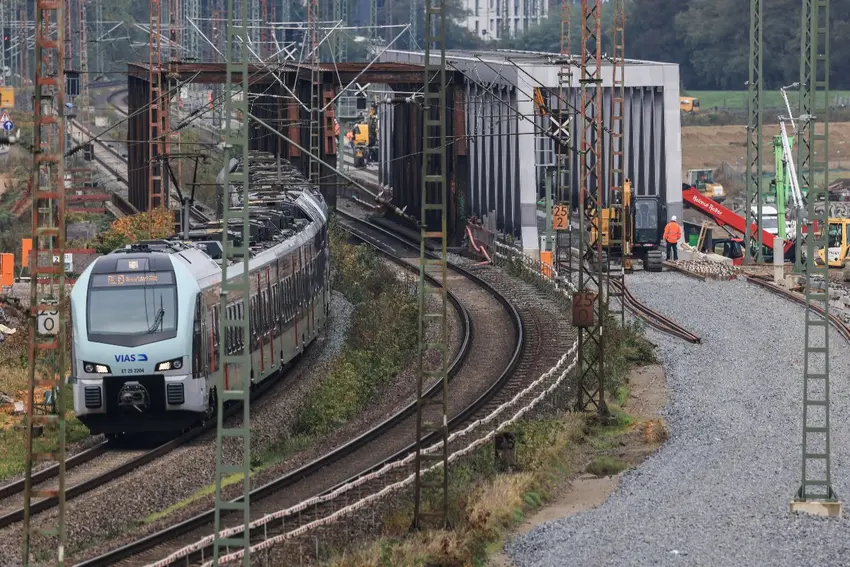
People travelling by rail across Germany are used to construction sites popping up - especially in recent months as part of Deutsche Bahn's rail renovations.
Although the aim is to make transport smoother, it causes headaches for people trying to get around. And there's more misery ahead: from the evening of Friday November 1st, the line from Oberhausen via Emmerich to the Netherlands will not be accessible at all or only to a limited extent - for around 18 months.
It's due to a long-running project being carried out by Germany - and neighbouring countries - to improve a key freight train corridor. Deutsche Bahn, which has described the work as an "unprecedented volume of construction", has warned that local commuters, long-distance travellers and businesses could be hit by disruption.
What's the background to this project?
The 73-kilometre-long route along the Lower Rhine region is part of the European freight corridor stretching from the North Sea port of Rotterdam to Genoa on the Mediterranean.
In the 1990s, the countries involved - Germany, the Netherlands, Switzerland and Italy - decided to expand and modernise the route, with the aim of connecting important business locations to the major seaports by rail.
The line, which previously only had two tracks and in some cases outdated technology, has long since reached its capacity limit. The Netherlands completed its section in 2007. The 160-kilometre Betuweroute from Rotterdam to the German border is considered one of the most modern freight transport routes in the world.
What's the status of the expansion on the German side?
In Germany, the expansion is lagging far behind that of neighbouring countries.
There are plans to build a third track along the entire route. On the Lower Rhine alone, 47 bridges are to be renewed and 38 new bridges are to replace level crossings with barriers. Furthermore, technology will be brought up to date and noise protection for local residents is being improved. The ceremony to kick off construction took place way back in January 2017 - but until recently, some permits were still missing.
And it will likely cause problems for years to come - even if the 80-week building marathon is completed in 2026 as planned, work on the route will continue. According to Deutsche Bahn, crossing the Wesel-Datteln Canal is a particular challenge for engineers and construction workers.
The existing bridge has to be made wider and 1.5 metres higher so that larger ships on the waterway can pass underneath. Because heavy goods trains cannot cope with steep gradients, the tracks between Voerde and Wesel have to be adapted to the new height level. To do this, other bridges, overhead lines and even a railway station will have to be raised.
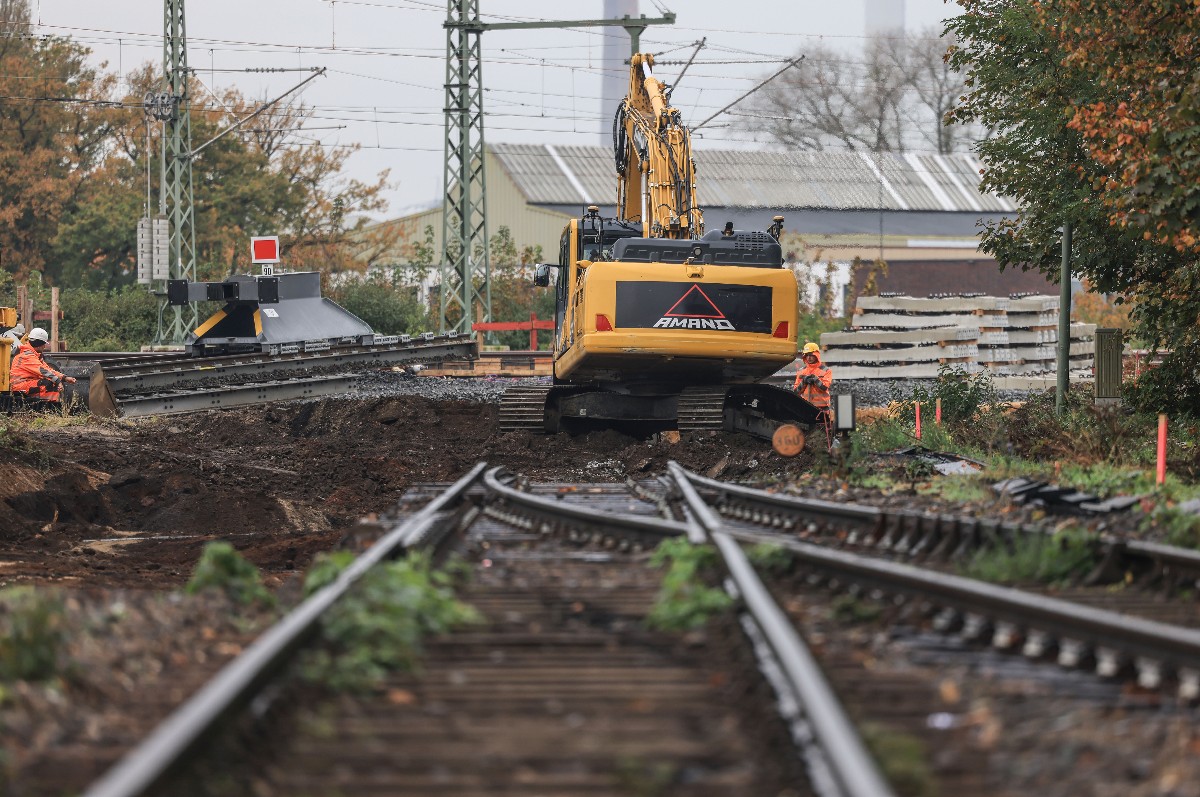
What restrictions do rail travellers have to prepare for?
For four years now, there have been repeated line closures, sometimes lasting several weeks.
However, the 80-week construction phase is a different ball game. For around two thirds of the time, the line will be single-track, meaning trains can only pass in one direction at a time, which will cause restrictions and delays.
During the remaining time, the section will be fully closed. The first closure starts on November 1st for three weeks. During the full closures, commuters on regional services on the RE5, RE8, RE13, RE19, RE44 and RE49 lines will have to switch to replacement buses.
Long-distance trains between Cologne and the Netherlands will be rerouted, making the journey longer.
What does the construction work mean for the region?
Politicians say travellers - and people in the region - should prepare. "The impact on the economy and on thousands of commuters in our region will be massive," said Wesel District Administrator Ingo Brohl (CDU).
He said that for years too little money had been ploughed into the railway network in the region. "Now we are seeing the consequences of these failures," he said.
Brohl appealed for understanding from people affected. "Modernised, functioning transport infrastructure is essential for shaping the future in the Lower Rhine district, despite all the current restrictions and disadvantages associated with it," he said.
The frequent long closures are also a problem for the manufacturing and chemical industries in the Lower Rhine region.
Matthias Simons, Head of Transport and Logistics at the Duisburg Chamber of Industry and Commerce, said the transportation of goods will be cut down during the works. "This poses major challenges for companies," he said.
In the long term, however, an efficient rail connection is an advantage for the region's economy.
Deutsche Bahn project manager Stefan Ventzke said: "Only with a modern and robust infrastructure will we be able to achieve the transport transition in the long term and convince even more people and companies of the benefits of climate-friendly rail transport."
With reporting by DPA
Comments