
Deutsche Bahn is currently carrying out building work at one in five of Germany's main stations. Long walks, noisy construction work, confusing paths or uncomfortable interim buildings will be very familiar to the passengers who travel through these stations.
"Currently, around a fifth of the main stations are being modernised; this ranges from replacing a lift to extensive construction work," a spokeswoman for Deutsche Bahn said in response to a request from the German Press Agency. In total, the railway operates 5,400 stations, 134 of which are main stations.
In Stuttgart, for example, rail passengers have been living with the mega construction site Stuttgart 21 in the middle of the city for more than 10 years - a project that affects far more than just the main station.
Below we look at some of the largest construction projects currently underway in the country and why they're taking so long.
Munich
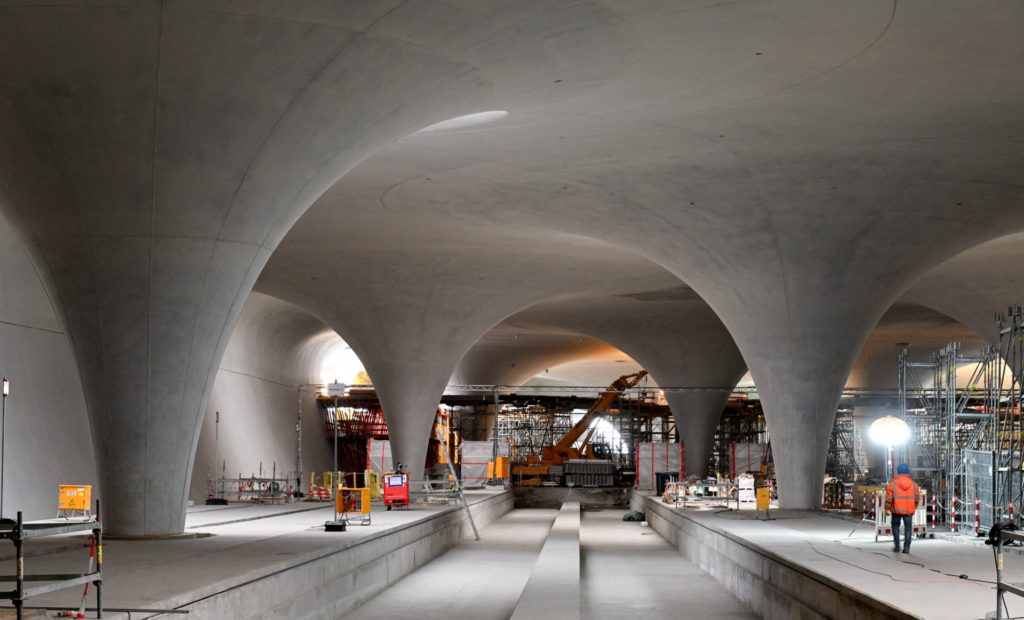
There are several construction sites at Munich's main station. The station building has been renovated and largely rebuilt since 2019, according to the railway. A new S-Bahn station for the second main line is to be built underground – as well as preparatory work for an underground station for a possible additional underground line – excavations have been going on here since 2019.
Next year, another construction site will start at the northern station station, which is to be rebuilt, including a 17-storey high-rise.
If all goes well, everything should be completed in the middle of the next decade. It was originally planned for the end of 2028, but because the project for the second main line was delayed, the completion of the new S-Bahn station and the main building has also been pushed back.
In order to maintain operations, the railway is building its own multi-storey interim station on the southern station forecourt to act as a replacement for ten years.
This interim station alone costs 20 million euros. Compared to the rest, though, that's a drop in the ocean: DB say the costs for the main building and the station wing run into the hundreds of millions.
Frankfurt
Up to half a million people travel through Frankfurt Central Station every single day. They're currently being impacted by renovations on the lower ground floor, the B level. This area that was once full of dark corners is being transformed into a bright passage with shops and cafés.
Part of 17 projects that form part of the 'Frankfurt Central Station Master Plan', this all comes at a hefty 1.2 billion euro cost and means travellers face one construction site after another in the building.
Among other things, an atrium is to be built in the large entrance hall. This will provide a clear view and path to the new shopping arcade below. Initial preparatory work is planned for next year, with completion in 2030.
Located in the middle of the country, Frankfurt Central Station is considered one of the most important hubs in the Deutsche Bahn network, but turning trains around in the terminal station is complex and is blamed for delays that have an impact across the country.
A huge project creating a tunnel and a new underground station for long-distance traffic is intended to help. But it comes at a hefty cost of at least 3.5 billion euros and of course another construction site to the south of the main station in the 2030s.
Hanover
Hanover Central Station is one of Deutsche Bahn's most important hubs so it's investing around 2 billion euros in a mammoth project to expand and renovate it. Two new tracks, an additional platform and a digital signal box are planned, while existing platforms, platform roofs, lifts and escalators are set to be renewed.
The 50 bridges the station stands on also have to be renovated. The work is expected to last until the mid-2030s.
Restrictions have been apparent for several months. To the annoyance of many of the approximately 140,000 travellers per day, two escalators are currently unusable because the aging models are being replaced. Some of them are not expected to return to normal operations until next year, at which point more escalators will be replaced and it all starts again.
Hamburg
The expansion of the Hamburg railway junction involves several major projects. The main station is to be rebuilt and expanded from 2028. Among other things, two extensions are to create more space for the approximately 550,000 people who use the station every day for a cost at at least half a billion euros.
DB estimates that relocating Altona station will cost about the same amount. So far, it has been a terminus station where trains have to change direction, which is time-consuming. Construction has been underway since July 2021 about two kilometres further north, at the current Diebsteich S-Bahn station.
Plans are for a through station with four platforms, one of which will be for the S-Bahn. It's scheduled to go into operation in 2027.
The station project is made even more complicated by another project: the new Altona station is to be connected to the main station via an S-Bahn tunnel. For this, four S-Bahn tracks will have to be built under the new station. The Hamburg Elbe bridges, the only rail crossing of the river in northern Germany alongside Lauenburg in Schleswig-Holstein, also need to be renewed.
Currently, up to 1,000 trains travel over the bridges every day.
Duisburg
The entire track hall, including the roof, is being rebuilt at Duisburg Central Station, while the platforms are also set to be completely renovated. The new steel and glass roof will allow enough natural daylight through during the day, so that artificial lighting is necessary.
Construction work has been underway since summer 2022 in parallel with ongoing operations, resulting in restrictions for the 61,000 travellers who use the station daily. The project is due to be completed by 2028.
Need for improved communication about delays
These construction times may be (very) lengthy, but the railway says they take so long because the work is carried out while the train is "rolling", i.e. trains are still running at the stations.
"A main station or important hub can only be closed in exceptional cases," a spokeswoman explained.
This is a particular challenge for logistics, passenger information and construction safety, among other things. Construction work on and in the buildings, some of which are listed, always has to be carried out in individual sections, without compromising safety.
Further complicating matters is main train stations' position in the middle of cities and therefore their proximity to other city buildings. "At some stations, such as Berlin Central Station, the railway property ends right at the exit door. Shopping malls, such as in Dresden or Hanover, often border the station."
One person who is familiar with all of these arguments is Karl-Peter Naumann, honorary chairman of the ProBahn passenger association. He thinks the railway's communication could be a lot better when it comes to telling passengers about delays.
"If there are problems, you have to explain them," said Naumann. "You need a future perspective. If I know that things are going to be better, I'm quite willing to hold out for two years."
Comments