
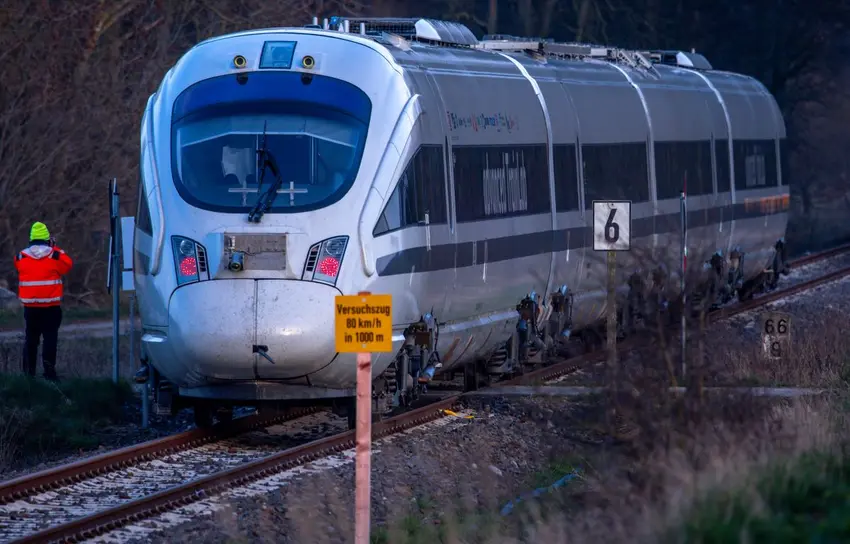
The German government's Digital Summit 2024 takes place in Frankfurt this week, and among the first news to come out of it is that Deutsche Bahn and several mobile networks have committed themselves to improving mobile phone service for rail passengers between Berlin and Hamburg.
The railway connection between Hamburg and Berlin is among the busiest in Germany. About 230 trains and up to 30,000 passengers make the 278 kilometre long journey every day.
But passengers in trains on this route suffer slow data speeds and patchy reception throughout much of the journey.
Now the German government, Deutsche Bahn and the four German mobile network operators (1&1, Deutsche Telekom, Telefónica/O2 and Vodafone) say they have plans to improve coverage in the area and along the railway in particular.
The plan is to make the connection in this area 5G-compatible.
How can mobile service be improved along the railway?
There are two main factors that currently reduce mobile connections for railway passengers.
The easier one to fix has to do with the trains themselves.
Deutsche Bahn’s older ICE trains have a coating on their windows intended to prevent the trains from heating up too much in the sun.
But this coating turned out to be resistant also to mobile phone signals.
Newer ICE trains use a mobile permeable window coating. On the older trains, however, scratching the window coating with a laser is sufficient to make them permeable to mobile phone signals.
The bigger challenge to overcome is that there is poor network coverage in many of the rural areas between Berlin and Hamburg.
To improve coverage here, the network operators aim to use the planned renovation of the tracks (to take place from August 2025 to April 2026) to install 5G communication infrastructure.
READ ALSO: Sections of the Berlin-Hamburg railway closed until December
Deutsche Bahn has already planned to use the closure break to set up radio masts for its railway communications.
Now the mobile network operators say they plan to examine if they can use DB’s new radio masts to operate 5G mobile communications hardware.
The mobile phone providers also suggest that they can share their radio systems along this route in the future, similar to how 5G coverage works in Berlin’s U-Bahn. There, Telefónica has built the mobile network for LTE (4G) and 5G, which can also be used by customers of the other networks.
"The Hamburg-Berlin railway line is to become Germany's innovation route for mobile communications with gigabit data rates on the train," said Transport and Digital Minister Volker Wissing (FDP) in Frankfurt according to DPA.
If the planned railway renovation continues as planned, passengers can expect improved service to be effective on the route from around April 2026.
READ ALSO: New daytime Berlin-Paris high-speed train service to launch in December
With reporting by DPA.
Comments