
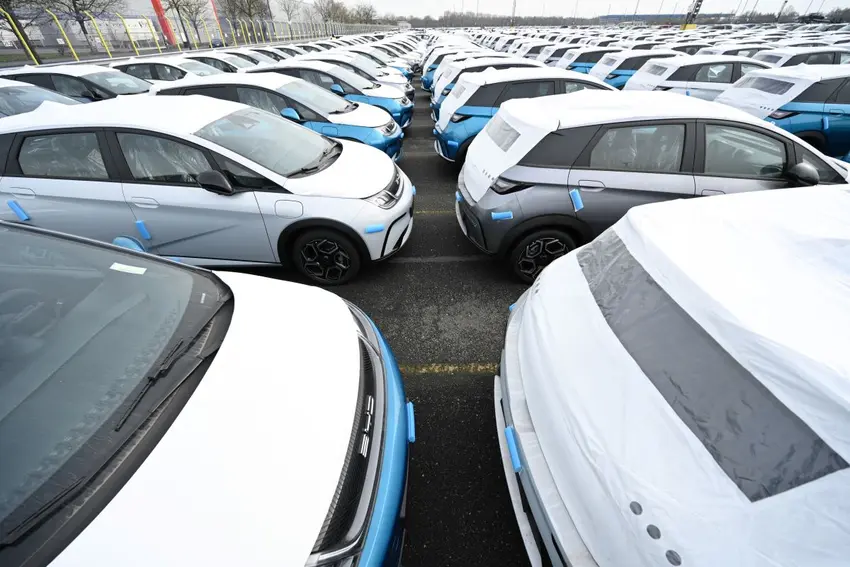
The EU is expected to apply tariffs of up to 45 percent on electric vehicles (EVs) imported from China from the end of October after member states voted in favour of the move last week.
Ten member states supported the introduction of tariffs, 12 had abstained, and just five – including Germany – voted in opposition.
Now the decision is left in the hands of the European Commission, but they are expected to follow the states’ vote. Commission President Ursula von der Leyen said the move had "huge potential for Europe's future competitiveness".
READ ALSO: EXPLAINED - Why the EU and China could be heading for a major trade war
German legacy car manufacturers see it differently. Last week Volkswagen urged Germany to vote against the tariffs, calling them “the wrong approach”.
Big German automakers like Volkswagen, BMW, and Mercedes have become heavily invested in China and many of their cars and parts for their cars are manufactured there. They fear that counter tariffs levied by China will hurt their exports at a time when domestic sales are slipping.
But for most people living in Germany, the tariffs mean one thing first and foremost: electric cars will likely get more expensive.
The price of EVs in Germany
By the end of 2023 the average price of an EV in Germany, excluding optional extras or subsidies, had risen to €52,700. That was up by more than €4,000 compared to 2022.
In comparison, the average price of a combustion engine car was €44,630, according to Statista.
The relatively high price of EVs is already taking a toll on sales. While EV sales hit an all time high across Europe in 2023, they actually fell in Germany compared to the year before, according to the International Energy Agency.
The drop in sales is largely attributed to the end of purchase subsidies for plug-in hybrids and EVs, which had boosted sales in 2022 and then abruptly ended at the beginning of 2023.
Although subsidies for EVs have been dramatically reduced, there are some smaller consumer-facing incentives that remain in place. In 2024, private individuals who buy or lease a fully electric vehicle may be eligible for an "environmental bonus". For EVs up to €45,000, the subsidy amounts to €4,500 in total. According to Tesla's website, customers who purchase a pre-configured Model Y can receive a €6,000 environmental bonus. Also, for used EVs less than a year old with less than 15,000 kilometres, the subsidy is €3,600.
EV owners can also apply for other bonuses, such as a greenhouse gas reduction premium, offered by Check 24.
How much will prices rise this time?
The new tariffs levied on Chinese EVs could be up to 35.3 percent, on top of a ten percent tariff already in place. So going forward Chinese EV imports could be hit with a price increase of up to 45 percent.
But the tariff price would vary depending on the level of cooperation between the automakers and the EU. Tesla cars can expect a tariff of 7.8 percent, whereas cars made by the Chinese state-owned SAIC could be hit with the full 35.3 percent increase.
To put these numbers in perspective, currently you could order a new rear-wheel drive Tesla Model Y for €44,990. An additional 7.8 percent tariff could be expected to push that price to €48,500.
Chinese automaker BYD, which recently surpassed Tesla as the industry leader worldwide, currently offers the Seal for the same price as the Tesla Model Y in Germany.
According to reporting by Reuters, BYD can expect additional tariffs of up to 17 percent. This could be expected to push the price of a Seal to about €52,600.
It’s not entirely clear to what extent tariffs would be passed on to customers. But of course, if manufacturers do not pass on the costs, they would end up paying the surcharge out of their own pockets, which would ultimately make a huge dent in profits.
Experts therefore believe that at least a proportion of the tariff costs will be passed on.
The Kiel Institute for the World Economy (IfW) announced earlier this year that tariffs would lead to rising purchase prices for electric cars, as imports from China would decline.
Where are Germany’s small and cheap EVs?
Baden-Württemberg's transport minister Winfried Hermann (Greens) recently complained that manufacturers in Europe had developed too few small and affordable EV models.
Among BYD’s celebrated successes, for example, is the creation of a small EV hatchback, the Seagull, with a price tag of just under €10,000. According to industry reports, BYD plans to bring production of its Seagull hatchback to Europe in 2025.
Meanwhile Germany’s legacy automakers have been criticised for largely ignoring the compact EV market – investing primarily in mid- to large size EVs which fetch a bigger sticker price instead.
There are, however, a few small and affordable European-made EVs on the market, such as Volkswagen’s e-up, which are more accessible for a wider range of consumers.
Comments