
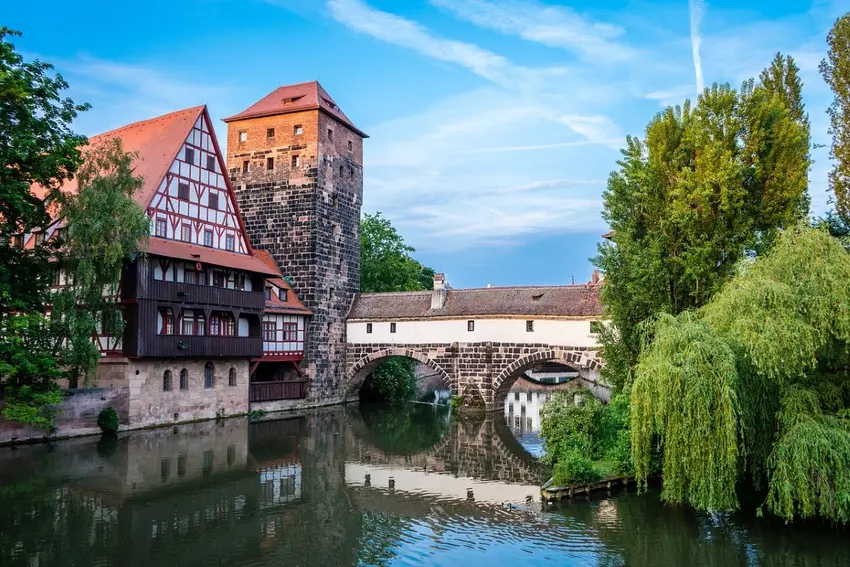
Nuremberg is not necessarily top of mind among those dreaming of moving to Germany, but with a handful of big international companies nearby that employ a large number of foreign workers, perhaps it should be.
In fact, Germany’s 14th largest city (and Bavaria’s second largest) is home to approximately 147,710 foreign nationals, according to the city’s immigration office.
This amounts to about 27 percent of the local population according to Germany's statistical agency (Destatis), as of 2022, which is well ahead of the proportion of foreign residents across Germany overall, which is 18.4 percent.
Nuremberg is located in the middle of Franconia, a region that makes up the northern part of the state of Bavaria.
Other Franconian cities of note are Würzburg, Bamberg, Bayreuth and Regensburg. All of which are worthy of a visit, but if you’re a skilled foreign worker seeking employment, then Nuremberg and the surrounding region are really the hotspot here.
Which companies employ foreigners in Nuremberg?
Just about 15 kilometres north of Nuremberg is Erlangen, which is also home to a large international community. In Erlangen the largest employers are Siemens and the Friedrich Alexander University (FAU) Erlangen-Nuremberg, which also attracts a fair amount of international students.
Not far from Erlangen is Herzogenaurach, where sportswear fashion giants Adidas and Puma are based. Both Adidas and Puma maintain international campuses and actively seek out talented designers, marketers and IT professionals from abroad. The primary working language in many of their teams is English.
Many of the foreign residents in Nuremberg city work in the companies listed above.
Other large companies based in Nuremberg include DATEV, MAN, Continental, Bosch and Diehl.
What’s a good salary in Nuremberg?
According to data collected by SalaryExpert.com, the average base salary in Nuremberg is approximately €53,947, which is just barely higher than the overall average across Germany.
Destatis suggests that in 2023 the average monthly salary for full-time employees in Germany was €4,479, which amounts to €53,748 for the year before tax.

But for comparing salaries, averages tend to be a bit misleading because they are skewed upward by a handful of extremely high salaries at the top of the spectrum. A better figure, for getting a sense of what most workers earn, is the media salary.
German website Lohntastik.de compiled median salaries for cities and districts across the country as of 2023. According to their data, the median monthly salary in Nuremberg is €3,865 or €46,380 yearly.
Interestingly, Erlangen had a significantly higher media salary at €5,200 monthly or €62,400 annually. This could be due to Erlangen having a higher number of technology and engineering jobs.
Both Erlangen and Nuremberg have higher median salaries than the other surrounding provinces in the area.
READ ALSO:
- Munich vs Berlin: What's considered a good salary for foreign workers?
- What's considered a good salary for foreigners in Frankfurt?
Which jobs pay the most?
Unsurprisingly, it’s the big multinationals that tend to offer foreign workers the best salaries in the region.
But salaries at these companies vary immensely depending on your position and experience. Of course if you are starting new with the company, you can expect to be offered a salary on the lower end of the spectrum for your position. From there you might negotiate a raise at each performance review cycle, or if you move up to higher positions.
To give an idea about standard salaries at these companies, the following figures are based on salary information collected by Glassdoor:
At both Adidas and Puma interns reportedly earn €15-20k yearly, whereas a director might earn €95-118k. For mid-level positions a designer or product manager could expect something between €50-70k, depending on their specific role and experience.
At Siemens, where most of the jobs are related to technology and engineering, the salaries are a bit higher. Here even a working student can earn between €14-40k, according to Glassdoor. A Siemens software engineer might take in €65-81k, and a senior manager could expect somewhere between €100-150k per year.
Keep in mind that these are pre-tax (Bruttolohn) figures. In Germany you can expect to pay between 30 to 45 percent of your gross salary for tax–including pension and health insurance contributions.
Your exact tax rate will depend on your salary as well as your age and marital status.
Cost of living in Nuremberg
Nuremberg is generally an affordable city to live in, and it will feel especially affordable for foreigners coming from the UK, the US or one of the bigger cities in Western Europe.
According to Numbeo’s cost of living calculator, a single person living in Nuremberg can expect to pay about €1,000 per month plus rent. Or a family of four might pay about €3,400 per month plus rent.
Numbeo suggests that Nuremberg’s living costs beside rent are just slightly less than those in Berlin, but its rent prices are much lower (by about 30 percent). This is significant, because in Berlin it’s the rising rent prices, more than anything else, that have recently caused the capital city to rise in ranks to being perhaps Germany’s most expensive city to live in.
The other perk of moving to Nuremberg, as opposed to Berlin or Munich, is that housing is readily available.
The downside, however, is that applying for a visa at the local immigration office is notoriously fraught.
Comments