
Germany considers fourth 'Warntag' a success
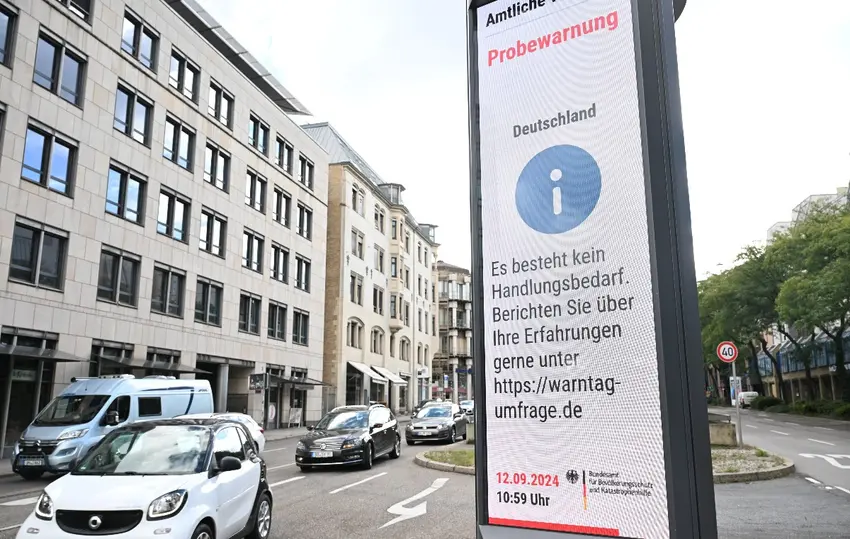
At 11 am on Thursday, mobile phones and sirens blared throughout Germany as authorities tested alarm systems that will be used to warn people in the event of a disaster.
And this year's event - the fourth ever - has been deemed a success.
"As planned, we reached the population with a wide range of warning resources," said the Federal Office for Civil Protection and Disaster Assistance (BBK) President Ralph Tiesler.
"We not only demonstrated the effectiveness of our warning systems, but also raised awareness of the important topic of warning."
Interior Minister Nancy Faser said the alerts had "once again passed a major stress test", adding that the system saves lives in an emergency.
The government tests the system out every year to prepare for possible catastrophic events such as flooding, power outages, or a cyber or military attack.
Card payments issue resolved
Germany was hit by nationwide disruption to card payments on Thursday, leaving many customers having to pay with cash.
However, industry experts said later on Thursday afternoon that the issue had been resolved.
"Payments at cash register terminals in retail are possible again as usual with all cards," the German Banking Industry said.
Form early in the morning there had been significant restrictions on card payments. In some cases, withdrawing cash from ATMs with debit and credit cards was also difficult. Some cards also reportedly did not work abroad.
VW and unions bring forward talks after factory closure threat
Volkswagen says that talks with unions over a new pay deal for workers are to begin a month early, following the German auto giant's threat to close factories and cut jobs at home.
Discussions are likely to be fraught with employee representatives promising "bitter resistance" to the cost-saving measures.
The IG Metall union and VW management had agreed to a first round of negotiations on September 25th, the group said.
The talks, initially slated to start at the end of October, will set the terms of employment for some 120,000 workers in Germany.
The "challenging situation" at the carmaker and the "resulting uncertainties" were behind the decision to bring forward the talks, the group said.
Lufthansa extends Beirut flight suspension
German airline group Lufthansa said Thursday it was extending a suspension of flights to Lebanese capital Beirut until October 15th due to heightened regional tensions.
Services to Beirut had previously been suspended until the end of September.
The Lufthansa group, whose carriers also include SWISS, Austrian Airlines and Brussels Airlines, has not flown to Beirut since late July.
Lebanese group Hezbollah has traded near-daily fire with Israeli forces in support of ally Hamas since the Palestinian militant group's October 7th attack triggered war in the Gaza Strip.
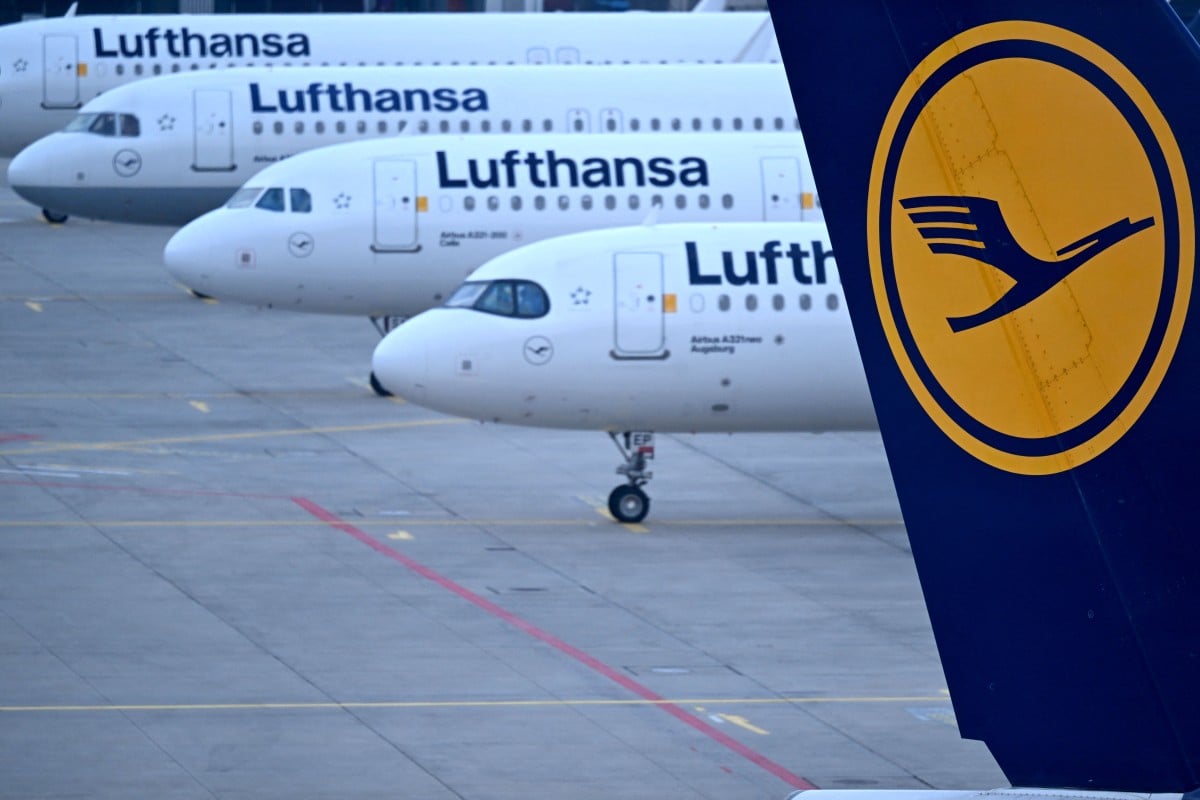
Lufthansa had also suspended flights to Tel Aviv in Israel due to the tensions, but resumed them on September 5th.
Flights to Tehran also resumed on September 5th, although Austrian Airlines is currently the only airline in the group serving the Iranian capital, a Lufthansa spokesman told AFP.
Greece concerned about German border controls
Greece has joined EU states expressing concern after Germany tightened controls in response to several suspected Islamist attacks, with its prime minister questioning the move.
"The answer cannot be the unilateral abolition of Schengen and to essentially pass the buck to countries located on the outer borders of Europe," Prime Minister Kyriakos Mitsotakis told Talk Radio.
Germany on Monday said temporary controls would be extended to land borders with all nine of its EU neighbours, even though it is part of the free-movement Schengen area.
These would limit migration and "protect against the acute dangers posed by Islamist terrorism and serious crime", Interior Minister Nancy Faeser told a press conference.
The controls on the borders with France, Luxembourg, Belgium, the Netherlands and Denmark will come into force on September 16th for an initial six months.
READ ALSO: Debt, migration and the far-right - the big challenges facing Germany this autumn
Deaths of UN staff in Gaza 'totally unacceptable', says German government
Germany on Thursday said the deaths of six UN staff in war-torn Gaza are "totally unacceptable" and called on Israel "to protect UN staff and aid workers".
"Humanitarian aid workers must never be victims of rockets," the foreign ministry said on social media platform X. "The death of six UNRWA staff at a school in Nuseirat is totally unacceptable."
Israel on Wednesday bombed a school housing displaced Palestinians in Nuseirat, central Gaza, which rescuers said killed 18 people, including UN staffers, while the Israeli army said it hit a Hamas control centre.
The UN agency for Palestinian refugees UNRWA later said six of its staffers had been killed in two Israeli air raids on the Nuseirat school and its surroundings.
The German foreign ministry said that "UNRWA is providing vital aid in Gaza and has a UN mandate to do so. Israel's army has a responsibility to protect UN staff and aid workers."
Germany bans Islamic centre over alleged Hamas links
German authorities say they have banned an Islamic centre in Brandenburg, the state that surrounds Berlin, over its alleged links to the Palestinian militant group Hamas.
Searches were carried out at the Islamic Centre Fuerstenwalde al-Salam (IZF) and at homes in Brandenburg and Berlin on Thursday morning, the state interior ministry said.
"The Islamic Centre Fuerstenwalde is associated with the Islamist terrorist group Hamas and the Muslim Brotherhood," state interior minister Michael Stuebgen said in a statement.
"The organisation acts against the free democratic order, spreads anti-Semitic narratives and denies Israel's right to exist. We cannot accept that."
Germany considers Hamas a terrorist organisation, and the state ministry said it also considered the Egyptian-born Muslim Brotherhood to be a "relevant Islamist group".
Comments