
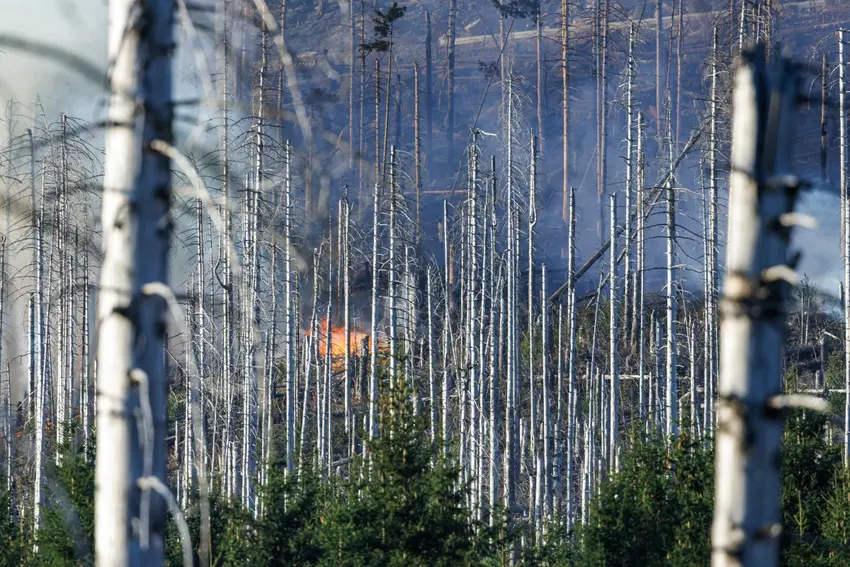
Flights were stopped overnight on the Brocken mountain in the Harz National Park.
Until shortly before 8.30pm, "the four firefighting planes and three helicopters were on the move non-stop to fight the fire on the Brocken," the district of Harz in the state of Saxony-Anhalt said on its Facebook page on Saturday evening.
"We expect to be flying all day tomorrow," Wernigerode town department head Immo Kramer was quoted as saying. District fire chief Kai-Uwe Lohse added: "We'll get more water on the fire area tomorrow."
Eight helicopters and four planes are to be deployed to the area on Sunday from 8am.
This is "the maximum amount of aerial firefighting equipment that can be coordinated over the highest peak in northern Germany," said Lohse.
On the ground, forces from the fire service, the Technical Relief Agency (THW) and the Harz National Park are fighting the fire.
They paused work at 10pm last night, said district spokesman Michael Randhahn-Schülke, but there were patrols overnight.
The blaze began in the Harz Mountains on Friday afternoon, and prompted the evacuation of about 500 hikers and other tourists from the area.
About 250 firefighters were deployed on Saturday to fight the blaze, a spokesman for the district of Harz told AFP.
Authorities at Harz National Park, which covers the affected area, said that all hiking trails around Brocken were closed.
In a message on its website, the park urged people not to enter the area "under any circumstances. Otherwise you will endanger yourself and hinder the fire brigade".
On Friday, about 150 firefighters backed by planes and helicopters had sought to quell the fire but some emergency workers were forced to retreat as the blaze spread rapidly.
A massive forest fire broke out in the Harz Mountains in September 2022. Authorities declared a state of emergency and hundreds of firefighters tackled the blaze for days.
Like other countries, Germany has been experiencing higher summer temperatures in recent years.
The EU's climate monitor on Friday said that the 2024 northern hemisphere summer saw the highest global temperatures on record, beating 2023's high and making this year likely to be Earth's hottest ever recorded.
The data from the Copernicus Climate Change Service followed a season of heatwaves around the world that scientists said were intensified by human-driven climate change.
Comments