
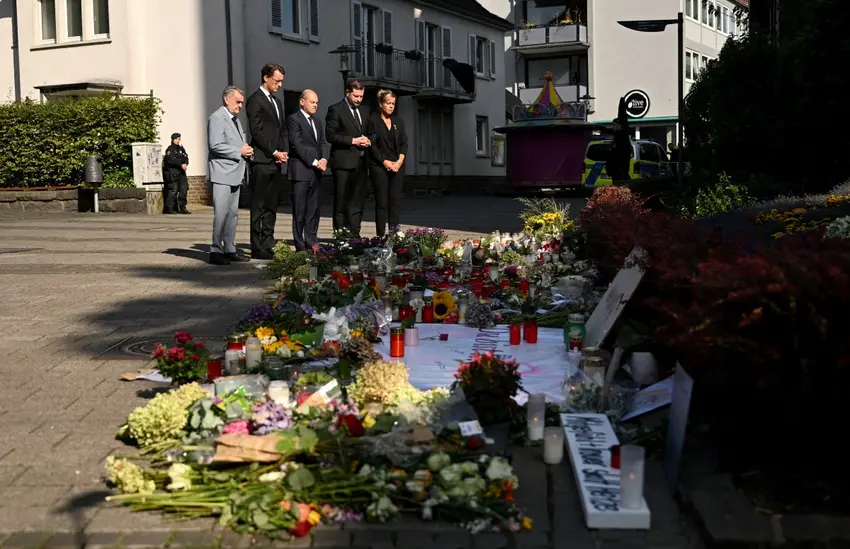
On Friday night a mass stabbing at the “Festival of Diversity” in the western German city Solingen shook Germany.
Three people were killed and eight people were injured, five of them seriously, according to police reports.
Police then launched a "major operation" to search for the suspect who was reportedly on the run. But ultimately a 26-year-old suspect, a Syrian man suspected of belonging to a terrorist group turned himself in and confessed to the stabbing, police said.
In the meantime the Islamic State (IS) group said Saturday in a statement that one of its members carried out a deadly attack a day earlier in Germany "in revenge for Muslims in Palestine and everywhere". But according to initial reports, the investigators have doubts as to the authenticity of the IS video and whether it shows the real attacker.
This devastating incident follows other high-profile knife attacks seen in Germany in recent months: at the end of May a man attacked anti-Islam campaigners in a market square in Mannheim, and few days later an AfD council candidate was attacked in the same city.
In response to what appears to be an increase in knife attacks, the Interior Ministry suggested last week that Germany needs stricter regulations on the kinds of knives that are allowed in public.
But while some suggest that banning knives in public places is the best response, others are calling for more far-reaching measures, including calls for the end of asylum for refugees from certain countries.
Immediate reactions
The premier of North Rhine-Westphalia, Hendrik Wüst (CDU), said in an initial response to the attack that the state and the residents "will not waver", according to a report by Focus.
He also gave a statement on WDR television in which he called for an investigation into the relevant authorities. "There are a lot of questions," he said. There are also a lot of authorities involved. It must be clarified where exactly something has gone wrong."
According to the Office for the Protection of the Constitution, the act in Solingen was the most serious attack committed in Germany for suspected Islamist motives since the attack on a Christmas market in Berlin in December 2016, in which 13 people were killed.
Calls to block asylum seekers
As the Spiegel reported, the suspect sought asylum in Germany at the end of 2022. He was not previously known to the security authorities as an Islamist extremist, but his asylum application was rejected.
However, he had hidden from authorities before he was scheduled to be deported to Bulgaria last year.
Some conservative politicians are suggesting that the attack in Solingen shows that Germany needs to stop accepting asylum seekers from Syria or Afghanistan altogether.
In a newsletter written by CDU leader Friedrish Merz, he wrote "After the terrorist act in Solingen, it should now be finally clear: It is not the knives that are the problem…”
This sentiment was echoed by Union parliamentary group vice-chairman Jens Spahn, who told the Rheinische Post on Monday that, "For years, hundreds of young men from Syria and Afghanistan have been coming to Germany and Europe every day. This must finally end."
Calls to ban knives
SPD leader Saskia Esken, however, rejected Merz's demand to block asylum seekers, saying such a step "is incompatible with our laws, with the European Refugee Convention, and with our constitution".
But she added that serious criminals and Islamist threats should be deported to their home countries.
Members of the SPD and also the Greens have tended instead to support plans to ban or limit knives in public spaces.
Interior minister Nancy Faeser (SPD) had suggested last week that Germany needs stricter regulations on the kinds of knives that are allowed in public.
READ ALSO: 'Half of Germans feel less safe' - Why the interior minister wants to ban knives
In response to the Solingen attack, Vice Chancellor Robert Habeck (Greens) also said he backed a knife ban: "No one in Germany needs to have a knife in a public place," the Green politician said on X, adding that stricter laws were needed.
Chancellor Olaf Scholz also supported tightening regulations on weapons while speaking in Solingen on Monday.
"We will now have to tighten up the weapons regulations... in particular with regard to the use of knives...I'm sure this will happen very quickly," Scholz said.
"We will have to do everything we can to ensure that those who cannot and must not stay here in Germany are repatriated and deported," he added.
President calls for more security
For his part, Federal President Frank-Walter Steinmeier suggests that Germany needs to expand the powers of its security authorities.
Better protection against attacks "also includes equipping the security authorities with the necessary powers," he said in an interview with ZDF.
Far-right parties win when xenophobia increases
The youth wing of Germany's far-right, anti-immigrant AfD party, Junge Alternative, said it planned to hold a demonstration near the scene on Sunday.
A counter-AfD protest was also planned for Monday.
With local elections in AfD strong-hold states – Saxony and Thuringia – less than a week away, leaders of the AfD can be expected to stir up anger and fears around the attack to promote their anti-immigration speaking points.
Responding to the event on X on Sunday evening, Björn Höcke wrote that the attack “Could have happened in any other German city…” and that “this will only change when those responsible are finally voted out”.
Höcke, who has been convicted of using Nazi hate speech twice, is the head of the party in Thuringia, where the AfD is currently leading in the polls.
READ ALSO: Inside Germany - Gearing up for state elections and the German 'Switzerlands'
With reporting by DPA and AFP.
Comments (1)