
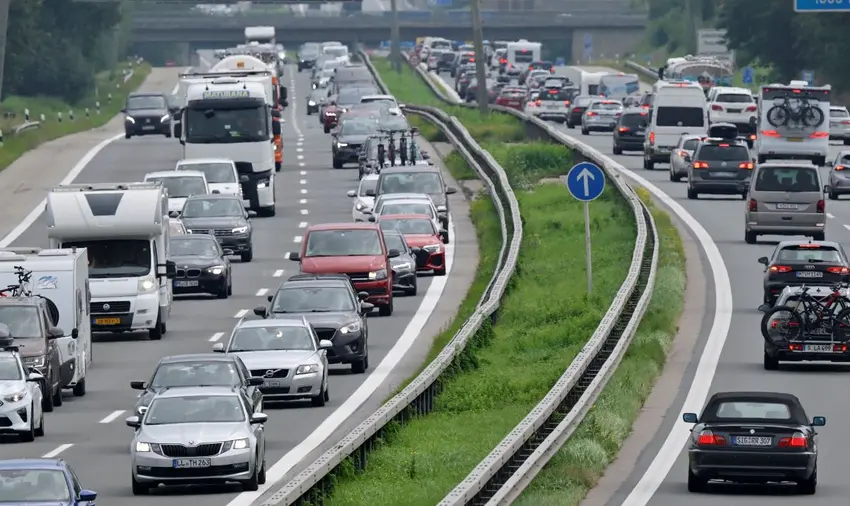
The study, which was released Monday, found that subsidies and tax breaks of at least €35.8 billion drove up greenhouse gas emissions in Germany in 2020 alone.
It also suggests that if current subsidies remain in place, they would amount to an additional 156 million tonnes of CO2 emissions between 2023 and 2030.
Titled "Quantification of the greenhouse effect of state benefits in Germany", the study was carried out by six institutes.
According to German Environmental Aid (DUH), the report was withheld from publication for nine months. The organisation had taken legal action to ensure the report would be made public, and accused Federal Ministers Habeck (Greens) of “disregarding freedom of information”.
The study’s authors confirmed that the report was completed in November 2023.
Germany’s climate commitments versus its actions
Within an agreement between G7 countries, Germany committed itself to eliminating all subsidies on fossil fuels that are inefficient for reducing greenhouse gas emissions by 2025.
Also in the traffic light’s coalition agreement, the current government set the goal of reducing "climate-damaging subsidies" and thereby creating "additional budgetary leeway".
But this 150-page report, prepared by six institutes – IREES, Prognos, GWS, Fraunhofer ISI, Ifeu and the Oeko-Institut – shows just how far those goals are from reality.
Of the €35.8 billion per year spent on climate-harming subsidies, the largest share by far goes to the transport sector – amounting to €24.8 billion in total.
The next biggest share of subsidies goes to agriculture (€4.7 billion), and then industry (€4.1 billion) and finally energy (€2.1 billion).
How transportation emissions are subsidised
Transportation remains one of Germany’s primary polluting sectors, and one that has proven particularly hard for the country to reduce emissions in.
READ ALSO: Has Germany avoided 'driving bans' by loosening its climate rules?
According to reporting by Clean Energy Wire (CLEW), subsidies in this sector have remained largely unchecked for years partly because the government doesn’t have a solid definition for which tax breaks and assistance programmes are included.
The most obvious subsidies in this sector would include tax breaks for diesel fuel. But they also include, for instance, tax breaks for privately used company cars.
The study found that abolishing diesel tax breaks alone would save 25.7 million tonnes of CO2 by 2030 and €9.6 billion more in annual tax revenue. Diesel subsidies amount to huge savings for shipping and aviation companies, among others.
But tax breaks for private car drivers would also amount to significant savings.
Cutting the so-called distance allowance, a tax break for employees who drive to work, would also amount to a CO2 emission reduction of 16.4 million tonnes, and €5.3 billion in additional revenue in that time.
Cutting tax breaks for privately used company cars could save 7.9 million tonnes of CO2 and add €6.1 billion in additional tax revenue.
READ ALSO: EXPLAINED - The top tax deductions often overlooked by employees in Germany
Other efforts
According to the report, other subsidies worth considering include energy and electricity tax breaks, which could amount to CO2 emissions reductions of 26.8 million tonnes and 25.2 million tonnes, respectively.
Also, a reduced VAT rate on meat products equates to an estimated 17 million tonnes of CO2 emissions by 2023.
Meanwhile, there are some climate-friendly subsidies already in effect. The report suggests that subsidies for energy and resource efficiency can be expected to reduce a total of 40.4 million tonnes of CO2 emissions by 2030.
The federal subsidy for efficient buildings is also intended to reduce emissions by a total of 53.6 million tonnes.
Comments (1)