
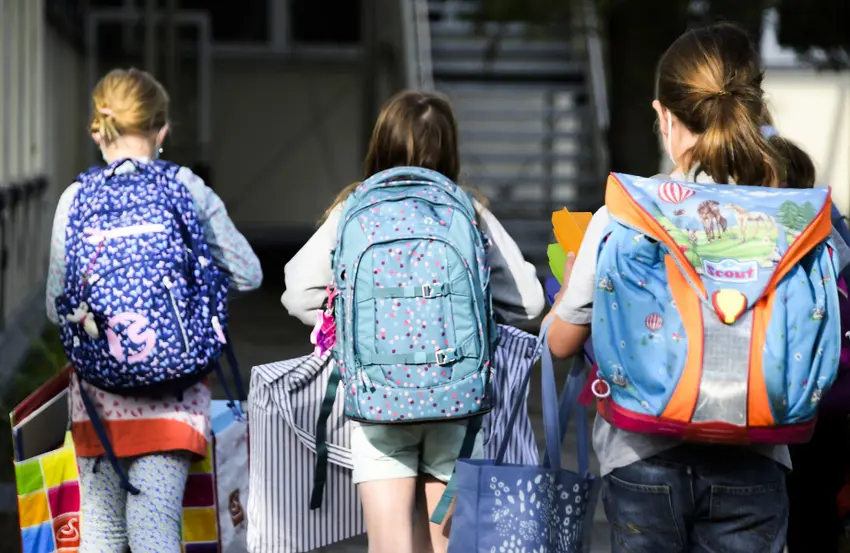
Germany's national and state governments are investing €20 billion in selected schools over the next 10 years. A total of some 4,000 schools are expected to benefit from the programme, with funding to the first 2,125 schools – the Startchance-Schulen (starting-out opportunity schools) – beginning this August and more to follow in 2027. You can see the individual schools on a map here.
Why does Germany need this?
German pupils have been performing badly at school. The shock results of an international PISA study, which looks at how 15-year-old school pupils are doing in various subjects like literacy, maths and science, showed that German students achieved some of their lowest scores ever.
In the study, which was carried out in 2022 and was the first since the Covid pandemic, German pupils’ performance was also found to have fallen significantly compared to other countries. Schoolchildren suffered in the pandemic as Germany was less well-prepared in terms of digital infrastructure for distance learning compared with other countries. And many primary school children struggle with simple maths and writing tasks.
READ ALSO: What is Germany's digital pact for schools and how does it affect pupils?
How is it decided which schools benefit from the funds?
The funds will be distributed based on need rather than on individual states' financial clout (as has previously been the case). The states and municipalities have chosen the schools with the greatest need from all those that applied.
The Startchancen schools have in common that they have a higher number of poorer students or children with a migrant background, which education minister Bettina Stark-Watzinger (Free Democrats) hopes will go some way to address educational inequalities.
Stark-Watzinger has repeatedly said that social background and the parental home still determine a child's educational success in Germany. And because the first few years of school set the course for future educational success, 60 percent of the students receiving support will be primary school pupils.
What does the programme hope to achieve in concrete terms?
Stark-Watzinger wants to "halve the number of students who do not achieve minimum standards in reading, arithmetic and writing," she said when she visited a Startchance school last month.
How will the money be spent?
The Education Minister said the funding is intended to be used, for example, to create new, creative learning spaces, employ additional social workers and support class workers, therapists and IT staff. However, it is not to be used for school renovations, even though many schools in Germany are in poor condition. That falls under the remit of the municipalities.
READ ALSO: 'Alarming': How children in Germany are lagging behind on reading skills
Is the money enough to make a real change?
That's less certain. Although the programme is welcome and gives support where it's most urgently needed first, more money is needed to turn things around, president of the German Teaching Association Stefan Düll told news website Tagesschau.
He said that not all schools that need funding would benefit from the programme because money is limited. About one in 10 schools in Germany will benefit from the programme.
So what else is needed?
Bundestag education committee chair Kai Gehring (Greens) told Tagesschau that the programme represents a start, but to achieve a "broader educational turnaround", Germany needs several other things: more country- and state-wide investment in daycare centres and across all schools, a major training programme for teachers, and more modern teaching that equips students with the necessary skills for the 21st century.
Meanwhile, the CDU's education policy spokesperson Thomas Jarzombek said that while the programme would not do any harm, it would not solve the real problem either. In order to achieve educational equality, he said that children needed support before they even started school. He called for "mandatory tests" for three- or four-year-olds and a "compulsory funded support year" for children before they started school with dedicated staff and equipment. However, it remains unclear where the additional staff for this would come from.
Comments