

Love them or hate them? E-scooters are one of the more controversial recent additions to modern urban life.
Some city-dwellers like that e-scooters offer an easy and affordable way to shorten your commute, by cutting down the time you spend walking to the train station, for example.
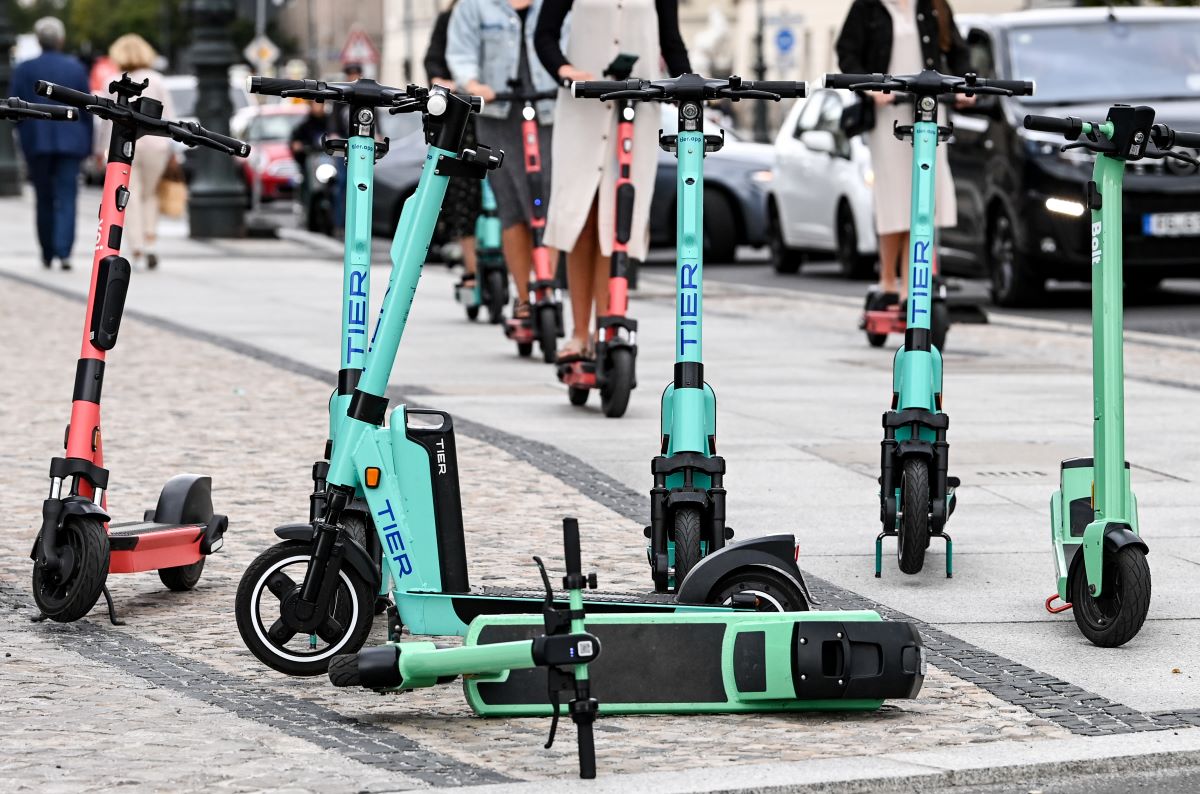
Others detest the space they take up on sidewalks and the danger that reckless riders pose to pedestrians.
A 2023 survey found that about half of Germans would approve of a ban on e-scooters.
Among the reasons some would rather see them go: a rise in accidents, with both pedestrians and drivers seeing them as unsafe.
Safety concerns have led the Federal Ministry of Transport, led by the Free Democrats' Volker Wissing, to draft new rules for e-scooter use in Germany, which – despite criticism from the pedestrian association Fuss, and the ADAC – are expected to be implemented nationwide.
Here are the planned new rules:
Alignment with rules on cycling
Currently e-scooters are allowed on cycle lanes and in cycle streets. Only when cycle lanes are absent are e-scooter drivers allowed to switch to the road.
Generally e-scooters are prohibited on the sidewalk.
According to the Ministry of Transport’s draft to amend the Small Electric Vehicles Ordinance: The regulations on e-scooters are to be aligned with those on cycling where possible.
For example, the draft proposes that sidewalks or pedestrian zones where cyclists are allowed (Fahrrad frei zones) should also be open to e-scooter riders.
As before, when riding on sidewalks, walking speed should be maintained and care should be given to pedestrians.
Also, drivers of e-scooters should be allowed to use the green arrow in the future like cyclists at a red light.
The new ordinance is planned to come into force in April 2025, but the rules for aligning it with cycling would not be enforced until a year later.
During the transition period, the Transport Ministry suggests that municipalities should consider if they want to allow e-scooters on sidewalks or pedestrian zones generally.
READ ALSO: EXPLAINED - The rules for riding an e-scooter in Germany
Mandatory turn signals
Soon newly registered e-scooters would need to be equipped with a turn signal.
According to the Transport Ministry’s draft law, this would apply from the beginning of 2027.
A market analysis revealed that newer scooters already tend to be equipped with turn signals.
The German Road Safety Council welcomed the fact that there should be mandatory turn signals for new vehicles in the future.
On e-scooters, the hand signal can lead to unstable driving because the handlebars are hard to stabilise with one hand.
The ADAC and pedestrian associations are critical
There's been pushback from other road and pavement users.
The pedestrian association (Fuss) suggested the draft law is a "gross attack" on people on foot.
Fuss suggests that with the draft law Transport Minister Volker Wissing (FDP) wants to allow e-scooters on more sidewalks and in more pedestrian zones, and that he wants to abolish the previously prescribed 1.5 metre minimum distance when scooter riders pass pedestrians.
Wissing also suggests mitigating parking chaos by enshrining parking rights for e-scooters in road traffic regulations.
Fuss, on the other hand, would rather see e-scooters parked only in marked areas.
From the ADAC's point of view, the lack of victim protection is not addressed by the proposed legal changes.
E-scooters are not subject to strict liability, according to an ADAC spokeswoman, due to their speed of a maximum of 20 kilometres per hour.
"Anyone who is injured by an e-scooter today through no fault of their own must prove personal fault to the e-scooter driver in order to receive insurance compensation”, the spokeswoman told DPA.
Rising number of accidents
Meanwhile, the number of e-scooter accidents continues to rise. Last year, the number of fatalities and injuries in e-scooter accidents doubled.
According to the Federal Statistical Office, there were 22 fatal e-scooter accidents on German roads in 2023, compared to 11 deaths in 2022.
In total, there were 9,425 e-scooter accidents in Germany in which people were injured – 14.1 percent more than in the previous year.
The Federal Office cited the incorrect use of the road or sidewalks as the most common reasons for the accidents.
Most accidents occur in large cities, and very often with drivers who are under the influence of alcohol.
States and associations have until August 9th to comment on the current draft law.
Then the Bundesrat would need to approve any changes before the law is adopted.
With reporting by DPA.
Comments