

Germany's Schwerin Castle named World Heritage Site
According to German media reports, UNESCO has named Schwerin Castle a World Heritage Site. Schwerin Castle, in the northern region of Mecklenburg-Vorpommern, survived World War II without suffering any bomb damage.
Its addition to the UNESCO list, along with Saxony's Hernhutt village a couple of days prior, means Germany is now home to 54 World Heritage Sites.
The Residence Ensemble Schwerin was officially named a heritage site on Sunday at the United Nations Educational, Scientific and Cultural Organization (UNESCO) 46th session in New Delhi.
The full ensemble includes Schwerin Castle itself as well as parts of the historic old town.
Right-wing parties reignite benefits debate
In light of a sharp rise in expenditure for long-term unemployments benefits - or Bürgergeld - politicians from the CDU/CSU, FDP and AfD are putting pressure on the government to further tighten the rules for the welfare payments.
"Bürgergeld has not met expectations and must therefore be reformed further," said Finance Minister Christian Lindner in the ARD Sommerinterview programme, adding: "We don't have too little money, we have too much expenditure."
"A major task will therefore be to reorganise our welfare state. In short: targeted, more empathy for those in need, but more consistent action against freeloaders."
On Sunday, CDU Secretary General Carsten Linnemann told the Funke Media Group that he believed benefits could be cut for more than 100,000 people who aren't willing to find a job.
"If someone is fundamentally unwilling to find a job, the state must assume that they are not in need. Then the basic income support must be cancelled completely," Linnnemann said.
His comments were met with outrage from the SPD, with deputy parliamentary chair Dagmar Schmidt accusing Linnemann of "defaming" social claimants.
As part of its growth initiative, the traffic-light coalition has already announced a number of changes to Bürgergeld, including encouraging applicants to take longer commutes to potential jobs and sanctions for refusing reasonable work.
READ ALSO: How the German government wants to toughen up rules on unemployment benefits
Wagenknecht: No coalition with parties who send arms to Ukraine
Sahra Wagenknecht, the leader of the new populist Sahra Wagenknecht Alliance (BSW) party, has said future coalitions in eastern Germany would be dependent on her partners' stance on the war in Ukraine.
"We will only participate in a state government that also takes a clear position in favour of diplomacy and against preparations for war," Wagenknecht told DPA. "A new arms race will swallow up billions that are urgently needed for schools, hospitals, housing and higher pensions."
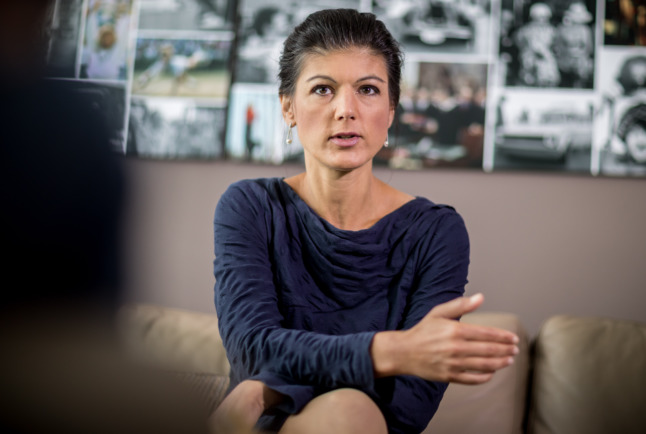
New state parliaments will be elected in Saxony, Thuringia and Brandenburg in September. In all three states, BSW is highly popular, currently polling at around 15-20 percent.
In addition to education and migration, the BSW has also taken a hardline stance against weapons deliveries to help Ukraine defend itself against Russia's brutal invasion.
READ ALSO: Why is a German populist left leader launching a new political party?
The far-right AfD, which is believed to have strong ties to Russia, has also taken up the issue. Both parties are against arms deliveries to Ukraine and in favour of immediate negotiations between Ukraine and Russia.
"The issue of peace is very important," said Wagenknecht. "Many people are rightly worried because the German government is increasingly turning our country into a warring party in the Ukraine war and has so far failed to make any effort to find diplomatic solutions."
She also criticised the announcement that US missiles would be stationed in Germany in the coming years as a reaction to a growing Russian threat.
Germany condemns Golan rocket attack
German Foreign Minister Annalena Baerbock on Sunday condemned what she said was the "deplorable" rocket attack on the Israeli-annexed Golan Heights, which killed 12 people, and called for "cool heads" in response.
"The perfidious attacks must stop immediately. It is important to act with cool heads. Far too many people have died already in this conflict," Baerbock wrote on X in reference to the Gaza war, which risks spreading to Lebanon.
Israel has vowed to "hit the enemy hard" after rocket fire from Lebanon killed 12 young people in the Israeli-annexed Golan Heights, fanning fears that the war in Gaza will spread.
Israel's army called it "the deadliest attack on Israeli civilians" since the October 7th attack that began the war in Gaza and triggered regular exchanges of fire across the Lebanese border.
In expectation of Israel's retaliation, Hezbollah evacuated several positions close to the border.
Hezbollah has said its cross-border fire is an act of support for Palestinian Islamists from Hamas who have been fighting Israel's military in Gaza since October 7th, when they attacked southern Israel.
That attack resulted in the deaths of 1,197 people in Israel, mostly civilians, according to an AFP tally based on official Israeli figures.
Militants also seized 251 hostages, 111 of whom are still held captive in Gaza.
Israel's retaliatory military campaign in Gaza has killed at least 39,324 people, according to the health ministry - though many believe the death count could be much higher.
In Gaza's southern city of Khan Yunis on Sunday, the civil defence agency reported five killed in an Israeli strike that hit several tents housing displaced Palestinians in a humanitarian zone.
Comments