
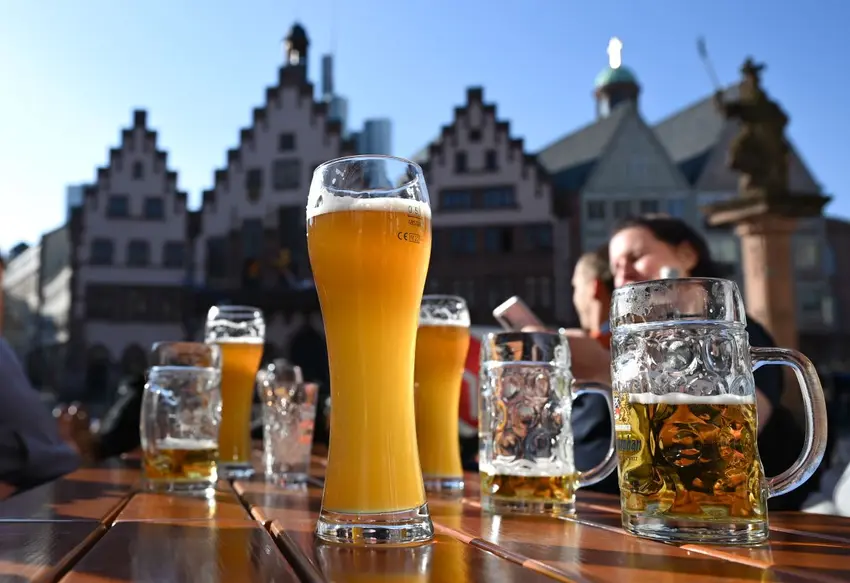
I didn’t come to Germany strictly for the beer, but I did see it as a compelling perk.
Having arrived in Berlin in the fall of 2020, just ahead of a wave of Covid restrictions, my first season in Germany was marked by nights spent simply drinking a few beers with my roommates in our shared Wintergarten.
On my first visit to a German grocery store, I was amazed to find half-litre cans of beer for 55 cents. When I got home I was amazed again when I tried it and found that it was actually pretty good – far better than cheap beers in the US anyway.
Later I would be amazed a third time when I realised that 25 cents of the price was actually Pfand, and therefore I could effectively exchange a handful of cans for a couple more beers.
Why I sampled hundreds of unique beers
I like to go out of my way to try new things. Given the choice between visiting a restaurant that I know is good versus one I haven’t tried, I’m rolling the dice. This proclivity led me to regularly find new beers to bring home, and yet there were always more waiting to be found.
Eventually I came up with a challenge for myself: I would try to drink at least 365 unique beers in the course of a year – aiming to try one new beer each day on average.
According to Statista, there are more than 1,500 unique breweries in Germany. Most breweries offer several to a dozen or more unique beers, so finding 365 of them would be easy enough, I reasoned.
I figured the challenge would push me to try beers that I might otherwise never find, and also allow me to discover which breweries and which types of beer were my favourites.
I found an app called Untappd (in which users rate beers) to help me keep track of what I’d tried.
By the way, I won't explicitly recommend this type of challenge to anyone. But I’ll just say that compared to say the British man who drank 10,000 pints in 200 days, I think I remained within the limits of moderation.
READ ALSO: How alcohol-free beer is booming in Germany
Pure water and simple ingredients
In my opinion, the beauty of German beer is in its simplicity. Deutsches Bier starts with pure water and contains only a few ingredients. This is established by law.
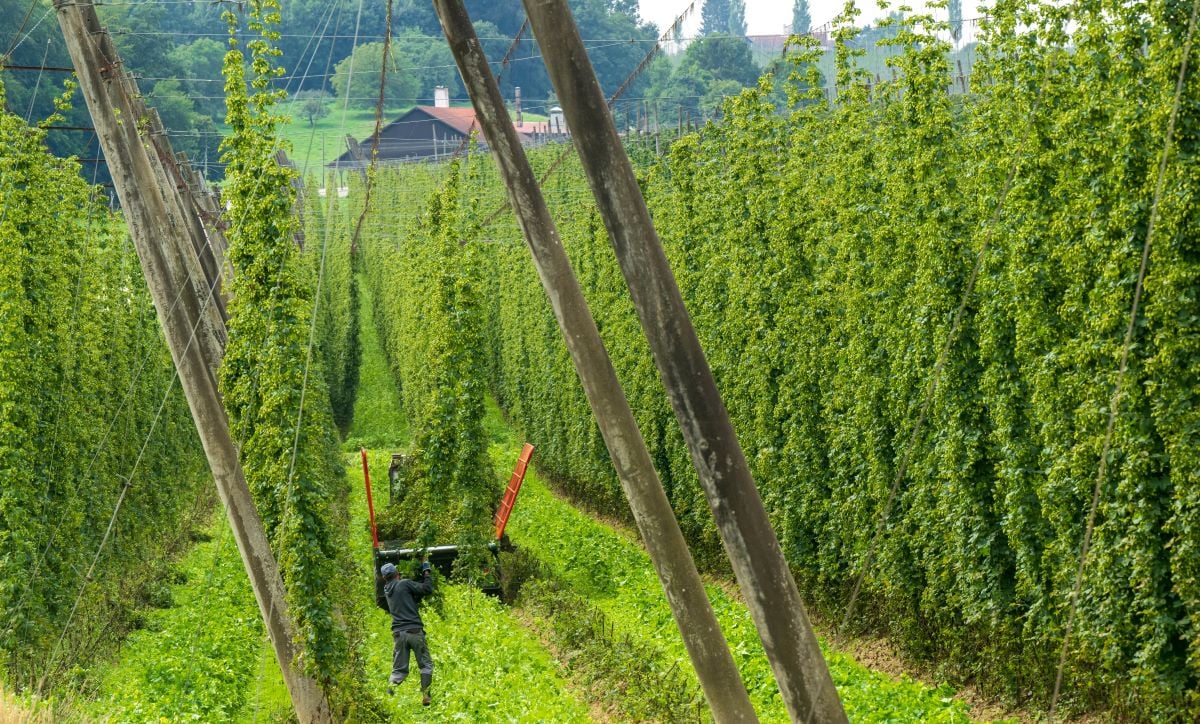
Germany’s famous purity law (Reinheitsgebot) declares that beer should only be made of four ingredients: hops, barley (malt), yeast and water. So if it's called “beer” in Germany, you know what you’re consuming.
Interestingly, Germans’ obsession with pure beer has had some far-reaching and unexpected impacts.
For example, in 2013, when oil and gas companies were trying to set up hydraulic fracturing (fracking) for shale gas in Germany, breweries wrote to government officials to argue that – for the sake of pure beer – Germany’s fresh groundwater resources needed to be protected. (Fracking notoriously resulted in poisoning groundwater supplies in the US and other parts of the world.) Ultimately Merkel’s government passed a temporary ban on fracking in Germany.
But I digress.
Beyond the purity of the ingredients used, German brewers seem to value simplicity and tradition in all things.
In contrast to the increasingly global, and IPA-obsessed craft brew trends, German breweries tend to reject modern marketing tactics. They avoid flashy labels with long-winded flavour descriptions.
While US-based micro breweries compete to create unheard of flavours, like peanut-butter milk stout or avocado honey ale, German brewers mostly stick to the classics.
In short, German beers are tried and true.
The focus on simplicity affects the way beer is ordered and served as well.
If I were to order “a beer” at a bar in California, I can expect an annoyed bartender to ask, “Which one?”
Whereas in Germany an unspecified, “Ein Bier bitte”, is a perfectly acceptable order and can be expected to result in a half-litre of the bar’s standard tap beer without further questions.
READ ALSO: 'Strong beer': UK issues special travel advisory for Germany
At most Biergärten you won't find more than a few options to choose from – Helles, Pilsner or Weizen, maybe a Dunkeles. Light, hoppy, cloudy or dark, take your pick. The main difference is just the colour of the grain or malt, and the taste.
Think global drink local
One thing I appreciate about German beer culture is that the local beer is always the best beer.
I’ve been caught in a Berlin Späti reaching for beers from faraway lands. On two separate occasions I was called out for my crime by a German customer.
“Why are you drinking that piss water?” they asked. “Here, let me show you a real good German beer.” And then they led me toward the Berliner Pilsner.
I was a bit confused the first time this happened. Don’t get me wrong: I like a good Berliner beer, but can we really say it's better than a Bavarian Helles?
I’ve since come to understand it as a bit of hometown patriotism. When in Munich, perhaps Augustiner’s Helles is the best beer, and in Baden-Württemberg it could be Rothaus’s Tannenzapfle. So it goes that in Berlin, we should drink Berlin beers.
My top-picks and takeaways
In the end I succeeded in trying 365 unique beers in as many days.
As of writing, I’ve tried about 300 German brews. The rest of the beers I tried were from neighbouring countries as I didn’t limit myself to strictly German beers for the challenge. (Czeck and Belgian beers by the way are strong competitors.)
A lot of the beers that I ranked among the highest came from Bavaria. In my opinion, Germany’s southwestern ‘Free State’ has earned its reputation for making some of the best beer.
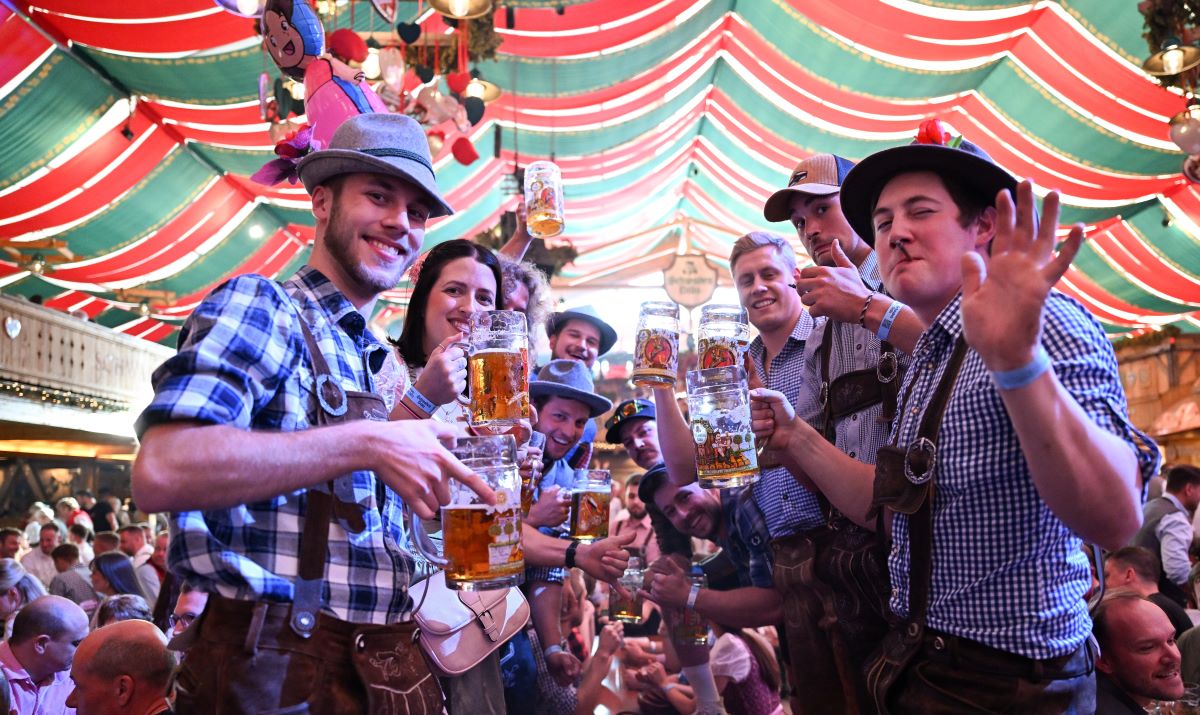
Franconia, a region in the northern part of Bavaria, is said to have the highest number of breweries per capita in the entire world. It’s also home to some unique beer styles like Nuremberg’s Rotbier (red beer), which gets its red colour from ageing in old wine barrels, or Bamberg’s Rauchbier (smoked beer) that has a particularly strong smoky flavour.
READ ALSO: Travel in Germany - Sipping smoked beer and soaking up culture in beautiful Bamberg
A few of my highest rated beers were Giesinger’s ‘Untergiesinger Erhellung’, the Rotbier by Nuremberg’s Hausbrauerei Altstadthof, and Hertl’s ‘Papa’s Weissheit’.
Of the beers more commonly found in corner stores across the country, I like Rothaus Pils or a Tegernseer Hell. But when I’m in Berlin, it’s probably Kindl. Or one of Quartiermeister’s bio-beers if it's available.
My ‘cheap and best’ picks include Lidl’s Perlenbacher beers, or the Turmbräu Pilsner or Weizen that can be found at Penny.
Comments