
“The security of Israel is Germany’s ‘Staatsräson’” said Vice Chancellor Robert Habeck in a speech that went viral on social media, adding that after Hamas’ attack this commitment could not just be empty words.
But what does this actually mean? Staatsräson literally means “reason of state”, and with such a grand title, you might expect this to be an established long-standing concept in German politics.
It's almost four weeks since the horrific terrorist attack on #Israel. A lot has happened, the public debate has become heated and confused. Find thoughts from Vice-Chancellor Robert #Habeck in the video, putting the events in context. ?With English, Hebrew and Arabic subtitles. pic.twitter.com/5jdXAZr7ey
— Bundesministerium für Wirtschaft und Klimaschutz (@BMWK) November 2, 2023
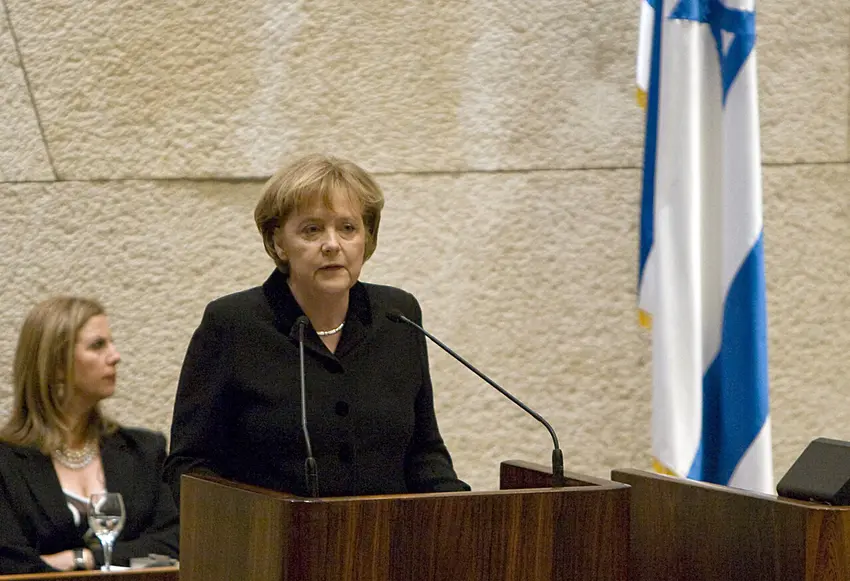
However, rather than going back to Germany’s constitution the Grundgesetz or the post-war founding of the Federal Republic of Germany, the idea that Israel’s security is part of the reasons for the existence of Germany actually comes from a 2008 speech by then-Chancellor Angela Merkel to Israel’s parliament, the Knesset.
Merkel said that every German government and chancellor was "committed to Germany's special historical responsibility for Israel's security".
She added: "This historical responsibility of Germany is part of the Staatsräson of my country. This means that Israel's security is non-negotiable for me as German Chancellor."
At the time, German politicians were worried that Merkel's use of the word "Staatsräson" could mean Germany had an obligation to offer security guarantees to Israel, quite a commitment in such a volatile region.
But after the speech her government clarified to the Bundestag that the Staatsrasön didn’t have any legal basis and was effectively just a political statement.
Since then, polls show German support for Israel and Germany’s special responsibility has gradually increased. In 2006, only 28 percent of Germans thought Germany had a special responsibility for the fate of Israel, with 58 percent opposed to the idea. And despite overwhelming support in politics, this is is still a minority position now, with only one third of Germans in favour, and 43 percent against the idea.

READ ALSO: Germany sees over 1,100 offences linked to Israel-Hamas conflict
The origins of a 'reason of state'
But where does a Staatsrasön come from? The term goes back to pre-modern states when kings and princes could override the law if they felt it was in the state’s interest, according to Germany’s official Federal Centre for Political Education (BPD), and is a translation of the French concept of raison d’etat. But the BPD is clear that this isn’t particularly relevant for modern states, saying "in democratic states, the reason of state, as described here, no longer play a role".
Meanwhile, the main opposition party the Christian Democrats have proposed to make recognising Israel’s “right to exist” as mandatory to get Germany’s citizenship reforms.
READ ALSO: CDU leader calls for German citizenship to be allowed 'only with recognition of Israel'
Muslims, and particularly Palestinians in Germany, are already sometimes asked to recognise Israel’s “right to exist” by individual government employees, with some even encountering problems with their visas and being at risk of deportation.
Legal scholar Ralf Michaels, the director of the Max Planck Institute for Comparative and International Law, has criticised the concept and how it has developed in recent years.
"Previously the emphasis was often on Israel’s security and Germany trying to negotiate for peace and a two-state solution" while Israel’s settlements policy in the West Bank was often criticised, including by Foreign Minister Baerbock in 2012, he said.
But Michaels points out that now you don’t hear this anymore: "What the Staatsrasön demands, appears to be limited to support for warfare, and questioning this is forbidden". He pointed out that when Germany abstained at a UN vote for a ceasefire recently, this was even criticised as being against the 'reason of state' by German President Frank-Walter Steinmeier.
And if Israel’s security really is Germany’s responsibility, then the massacre of October 7ths shows they failed at it, Michaels argues. "The claim that talking of Staatsrasön is just rhetoric without any meaning has become more plausible," he said.
So should the Staatsrasön mean total support of Israel's government, no matter what happens? That's a current debate ongoing in Germany. The Israeli historian Moshe Zimmerman wrote shortly before the October 7th attack that “because Israel’s government is the biggest danger for the country and the region, supporting this government means betraying the task of treating Israel’s security as Germany’s Staatsrasön".
Regardless of the debate and amid the ongoing tensions in Germany surrounding the Middle East crisis, you can expect to hear 'Staatsräson' lots more from German politicians.
Comments