
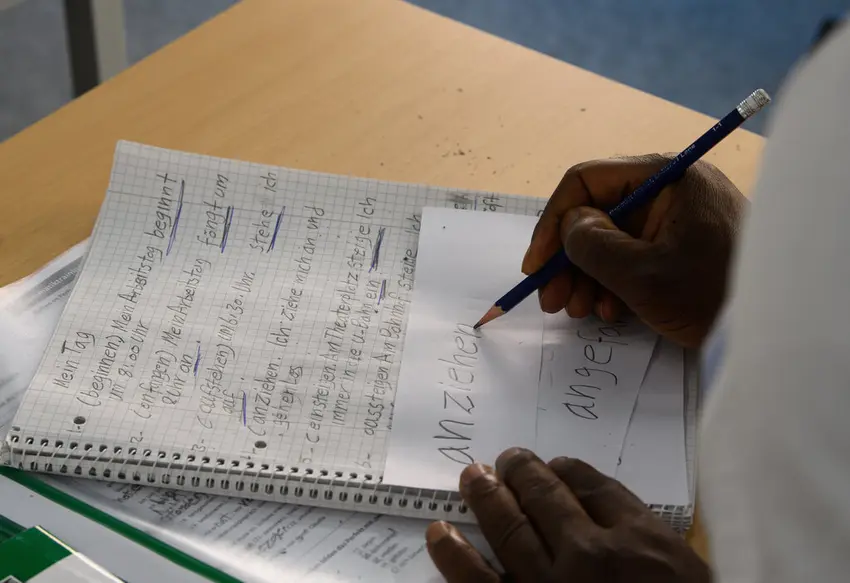
To fulfil the basic requirements for German permanent residency and citizenship, you'll first have to obtain a B1 level of proficiency in the German language.
Keep in mind, however, that you'll need prove a higher level of German, B2 (or C1 in future), to expedite the process for citizenship.
READ ALSO: What's the difference between B2 and C1 German for new fast track citizenship?
German language competence is assessed using the Common European Framework of Reference for Languages (CEFR).
Perhaps you think you already have B1 German but you'll need to prove this through official accreditation.
If you are starting to learn German from scratch and are curious about the timeline for achieving this proficiency level, we break down the steps to reach this point.
What does B1 German look like?
According to the CEFR, if you are at B1 level:
- You can handle most situations while travelling in different areas in which German is spoken
- You can describe your experiences of different events and meetings
- You can understand and discuss the main points of your immediate circumstances - family, school/work and surroundings
Grammar at this level includes:
- More complex German phrases (position of verb and word order)
- Modal verbs - dürfen, können, mögen, müssen, sollen and wollen
- Genitive case - for example, das Haus meiner Mutter (my mother's house)
- Passive forms of verbs - "mein Bruder bereitet das Essen zu" (My brother prepares the food) becomes ‘das Essen wird zubereitet’ (The food is being prepared).
- Imperfect tense - er las ein Buch (he read a book)
As a general rule of thumb, you should know 2,400 ‘common’ German words.
These normally include greetings (Hallo, auf Wiedersehen) and frequently-used nouns (die Familie, das Essen).
How does this differ from A1 or A2 level?
A1 is the lowest scale on the CEFR and it is expected that you have basic grammar skills, knowledge of sentence structures and you can hold basic conversations.
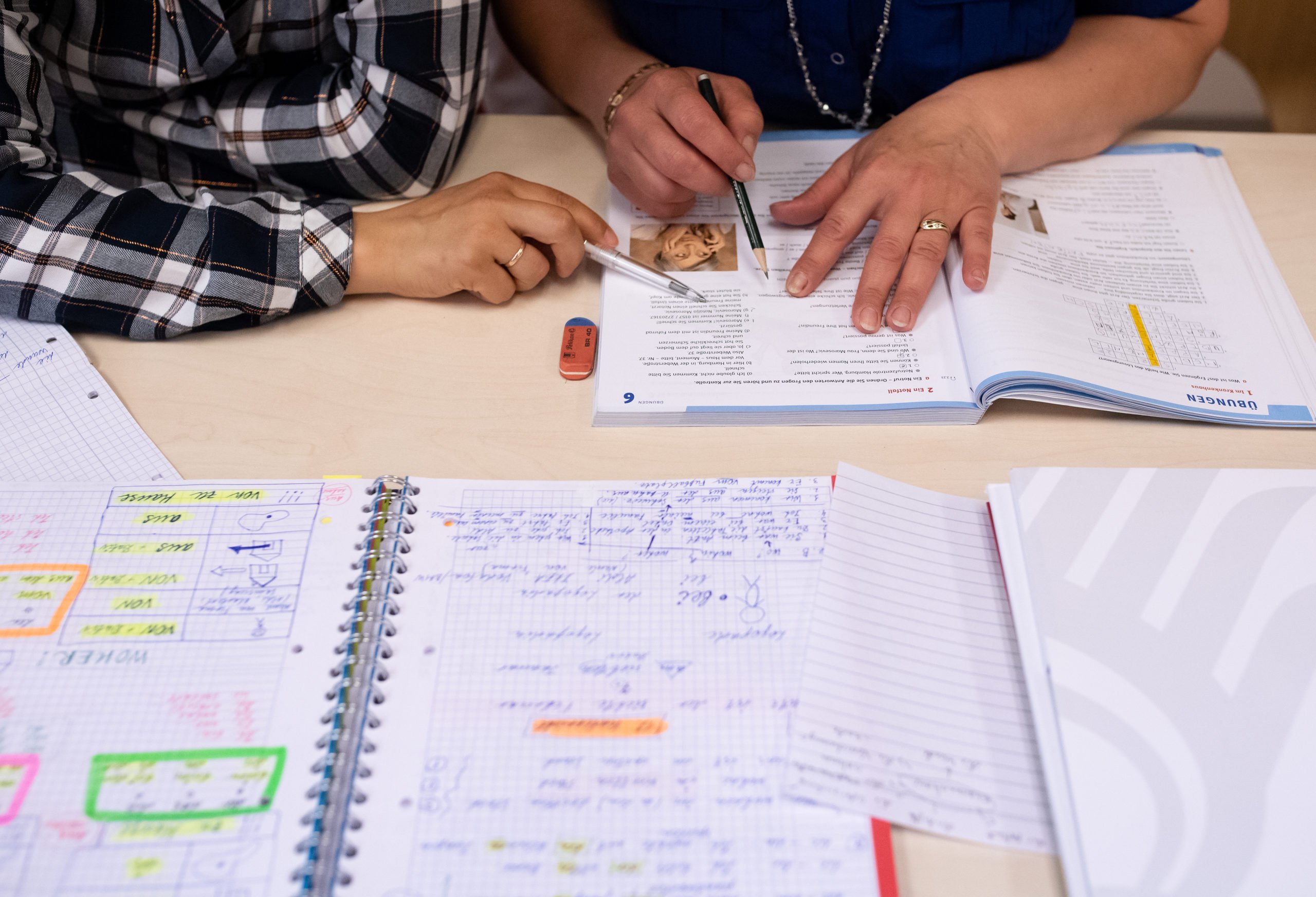
A2 builds on from this, particularly with grasp of grammar. You should have firm knowledge of the accusative case, prepositions that take the dative case, reflexive and separable verbs, the simple future tense (ich werde reisen or I will travel ) and the past tense (ich habe Fußball gespielt or I played football).
How long will it take?
Language learning is very subjective and takes different people different lengths of time.
For instance, learning German when you already know another Germanic language like Dutch or Danish immediately speeds up the process, just as learning Portuguese usually comes easier when you already know Spanish.
The Foreign Service Institute (FSI) uses the following to predict how long it will take to learn German when learning German from English:
A1 - 60-150 hours
A2 - 150-260 hours
B1 - 260-490 hours
Other researchers suggest that reaching B1 level can take up to 540 hours.
Therefore, if we use the assumption of attending language classes for 4.5 hours a day, 5 days a week, it will take you five to six months to reach that level from scratch.
Naturally, this will be a lot less if you are already at A2 level, or even A1.
But don't be alarmed if you do not have the time/resources to attend a language course, as there are many other methods of Deutschlernen, some which will allow you to advance without paying anything at all.
READ ALSO: The best ways to improve your German for free
How do I prove my level of German?
According to Germany visa, here are the several ways to prove your B1 level:
- A German language certificate such as the Zertifikat Deutsch
- A certification that you have obtained through an integration course, such as the ‘DTZ - German test for immigrants’
- A certificate that proves you have completed your education at a German secondary school
- Admissions proof in a German upper secondary school
- A certificate that proves you have completed at least four years of school in German with a passing grade
- Proof of higher education degrees in German.
If you don’t have one of these documents, you can complete a government language test administered by your respective citizenship authority.
B1 level proficiency in German is a crucial step toward obtaining permanent residency or citizenship.
Comments (1)