
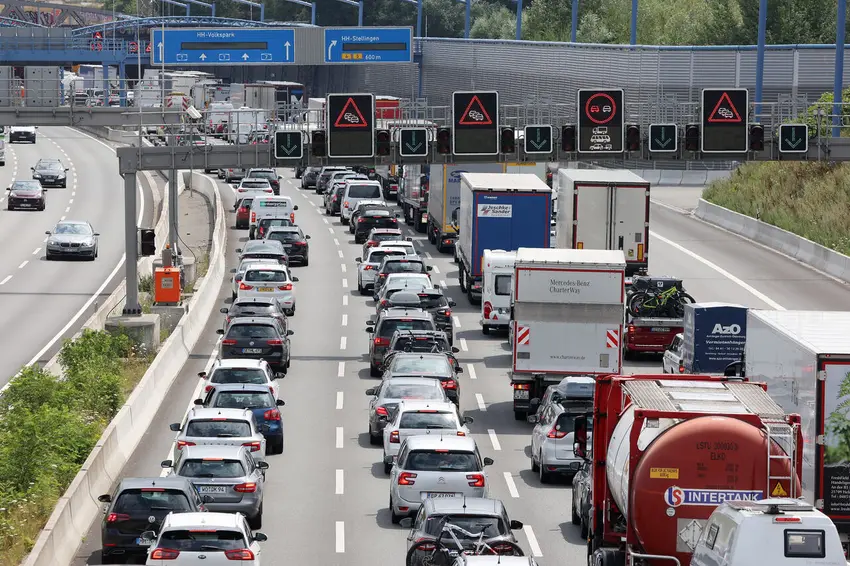
Those wanting to take a road trip next weekend in Germany should brace themselves for heavy traffic as, according to the German Automobile Association (ADAC), the summer travel wave on German motorways is about to approach its peak.
Starting from Friday, the ADAC expects "one of the most congested weekends of the season", as, in addition to the eleven states that have already started their summer holidays, Hesse, Rhineland-Palatinate, and Saarland will close their schools on Friday too.
With the exception of Bavaria and Baden-Württemberg, the entire Germany will then be on summer vacation. Therefore, according to ADAC, traffic will only move "at a snail's pace" along sections of the most important holiday routes.
The longest traffic jams are expected on Friday afternoon, Saturday morning, and Sunday afternoon. The ADAC (German Automobile Club) has advised that motorists plan for extensive delays, particularly in the Stuttgart region, and allocate extra time for their journeys.
READ ALSO: Driving in Germany: Eight German road signs that confuse foreigners
The delays will affect many popular highway routes, as well as traffic in and around Berlin, Stuttgart, Cologne, Frankfurt am Main, and Munich, as well as the highways to the North and Baltic Seas. ADAC advises flexible vacationers to choose quieter routes or to travel on a different day, as traffic is expected to be calmer on the highways in the middle of the week.
Traffic jams are also expected to continue into Germany's neighbouring countries, too. Problem areas are likely to include the Tauern, Fernpass, Inntal, Brenner, and Gotthard routes in Austria, as well as the highways to the Italian, French, and Croatian coasts and on the highways heading towards Scandinavia.
According to ADAC, the three highway border crossings with the highest risk of congestion are Suben on the A3 between Linz and Passau, Walserberg on the A8 between Salzburg and Munich, and Kiefersfelden on the A93 between Kufstein and Rosenheim.
Comments