
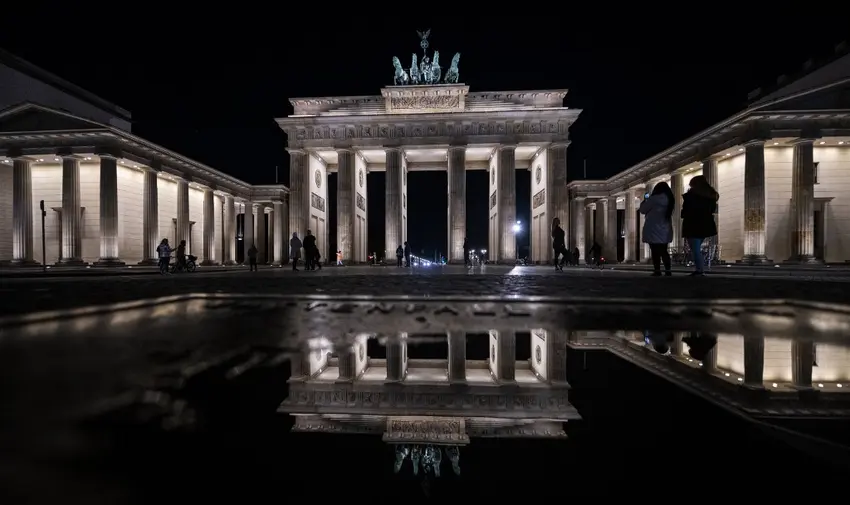
Russia's invasion of Ukraine and ensuing sanctions has seen energy prices soar, while the Russian leader is also threatening to cut off gas supplies to the west in retaliation for the sanctions.
All this means that countries around Europe face a difficult winter and the prospect of energy shortages - so many are already taking action to stockpile gas and cut energy usage.
Here's a roundup of what actions are being taken.
Germany
Heavily dependant on Russian gas, Germany is already feeling the effects of the energy squeeze, with many households and businesses turning down the thermostat or dimming the lights as gas storage facilities are being filled at a slower pace.
A lovely thing, this dimmed Television Tower: a small sacrifice, a nightly reminder of the stakes beyond our borders, a sense of solidarity & wir schaffen das #ditisberlin pic.twitter.com/MQCjEN7IBj
— Deborah Cole (@doberah) July 29, 2022
Rules - Early in July, Germany’s lower house of parliament or Bundestag passed a plan to turn off the hot water in its offices and keep the air temperature no higher than 20C in the winter. This limit is merely recommended for households.
However homeowners will not be allowed to heat private pools with gas “this winter”, according to government plans, while a regulation requiring minimum temperatures in rented homes is expected to be suspended “so that tenants who want to save energy and turn down the heating are allowed to do so”.
As well as national rules, many German cities have also adopted their own energy-savings plans.
The Bavarian city of Augsburg, for example, has turned off its fountains, dimmed the facades of public buildings at night and is debating switching off some under-used traffic lights - and a housing cooperative in Dresden made national headlines when it announced it would limit hot water to certain times of day.
With certain exceptions, public buildings in Berlin will not have heating from April to the end of September each year, with room temperatures limited to a maximum of 20C for the rest of the year. In areas such as warehouses, technical rooms, corridors, the maximum will range from 10 to 15C.
Private enterprise has been getting in on the act too - Vonovia, Germany’s largest property group, plans to limit the temperature in its 350,000 homes to a maximum of 17C at night.
The head of consumer chemicals group Henkel has said that work-from-home practices may be reintroduced, while chemicals giant BASF has raised the possibility of putting its employees on furlough.
Recommendations - Economy Minister Robert Habeck has made headlines for extolling the virtues of shorter, colder showers.
France
France has an ambitious plan to cut its energy usage by 10 percent within two years and a government plan for sobriété énergétique (energy sobriety) is expected by September.
In the meantime, some rules have already been put in place while there are also some official recommendations. The general principle is that changes will be obligatory for government buildings and businesses, but voluntary for private households.
Rules - In 2013, a law obliging businesses to switch off outside lights by 1am came into force. That deadline may be brought forward and towns and villages may have to switch off streetlights earlier - some areas have already taken this decision.
Shops that have air conditioning may not leave their doors open, so that less energy is lost.
Limits have been suggested for heating and air conditioning - keep heating to a maximum of 19C and air con to a minimum of 26C at the height of summer. The Prime Minister says she 'expects' government buildings to show an example and adhere to these, but they are voluntary for households.
Meanwhile, the heads of large supermarket chains in France have made a voluntary agreement for all stores to employ energy-saving techniques, such as turning off electric signs at closing times, reducing light usage, and managing store temperatures, from October 15th this year. They will also cut lighting by half before opening time, and by 30 percent during “critical consumption periods”.
Additionally, they will “cut off air renewal at night” and “lower the temperature in outlets to 17C this autumn and winter, if requested by a regulatory authority”.
Recommendations - The government has urged individuals to adopt energy-saving practices - by switching off wifi routers when on holiday, turning off lights, unplugging electric appliances when not in use, and lowering the air-con.
France’s energy transition minister Agnes Pannier-Runacher has urged people to keep heating to a maximum of 19C and air con to a minimum of 26C at the height of summer.
Spain
Spain has introduced perhaps the most wide-ranging set of rules in its new energy-saving bill, which comes into force on August 10th.
Public buildings as well as shops, restaurants, cafés, supermarkets, transport hubs and cultural spaces must:
- Set heating and cooling temperatures to limits of 19C and 27C respectively;
- Install doors that automatically close by September 30th to prevent energy waste, as can happen with regular doors that are left open;
- Lights in shop windows must be turned off by 10pm;
- Posters must be put up to explain the energy saving measures in every building or establishment, and thermometers must be displayed to show the temperature and humidity of the room.
READ ALSO: Is it realistic for Spain to set the air con limit at 27C during summer?
Recommendations - the above rules do not apply to private homes, but it is recommended to follow the heating and cooling limits.
Meanwhile, working from home is recommended for large companies and public administration buildings to help “save on the displacement and thermal consumption of buildings”, Spain’s Minister for Ecological Transition Teresa Ribera said.
And have you thought about your outfit? Here's Prime Minister Pedro Sánchez explaining why he's ditching his tie to stay a little bit cooler.
https://youtu.be/1gX39YsW8gU
Italy
Back in April the Italian government approved limits on the use of air conditioning in public offices and schools from May 1st, to save energy and wean itself off reliance on Russian gas imports.
At the time Ministers said that Italy would be able to end its reliance on Russian gas within 18 months, after previously giving a timeframe of at least two years.
Rules - In public buildings, energy use will be measured in individual rooms of each building – the temperature must not exceed 19C in winter and cannot be any lower than 27C in summer, with a margin of tolerance of two degrees – meaning the lowest allowed temperature is actually 25C.
Fines for non-compliance with the rules are said to range from €500 to €3,000. The measure does not currently apply to clinics, hospitals and nursing homes.
Italy has long had rules in place limiting the usage of heating in homes and public buildings during winter. Northern and mountainous areas are allowed to switch on the heat in October, while some parts of the south can’t turn up the dial until December.
Even then, there are limits on how long you’re allowed to keep the central heating on each day, ranging from six hours in the warmest parts of the country to 14 hours in chillier regions.
And there are rules on maximum temperatures - private homes, offices and schools should not be heated to more than 20C, with a 2C tolerance. Meanwhile factories and workshops should generally be kept at 18C.
Austria
The Austrian government has said it will work on measures to encourage energy saving among households and businesses while putting a cap on electricity prices.
The aim is to “support the Austrian population to ensure affordable energy supply for a certain basic need”, according to a government statement.
The government didn’t give details on the price cap but said that conditions would be developed by the end of August.
Sweden
Sweden has announced no new measures in response to the energy crisis, but already has certain limits in place.
Many Swedish apartment buildings and housing cooperatives have a strict maximum heating limit of 21C indoors and in some buildings radiators have a limiter on them so they cannot be turned too high.
In Denmark, too, the government has introduced no specific new measures.
Switzerland
In common with other countries, Switzerland is at risk of a gas shortage this winter and the government has warned that restrictions on consumption during the coldest months cannot be excluded.
Nearly half of its annual supply is of Russian origin. “We are not an island, so the war in Ukraine and the global energy crisis also affect Switzerland,” Energy Minister Simonetta Sommaruga said at the end of June. “In this context, there is no certainty about what awaits us.”
The possibility that Swiss households will have to turn down the thermostat this winter is very real.
In the event of an actual shortage, “consumption restrictions may be ordered, for example restrictions on the heating of unoccupied buildings. The switching to biofuel could be imposed by ordinance”, Economy Minister Guy Parmelin has said.
If shortages persist, a quota system would be implemented - with households and essential services, such as hospitals, among the last to be affected.
But Parmelin insisted, “the role of the State is to guarantee a good supply of gas and electricity to the country. We want at all costs to avoid a disruption in supply, which would have a strong impact on businesses and would then lead to an economic crisis”.
UK
Less reliant on Russian gas because of its own gas reserves, the UK is currently less worried about supply than price - soaring utility bills may force many households into poverty this winter, campaigners have warned.
Households in the UK will start receiving a discount worth a total £400 (€478) off their energy bills from October, the British government has said, with the support package rises to £1,200 (€1,430) for the poorest households.
A recent report by National Grid said there was little chance of the lights going out in the UK this winter - though experts have warned that a severe cold spell could prompt action, such as shutdowns of non-critical factory operations, to ensure homes can be heated.
Comments (3)