
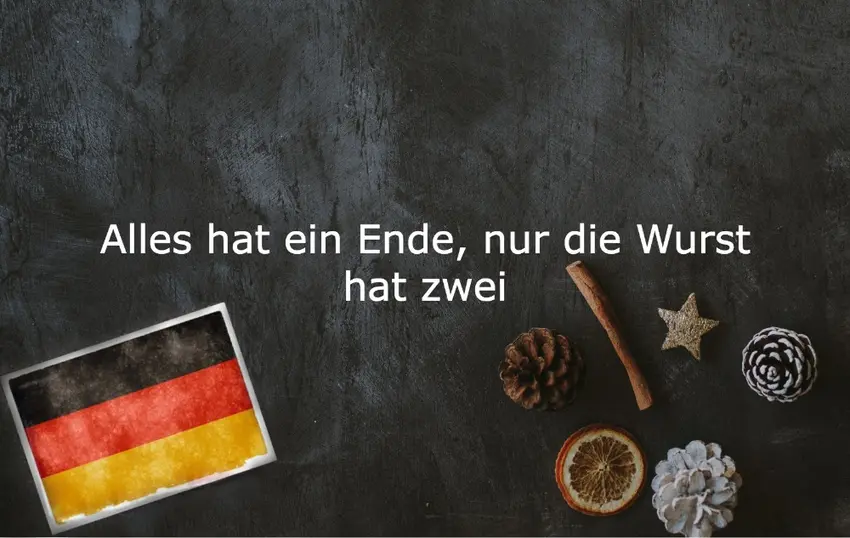
Why do I need to know alles hat ein Ende, nur die Wurst hat zwei?
In English, it’s fairly common to hear the phrase “everything comes to an end”. It’s a phrase you’ll often see spring up in various inspirational quotes, such as the Buddha’s “Everything that has a beginning, has an ending. Make your peace with that and all will be well.” This can mean the end of both good and bad things – a tough year, a good book, or (if you’re feeling particularly morbid) even life itself.
Given the serious conversations this phrase can come up in, you probably wouldn’t expect a follow up line about a sausage – but if there is one thing I have learned about the German language and its many obscure phrases, it is to expect the unexpected, as well as the unexplainable.
What does it mean?
The phrase alles hat ein Ende, nur die Wurst hat zwei translates into English as “everything has an end, only the sausage has two”, and means exactly what you think it means: it serves to lighten the conversation, although hopefully you won’t hear (or say) this phrase after any truly serious announcement. The saying uses a neat little bit of word play, since ein Ende can mean both “an end” and “one end”, allowing for the punchline that a sausage has two ends, rather than one.
READ ALSO: The seven best and seven 'wurst' German dishes
It's difficult to say exactly when this phrase was invented (it might even date back to an English play from 1607, ‘The Knight of the Burning Pestle’, which features the line “Although, as writers say, all things have end, and that we call a pudding hath his two”, with ‘pudding’ meaning a sausage).
The credit for its mainstream use, however, goes to the German singer Stephan Remmler, who released the song “alles hat ein Ende nur die Wurst hat zwei” in 1986 (this performance is well worth the watch - we've embedded the video below). The song tells the story of a man, Krause, who decides to leave his partner, Ruth. He consoles her, telling her that everything must come to an end eventually – except sausages, of course, which have two! By the end of the song, though, it is Krause who needs consolation: he decides to win Ruth back, only to find that she is seeing someone else, forcing him to recognise the end of their relationship for what it is – the end.
Use it like this:
Ich will nicht, dass dieses Buch zu Ende ist.
Aber es muss ein Ende haben! Alles hat ein Ende, nur die Wurst hat zwei
I don’t want this book to end.
But it has to end! Everything has an end, only the sausage has two!
Alles hat ein Ende
Nee, weil eine Wurst zwei hat!
Everything has an end
No, because a sausage has two!
Comments