
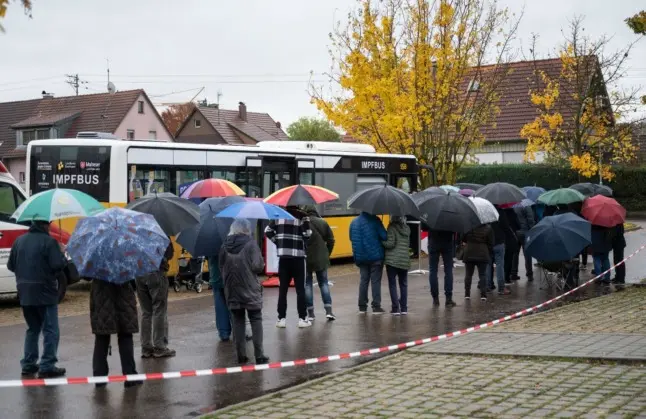
"The federal states agree that everyone who had their second jab six months ago or longer should be able to get an appropriate booster," Bavarian health minister Klaus Holetschek told a press conference.
Outgoing federal Health Minister Jens Spahn has also called for booster jabs for all, but the STIKO vaccine commission has so far recommended them only for those aged over 70 or with preexisting health conditions.
Germany registered 37,120 new infections in the past 24 hours on Friday, according to the Robert Koch Institute (RKI) health agency - a record rise for the second day running.
READ ALSO:
- Germany’s RKI raises Covid risk level for the unvaccinated to ‘very high’
- Germany records more than 37,000 Covid infections in 24 hours
The health ministers from Germany's 16 states had met for two days of talks on how to tackle the alarming trend.
Spahn said Covid health pass entry rules to indoor events or restaurants (known as 3G or 2G in Germany) would become even more important in winter.
The consensus is "that we need more monitoring of 3G (rules) in everyday life", Spahn said after the conference in Lindau on Lake Constance. 3G means access is only granted to people who can show a vaccination certificate (geimpft), proof of Covid recovery (genesen) or a negative Covid test (getestet).
Furthermore, he said 2G - i.e. access only for the vaccinated and people who've recovered from Covid - should be an option for businesses in regions with a very high incidence of infection. He said it was the first time there's been consensus between the federal government and all the states that there should be such 2G regulations.
Health ministers also decided to extend compulsory testing in old people's homes - even for people who are vaccinated or have recovered from Covid recently.
It comes as Germany is still in political limbo following September's general election.
The incoming coalition parties, aiming to form a government by early December, have so far ruled out mandatory jabs and said there will be no new lockdowns - at least not for the vaccinated.
READ ALSO: Majority of Germans in favour of compulsory vaccination
But with just 67 percent of the population fully inoculated and intensive care beds filling rapidly, calls are growing for action to tackle the upward curve.
Several of Germany's states, which have significant powers to decide their own Covid approach, have already agreed or introduced restrictions for the unvaccinated.
These include limiting certain events and spaces to people who are fully vaccinated or can show proof of recovery - a system that excludes the unvaccinated - the 2G rule.
Comments