
The big bang
Nördlingen is a city that's played a significant role in Germany’s history over the centuries.
Around 14 million years ago, the region in which Nördlingen lies was the site of a close encounter of the extra-terrestrial kind. An asteroid with a diameter of 1.5 kilometres impacted with the explosive force of 1.8 million Hiroshima atom bombs. The explosion would leave a crater 24 kilometres wide, and up to 150 metres deep. Ejected materials from the event can be found as far away as the Czech Republic.
To this day, buildings made from stone within the Nördlinger Ries contain tiny diamonds created in the blast, that glitter in the sunshine. You can see examples of stone, and learn more about the catastrophic event that shaped the area at the RiesKraterMuseum. You can even buy your own little piece to take home!
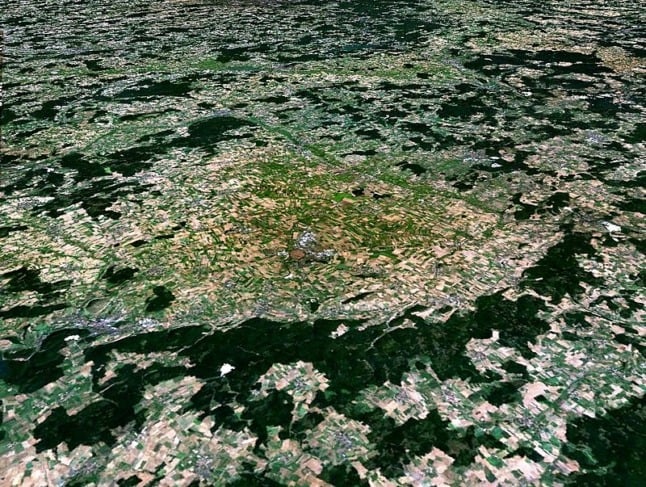 Aerial view of the Nördlinger Ries Photo: Wikimedia Commons
Standing tall
Nördlingen’s status and wealth has long depended on its position along a number of ancient trade routes between larger cities. Beginning in the 13th century, it was the site of a large market fair that would bring craftsmen and traders streaming in, Merchants would settle in the newly-declared Free Imperial City in magnificent stone buildings, many of which still stand.
These proud inhabitants would reinforce their city with the Stadtmauer, or city wall that exists to this day – in fact, the walls are often used by locals to get around the town. Around the city exists a number of large gates to let traffic through, each with its own style. Subsequently, it’s very hard to get lost.
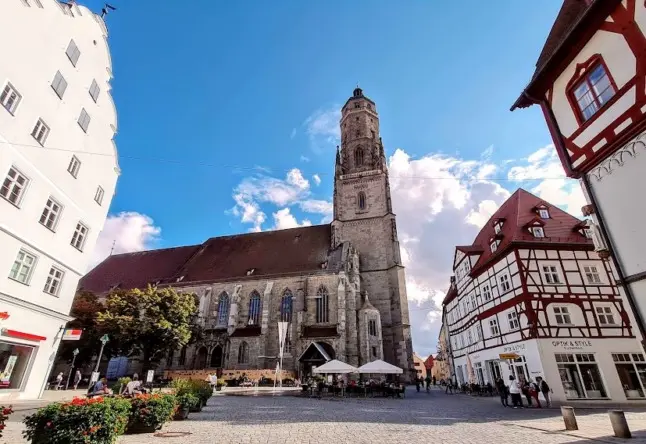
Nördlingen’s wealth and importance is also shown by the church that dominates the city’s skyline. The St-Georg-Kirche with its striking church tower known as ‘Daniel‘, can be seen from almost anywhere in the city, and has served as its watchtower over hundreds of years. Inside, the church is a treasure house of medieval and Renaissance art and well worth an hour of your time.
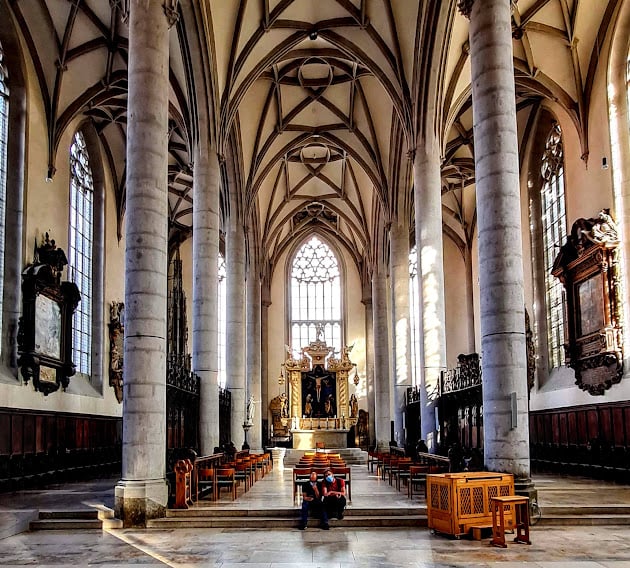
Interior of the St-Georg-Kirche Photo: Mike Stuchbery
Comments (1)