
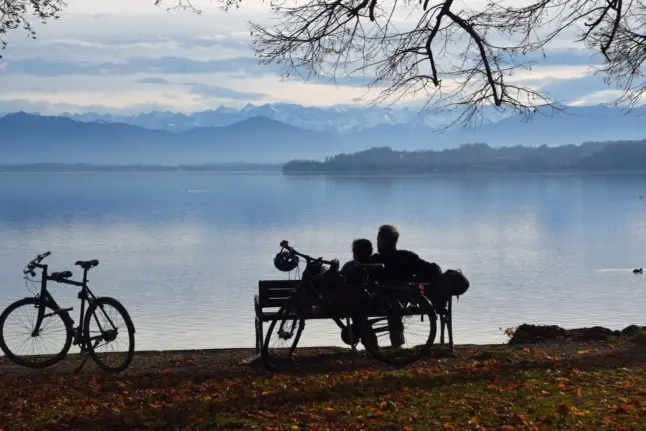
Can you feel the Alpine breeze? Nope, that’s just a hairdryer …
This word is certainly multi-faceted. Der Föhn, along with the word der Haartrockner, translates to ‘hair dryer’. Unlike the latter, literal translation, though, der Föhn has further meanings.
Der Föhn is also used in a meteorological sense to refer to the dry, warm winds which occur when air flows over high mountains, particularly over the Alps. According to the German dictionary Duden, the word Föhn can be traced back to the Middle High German foenne and Old High German phōnno. This in turn sees its roots in the Latin favonius, which translates to ‘spring wind’ or ‘west wind’.
We use Föhn as a loanword in English with the terms ‘foehn winds’ or ‘the foehn effect’. These expressions are used to describe the process of wet and cold conditions on one side of a mountain becoming dry and warm on the other side. You can perhaps see the logic between the two definitions of the German Föhn, then. The warm air produced by a hairdryer reflects the warm winds of the Alps (supposedly).
ANALYSIS: What's going on with Germany's weather right now?
The Föhn also plays a significant role in the west European cultural mindset. The Alpenföhn (‘Alpine wind’) has been said to affect residents’ mental states, as well as to bring about physical illness. There are various compound nouns using Föhn which describe these states, for example Föhnstimmung (‘foehn mood’), Föhnkopfschmerzen (‘headache caused by foehn winds’), and Föhnkrankheit (‘foehn disorder’ or ‘foehn illness’).
The use of the word Föhn doesn’t end there, though. Used in the colloquial phrase, einen Föhn kriegen means ‘to become angry’. If all else fails, just blame it on the Föhn!
Examples:
Spürst du den Föhn?
Can you feel the foehn?
Ich krieg(e) ‘nen Föhn.
[‘nen = einen]
I’m getting annoyed.
Comments