
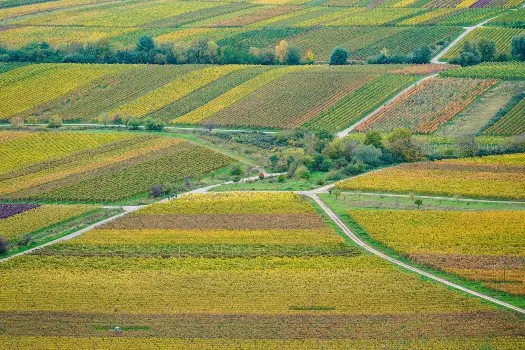
The Deutsche Weinstraße is the oldest wine road in Germany. It is over 85km long and passes through the wine region of the Rhineland-Palatinate, one of Germany’s favourite wine areas.
Nowadays, the Weinstraße is an idyllic tourist-magnet. The area is sometimes nicknamed “the German Tuscany” for its mild climate, and hosts over 200 wine festivals a year, which attract visitors from all over Europe.
And it certainly is beautiful: panoramas of gently rolling vineyards, interspersed with miles of alleys lined with almond trees, which bloom bright pink in the spring.
But there is something that many don’t know about this small pocket of paradise, or at the very least, don’t care to talk about: its Nazi heritage.
Unfortunately, the founding of the wine road was deeply interlinked with the NS-Regime, a fact that often slips under the radar beneath all the wine festivities and tourist attractions.

Collecting grapes in Neustadt an der Weinstraße. Photo: dpa | Uwe Anspach
A self-made problem
The road was founded in 1935 by Gauleiter (Nazi party leader) Bürckel.
Bürckel was an avid National Socialist and anti-Semite. He would later be responsible for the organization of the forced emigration and murder of almost 49,000 Austrian Jews, and play a big role in the SS.
In 1935, however, he was still trying to stabilize his significance in the party.
At that time, the Rheinpfalz wine region was suffering. As a result of a complicated past with France, wine from the Rheinpfalz was not very well known. But now, a particularly successful wine harvest in 1934 had driven prices to an all-time low, and wine growers were struggling to make ends meet.
The situation was aggravated by the fact that many of the wine merchants, who usually bought the wine growers stocks and distributed them elsewhere, were Jewish.
Even before the country-wide boycott of Jewish businesses in 1933, Bürckel had NS-officers stationed outside Jewish businesses, who would regularly vandalize and harass the owners, and prevent customers from entering.
By the time the wine crisis arrived, many of the wine merchants had left. Vineyards either couldn’t, or wouldn’t sell to those remaining, and so there was no market for the abundance of wine they had on their hands.
A National Socialist Statement
Where we now see a problem born of prejudice and persecution, Bürckel saw opportunity.
He used the crisis to show that the NS-party cared about “die kleinen Leute”, the everyday farmers and agriculturists that were struggling in the Rheinpfalz - so long as they weren’t Jewish, of course.
SEE ALSO:
- Meet the man introducing internationals to German wine
- Five of the best day trips to take in Lower Saxony
And as far as PR goes (in this case, a “Propaganda Roll-out”), Bürckel knew what he was doing.
He launched a huge advertising campaign for German wine across the country. The road was developed and christened with the first German wine festival. He even had a gateway built at the border, to antagonize the French, their biggest wine competitors.
The campaign succeeded in kick-starting the area’s wine-tourism and market.

The German Wine Road Gate, with an imperial eagle that used to hold the Nazi swastika. Photo: dpa | Uwe Anspach
Dealing with a legacy
In 2010, the regional newspaper Die Rheinpfalz published an article on the wine road titled “Geniale Idee mit problematischer Herkunft” (brilliant idea with a problematic origin).
This strikes at the core of the issue: though he was using it as a propaganda opportunity to secure his own position in the party, Bürckel created a booming market for Rheinpfalz wine, like it had never existed before.
The knock-on effect was that several generations of wine and hospitality businesses flourished in the Rheinland-Pfalz. Would the region be the same tourist hot-spot it is today, without the dubious origin of the wine road?
In 2016, SWR / ARD televised a documentary called ‘Der Coup des Gauleiters – Die Geburt der Deutschen Weinstraße’ (the coup of the Nazi party leader - the birth of the German wine road). But other than this, there have only been few attempts to grapple with this Nazi legacy.
What does this mean for Germany’s goal of ‘coming to terms with the past’? Does the good sometimes outweigh the bad?
Comments