
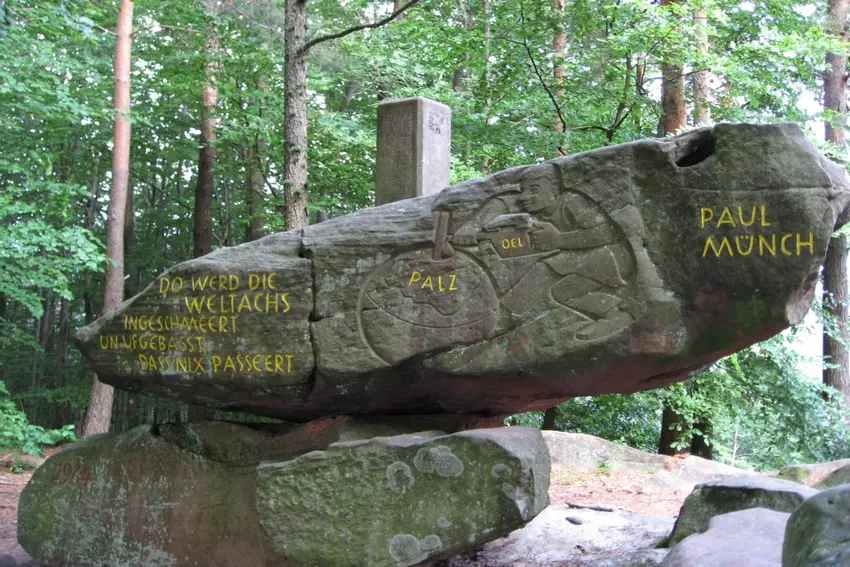
In Rhineland-Palatinate there is a secret. The entire population is, essentially, bilingual.
Recently, concerns have been raised about the “dying out” of local dialects in Germany. Visitors to the Rhineland could be forgiven for thinking the dialect is nothing more than a slight twang to the Hochceutsch (standardised form of German we hear and read in the media) spoken by locals.
READ ALSO: Grüß Gott, Moin, Hallo! The complete guide to regional dialects around Germany
Out of ear-shot, however, and at the end of the winding country roads, “Pfälzisch” is still very much alive and well. It’s such a rich and colourful dialect that it can even seem like its own language.
Norre weil du dich domols
ääfach bei mer eighenkt hoscht,
wie mer hääm sin,
do bin ich, norre weche dir,
gschdolwert iwwer mei äächene Fieß:
Un mein Knechel umgeknixt, un wie! Ganz grie-gääl-bloo!
- Matthias Zech, ‘Alles norre weche dir!’
(Just because back then,
When you just put your arm in mine,
As we were walking home,
Just because of you, I
Tripped up over my own feet:
And twisted my ankle, and how! All green-yellow-blue!)
In truth, it’s more of an amalgamation of languages. Because of the historically fluid borders between the Rhineland and what is still colloquially known as “Lothringen” (Lorraine), there is a strong French influence. Words like “Malöör” (bad luck) from the French “Malheur”, replace the more traditional German vocab like “Unglück”.
Other words remind of the shared germanic root of English and German, pronouncing many of German T-sounds as D-sounds, like “Daa” (day) instead of “Tag”.
With that in mind, The Local has collated some of the most essential Pfälzer vocabulary, to give you a taste and really stun the locals as an expat living in the Rhineland, or a visitor to the beautiful, but often underappreciated, province.
The basics:
Aarisch: sehr - very
Ajo: das stimmt / ich stimme dir völlig zu - that’s true/ I completely agree
Allahop: also gut/in Ordnung - alright then/ok then
Allemo: Ja, natürlich
Babbele: reden - speaking
Bagaasch: Verwandtschaft - relatives, from French “baggage”
Drepsele: sanfter Regen/ light rain
Due: tun / machen - to do
Ebbes: etwas - something
Elwetrittcher: a local mythical creature, described as a chicken-like figure with antlers
Fraa: Frau - woman
Gäälrieb: Karotte - carrot
Gell?: nicht wahr? / stimmts? - right?
Geworschdel: Durcheinander - a muddle
Gosch: Mund - mouth
Guggemo do: Guck mal - look at that
Grumbeere: Kartoffel - potato
Hä?: Entschuldigung, ich habe sie nicht verstanden, können sie das bitte nochmal sagen? - excuse me, could you repeat that, I didn’t hear you the first time
This video shows conversations in Hochdeutsch (standard German) vs. Pfälzisch.
Hamma: haben wir - we have
Hasche?: hast du? - do you have?
Isch ebbes?: ist etwas? - is something up?
Isch kennt misch uffreesche - “Ich könnte mich aufregen” - ein Ausruf der Wut / “I could get so annoyed” an exclamation of anger/frustration
Jesses!: Ausruf des Erstaunens/exclamation of disbelief/surprise
Mänsche?: meinst du? - Do you think?
Sellemols: damals - back then
Oh her doch uff!: Ach, hör doch auf damit! - Oh, stop that!
Uffbasse!: Pass auf! - watch out!
Colourful expressions:
Rutsch mer doch de Buckel nunner! - “Slide down my back!” - as much as: Go to hell / I don’t care
Die sinn en Kopp un en Arsch - “They’re one head and one arse” - they’re just like one another / just as bad as each other
Fer en Klicker un en Knopp - “For a marble and a button” - bought affordably, a real bargain
Wer lang kräxt, lebt lang - “Those that complain the most, live the longest”
Was ma hat des hat ma - “What one has, one has”
Es hellt sich uff zum wolgebruch - “It’s brightening up for a cloudburst”
Er/sie hat de hinnere in zwe haenn genomm - “He/she took his/her backside in two hands” - he/she made a swift exit / ran away quickly
Der is am deiwel aus de Pan gehubst - “He/she must have jumped out of the devil’s pan” - they’re a bad apple
Do kennt ma helle Träne forze un senkrecht in die Luft scheisse - an expression of anger
Comments (1)