
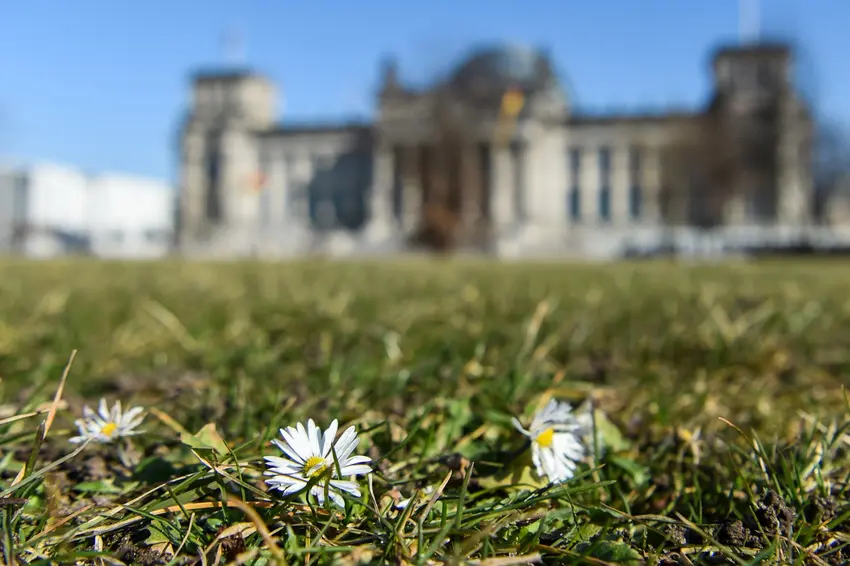
Last week, it seemed like all of Berlin emerged from hibernation. Clambering out of their burrows, Berliners blinked at the sun, and the 20C weather in utter bewilderment: wait, isn’t it still February?
Following some icy spells across the whole of Germany (with some places reaching below -20C!), the country was catapulted into spring with little to no warning. And of course, the Germans have a word for this: Blitzfrühling.
READ ALSO: Germany sees temperature rise of record 41.9C in one week
A literal translation is “lightning spring,” but there doesn’t seem to be any direct English equivalent. The closest idiomatic translation might be ‘flash spring,’ though the German imagery is certainly a lot more striking.
Blitz- is often used as a prefix in front of a noun in German, and indicates that something is sudden, surprising and short (you might think of “Blitzlicht” for a camera flash, or even the word “blitzkrieg,” a germanism adopted into the English language in 1939).
However, the union of ‘Blitz’ and ‘Frühling’ is quite a recent one. Online, the earliest use of the word appears to be in 2010, on Volksstimme.de, the Saxony-Anhalt's local newspaper.
There, H.-E. Gorges writes: “vom sonnenhungrigen Menschen aus gesehen, [...], kam der ‘Blitzfrühling.’” Or, roughly translated: “From the point of view of the sun-starved people, there came the ‘Blitzfrühling’.”
But, when temperatures shot up last week, so too did Blitzfrühling’s popularity, appearing in most of the major German newspapers and weather reports.
READ ALSO: Germany to see temperatures up to 20C after winter freeze
Of course, there is a potential dark side to what is unquestionably a charming addition to the German language. Meteorologists around the world are reporting increasing numbers of extreme weather variations and temperature changes.
The recent addition to the Blitz- family reflects these changes, and could become an increasingly common phenomena in the early months of the year. This might seem like a welcome change for us, but will become a confusing and even dangerous development for animals who rely on hibernation to get through the winter.
This includes those pesky Berliners like myself.
Example sentences:
Nach dem Blitzeis kommt jetzt der Blitzfrühling.
Dangerous icing conditions will be followed by a “Blitzfrühling”.
Nach dem Blitzfrühling bleibt es bis Monatsende überwiegend freundlich und trocken.
Following the “Blitzfrühling,” the rest of the month will remain mostly bright and dry.
Das Winterwetter ist noch lange nicht vorbei, das Wochenende bringt aber zumindest einen Blitzfrühling.
The winter weather isn’t over by a long-shot, but we’ll see a “Blitzfrühling” at the weekend.
Comments