
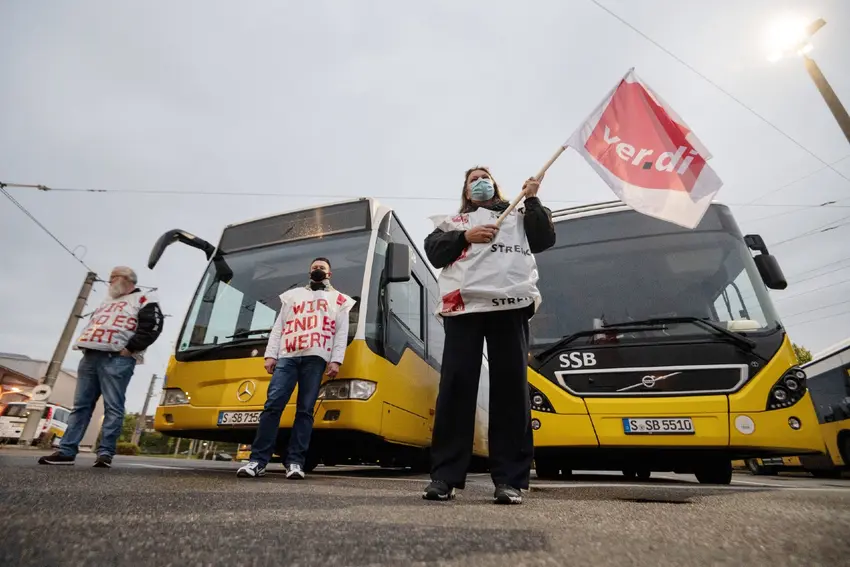
The trade union Verdi, which represents around 87,000 workers from 130 public transport companies, announced the strikes on Tuesday.
In Berlin, all trams and U-Bahn lines, as well as most busses, will come to a standstill for 24 hours from 3am on Friday. The strike in Brandenburg will last from 3am until noon.
Not every public transport service will be affected, however. In the capital, S-Bahn lines and regional trains will continue to run, as well as bus lines run by private companies.
READ ALSO: Public transport strikes across Germany cause major disruption
The following bus lines will be running as normal in Berlin:
106, 112, 140, 161, 163, 168, 175, 179, 184, 234, 275, 284, 334, 341, 349, 363, 369, 370, 371, 380, 399 , 740, 744, N12, N23, N34, N35, N39, N40, N52, N53, N56, N58, N60, N61, N62, N67, N68, N69, N77, N84, N88, N90, N91, N95, N97
In Brandenburg, the list of companies taking part in the strike limited to the following:
-
ViP Verkehrsbetriebe Potsdam GmbH
-
Regiobus Potsdam Mittelmark GmbH
-
Havelbus Verkehrsgesellschaft mbH
-
die Verkehrsbetriebe Brandenburg an der Havel GmbH
Call for negotiations
Verdi hopes that further ‘warning strikes’ - or a lead up to further actions - will put pressure on public service employers to agree to their demands.
The trade union is calling for a nationwide standard pay for its workers to combat growing discrepancies in wages between different states.
Other demands include extra leave or special bonuses to relieve the strain on employees, as well as policies focussing on the recruitment and development of young workers.
Risk to health?
As coronavirus cases in Germany continue to rise, concerns that the strike could heighten the risk of infection were rejected by Verdi representative Jeremy Arndt.
“The employers are leaving us with no other choice, as they simply don’t want to negotiate with us”, he told the broadcaster RBB (Radio Berlin Brandenburg) on Thursday. “Unfortunately we have to go ahead.”
He pointed to the nationwide strike that took place on September 29th, arguing that “the expected chaos on public transport networks was avoided”.
Many simply travelled by bike, and additional S-Bahn services prevented trains from becoming overcrowded. Arndt expects that “the same will be the case tomorrow”.
A bad time
The German Association of Municipal Employers (VKA) rejected Verdi’s demands once again on Tuesday, expressing criticism toward the second round of strikes.
“These warning strikes are not just an unreasonable burden for the population, but also for the local transport companies already struggling to cope with the enormous loss of revenue caused by the coronavirus crisis”, said the association on Tuesday.
READ ALSO: Explained: What sparked the protest culture of modern Germany?
Christine Behle, Vice President of Verdi, sees it differently. “We announce the strikes well in advance to allow citizens to plan around the situation”, she said.
Public transport strikes have taken place in various German states over the course of the past week, with Hessen affected on Tuesday, Lower Saxony and Bremen on Wednesday, and Badem-Württemberg and North Rhine-Westphalia on Thursday.
There will also be strikes until noon in nine towns in Bavaria, including Regensburg and Nuremberg, on Friday.
"We are already expecting that employers will change their tune and enter into negotiations with us," said Arndt. “If not, expect the strikes to continue.”
Comments