
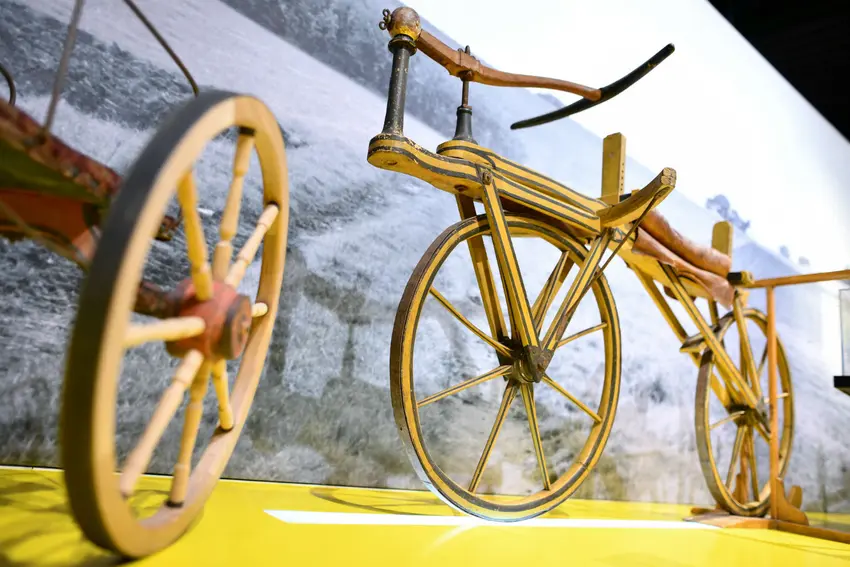
Beginning on the April 5th, 1815, the eruption of Mt Tambora in modern-day Indonesia let to vast clouds of ash, shot high into the Earth's atmosphere. Not only dimming the skies, it led to a sudden cooling of temperatures, killing crops and lead to famine.
In many parts of the world, 1816 became known as the 'Year Without A Summer'.
In Europe, not only did the eruption lead to famine, but also impacted people's ability to get about. With less feed for horses, it simply wasn't possible to keep as many stabled, or use them more than necessary.
A prototype for horseless travel
Enter then, our hero - a German, no less. Already able to devote his life to invention, thanks to his noble background, Baron Karl Von Drais noted the need for a new mode of transportation due to the lack of healthy horses around.
Based in Karlsruhe, in the southern state of Baden-Württemberg, he spent hours developing a prototype for horseless travel.
SEE ALSO: 10 things you use everyday and had no idea were invented by Germans
On June 12th, 1817, Von Drais revealed his creation to the world - or the people of Mannheim, at least.
It looked like a very primitive bicycle, propelled by pushing one's feet along the ground. He called it a 'Laufmachine', or 'running machine' - it would later become known as a 'draisine' and in English, the 'dandy horse'.
Riding a distance of about four and a half kilometres along roads and footpaths, Von Drais made the journey in an hour, a considerable saving of time on the same journey by foot.
The people of Mannheim were impressed, and news soon spread of this new invention. Once people actually tried the vehicle, however, uptake would not be as high as he hoped.
For a start, roads across Europe were terrible, and the 'Laufmaschine' lacked any kind of suspension. It was also a pain to push uphill. The skies would also clear by the following year, allowing travel by horse to resume again at normal levels.
One invention leads to the next
Von Drais was awarded a patent for the 'Laufmaschine', along with several other of his inventions such as a meat grinder and an economical heater. He would hardly profit from them, however.
Alongside the wider lukewarm reception to the vehicle, family connections made him a target for revolutionaries, who hounded him into poverty. He died in 1851.
It may seem that describing Von Drais as a hero is overdoing it, especially considering the drawbacks of his invention. However, it would undoubtedly go on to inspire a generation of pioneers and inventors who would change the world.
For example, as they will tell you in Karlsruhe, just a few streets away from Von Drais' residence, lived a small boy who could not have but heard about the 'Laufmaschine', and seen a few trundling around the streets at the time. It must have excited him.
His name was Carl Benz.
Comments