
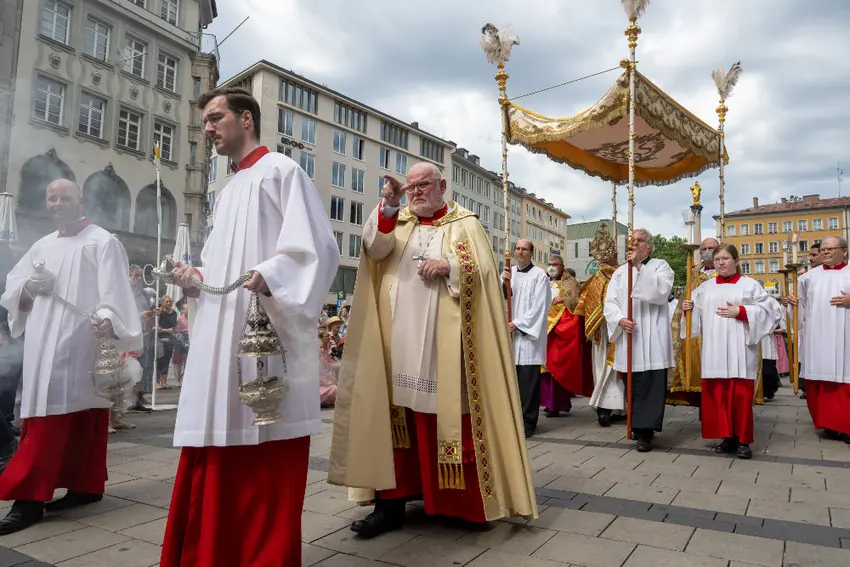
This year, Thursday June 4th marks the Catholic holiday of Fronleichnam, known sometimes as Prangertag or Blutstag. In English the simplified Latin term, Corpus Christi, or the Feast of the Body of Christ, is used.
Catholics celebrate the holiday on the second Thursday after Pentecost, and it's also a public holiday in eight German states.
Regularly employed workers in these states can expect the day off work. Since it falls on a Thursday, the holiday also presents the opportunity to make a four-day holiday weekend by taking a bridge day.
Where and how is it celebrated in Germany?
Corpus Christi is a public holiday in Baden-Württemberg, Bavaria, Hesse, North-Rhine Westphalia, Rhineland-Palatinate, Saarland, Saxony and Thuringia - and it's mostly celebrated in these regions as well.
You may notice that the holiday is honoured mainly in Germany's predominantly Catholic states.
Basically you'll have the day off work if you live in a part of Germany where Martin Luther didn't have an upper hand.
CALENDAR: How employees can make the most of Germany's public holidays in 2026
However, the holiday is also celebrated in other parts of Germany, such as in Sorbian communities. The West Slavic ethnic group lives in the eastern states of Brandenburg and Saxony, and the majority are Roman Catholics.
Celebrations of the holiday include a Holy Mass with the Eucharist, followed by a Fronleichnam procession led by a local Priest, during which praying and singing takes place.
This and the following barbecue is considered the Fronleichnamsfest (which is pronounced like froon-laich-naams-fest). The feast varies greatly in size from town to town.
In Fritzlar in northern Hesse, the celebrations usually start on Wednesday night with the so-called Katzenkoppschießen. During this ceremony, the eight bells of the town cathedral are rung and a canon is fired, a ritual that is repeated three times.
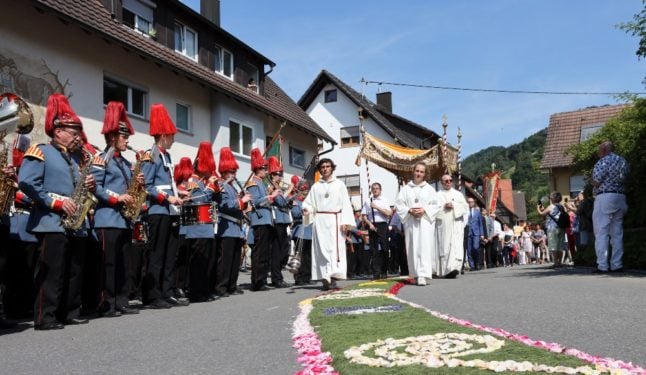
In Cologne, there is usually a procession involving over 100 ships, while in Bamberg 18 men carry a huge cross through the town.
The parades are often highly decorated with ornate floral images with motives from the Bible. People who celebrate usually decorate their houses with similarly elaborate designs and symbols, such as a Biblical fish.
What are its origins?
The word itself comes from the Middle-High German term vrône lîcham, meaning “Body of the Lord”. The term comes from the words vrôn (meaning “what concerns the Lord”) and lîcham (meaning body).
The variations of the word Fronleichnam also have their origins. Blutstag is comprised of the words Blut (meaning blood) and Tag (meaning day), so it literally means “Blood Day”. This makes sense as it celebrates the blood of Christ.
Prangertag, on the other hand, is a little more strange.
Pranger means pillory, which is a wooden framework with holes for the head and hands, and was used to imprison offenders during Medieval times.
However, Pranger in this case supposedly does not mean an ancient torture device. It is said to reference the thought that “die Natur prangert in ihrem herrlichsten Kleid” (nature denounces in her beautiful dress).
The only sense that can be made of this is that nature can be quite beautiful around this time of year.
But what actually is Fronleichnam?
Fronleichnam is the liturgical solemnity celebrating the presence of the blood and body of Jesus Christ in the elements of the Eucharist.
So essentially it celebrates Jesus and his role in elements of the commemoration of the Last Supper.
Fronleichnam in a sentence:
Na? Gehst du gleich zum Fronleichnamsfest?
Well? Are you going to the Corpus Christi celebration?
Pfarrer Mustermann mag Fronleichnamsprozession besonders viel, hab’ ich gehört.
Father Mustermann likes Corpus Christi in particular, I have heard.
Comments (1)