
"Just get married in another country, it’s a lot easier.”
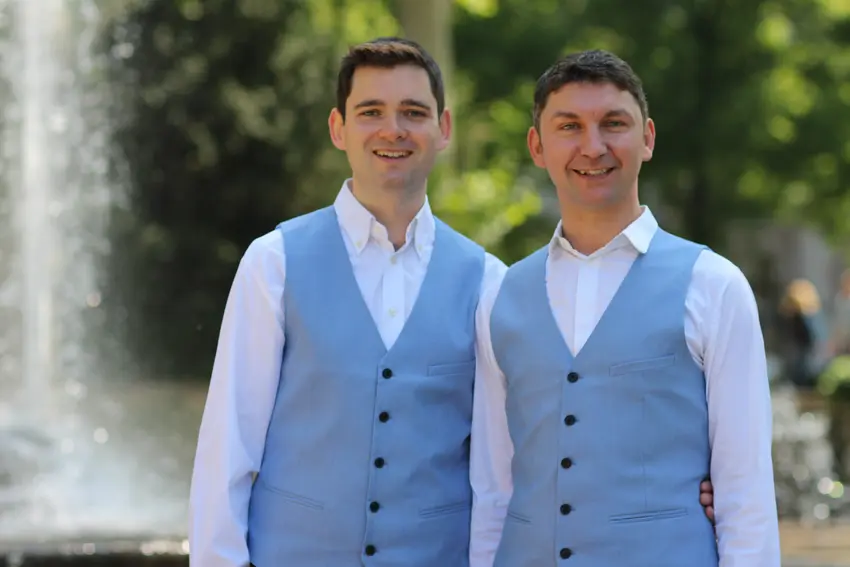
That’s the advice Andrew France-Raffeneau, 34, from England, and his husband Jérôme, 39, from France, heard when they were planning their German wedding.
“A lot of our friends who are also Ausländer (foreigners) said that to us,” France-Raffeneau, who wed Jérôme recently in Berlin, told The Local.
Many couples prefer to cross the border and get hitched somewhere else instead of facing the long drawn out process and bureaucracy that has become synonymous with Germany.
But for those with their heart set on marrying in the Bundesrepublik, just how do you go about it? And is it really as difficult as some people say it is?
Stressful to prepare
France-Raffeneau's partner proposed to him last December and the couple made their registration appointment at their local Standesamt (registry office) in Berlin Schöneberg in January this year.
“The most stressful thing was getting the registration meeting, preparing for that and hoping that your German would be good enough,” France-Raffeneau told The Local. “Once that’s locked in, the rest of it is very easy.”
The Standesamt sent the France-Raffeneaus a form detailing what they needed to register, such as birth certificates (which had to be translated into Germany by official translators) and identification, plus proof of address in Germany.
However, the documents you need depends on where you're from, and also where in Germany you are registering your marriage. Couples should follow the instructions from their local Standesamt.
READ ALSO: The 10 things you need to know about a German wedding
 Photo: DPA
In Germany, all weddings must be held at the Standesamt as only an official registrar can perform a legally binding marriage. So if couples want to have a symbolic wedding in a religious surrounding for example, the civil ceremony at the registry office has to come first.
France-Raffeneau, who is a web developer, said it can be easy to make mistakes during the process because of the different requirements. For example, his partner Jérôme was asked for a fresh copy of his birth certificate from France, so France-Raffeneau thought he did too and ordered it.
“It took weeks to arrive,” he said. “But then we found out it’s only French people who need a new one and English people can use their original birth certificate.”
Non-EU citizens often need to get something called a Ehefähigkeitszeugnis (also known as a CNI in some countries) from their home country, which verifies that they are free to marry (ie. not already married).
Name change rules
Another point that France-Raffeneau found surprising was the policy on marriage name change rules, which are more restrictive in Germany.
According to law, only one person in the couple can change their name which makes it difficult if both people want each other’s names.
“However, if you are a citizen of another country, then those countries 'name rights' apply and so we were both able to double-barrel our name due to my British citizenship,” he added.
France-Raffeneau said it is “important” your German is good enough; otherwise you could be asked to have a certified translator in every Standesamt meeting and at your wedding.
YouTube videos
In the run up to the big day on May 17th, France-Raffeneau watched YouTube videos of German weddings.
“We had no idea what to expect,” he said.
The couple were told to turn up to the ceremony 20 minutes before the start. The room was arranged to accommodate their witnesses and they were asked to put rings, if they had them, on a train.
The official conducting the wedding gave a speech about the importance of union between people and “appreciating moments in your married lives”.
The couple were then asked if they would take each other in marriage and answered with: “Ja, ich will” (the equivalent of “I do”).
“You have to say it in German,” said France-Raffeneau. Next they were congratulated and then they kissed.
“It was a very emotional situation; we were both a little bit tearful,” France-Raffeneau said.
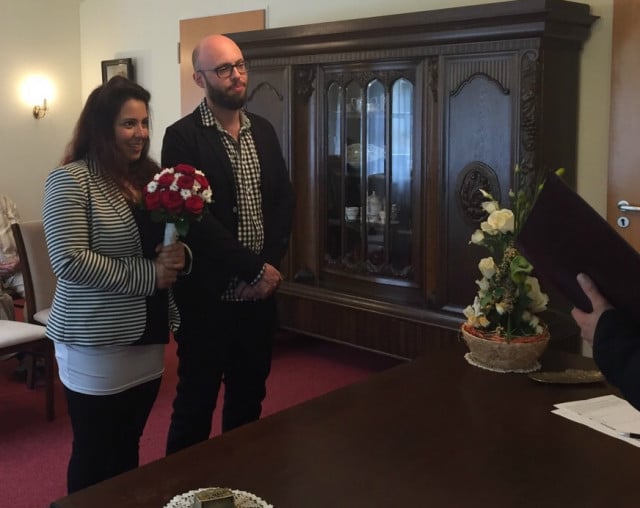
An example of a Standesamt wedding in Germany.
The cost of hiring the registry room and for documents can range in price across Germany, from around €65 to €200, even more in some cases.
Overall, the cost of the France-Raffeneau’s wedding was about €130. They were married on a Friday morning and had a party with friends and family on Saturday. It usually costs more to conduct the ceremony on Saturday.
More expensive for foreigners
Guilia Pines who’s from the US, and got married to a German man in Brandenburg in July 2011, recalls lots of “barriers” and paperwork during the process.
“We kept getting notices that said: ‘Here’s how much this would cost if you were German but because you’re a foreigner, we’re going to double the price,’” the 34-year-old told The Local.
“The amount to rent the room in the Standesamt was a set price but it was double for foreigners.”
Pines also had to negotiate over name change rules, because she had wanted to add her husband’s name to hers but without a hyphen – something that usually isn't accepted in Germany.
“They took the conversion about the hyphen so seriously,” she said.
“I remember being in the Standesamt office with a lovely elderly woman; she went over to the book shelf and took this encyclopedia sized book which had the laws about naming rights in every single country in the world.”
 Photo: DPA
Overall, the wedding, with all the documents, cost about €500 to €600.
Out of curiosity, Pines looked up how much it would cost to get married in New York, where she lives now.
“I think you could go to the City Hall in New York City and get a marriage licence for $25,” she said.
Pines, who’s now going through a divorce, said she was finding the process of ending her marriage particularly strenuous.
“Overall Germany makes it pretty difficult to get married and they also make it pretty difficult for anyone getting divorced,” she said.
Birth certificate from home
Canadian Shelley, 32, wed German husband Andre at the Standesamt in his home city of Münster in November 2017.
Overall, Shelley found the process not very stressful or difficult “so long as you have all the necessary documents”.
However, she can understand why others choose to get married somewhere else. Denmark, especially the island of Ærø, which has become known as the Gretna Green or Las Vegas of Europe, is particularly popular because there's less paperwork involved.
READ ALSO: Here's how to marry a German as an expat
“I'd heard it can be fairly bureaucratic in Germany – surprise, surprise – but I think a lot of it depends on one's citizenship," she added.
Ahead of the Standesamt appointment, which they had booked one or two months in advance, Shelley had to submit a long form birth certificate.
“This was definitely the trickiest part of the process as I could only obtain that document back home,” she said.
Shelley asked a family member based in Toronto to get it for her and post the certificate over.
This process cost about €100, while the Standesamt ceremony, which was held on a Wednesday, cost around €90-€100.
 Cutting the wedding cake. Photo: DPA
'Stereotypically German'
Freelance editor Natalye Childress, from California, got married in 2013 in Berlin to a German man.
“I found it very stereotypically German in that there was lots of paperwork involved,” she said.
Childress had to have a copy of her birth certificate issued no earlier than six months before their wedding. But – she had to pick it up from California.
“I feel very lucky that we happened to have had a trip to California already booked when we were planning the wedding; otherwise, we would have had to either postpone it or have myself or my parents fly there just to get the birth certificate,” she said.
As Childress had been married previously, she had to have copies of the former marriage certificate and divorce documents.
These documents had to have an Apostille – a legal stamp – and be translated professionally into German.
For the Ehefähigkeitszeugnis, Childress had to do a sworn statement at the US Consulate because the US does not have an equivalent document.
In total, the couple spent more than €500 for all the paperwork, stamps and translations.
The couple chose to have a small ceremony at the Standesamt on a Friday, followed by a dinner with loved ones, and then a party with friends and family on Saturday.
No religion at ceremony
Musicians Arie Burshtein, 32, and Netta Nimrodi, 36, both from Israel, wed in Berlin four years ago.
They describe it as a “relatively simple process” – but with lots of details.
Their paperwork had to be translated from Hebrew into German and given the legal stamp. The couple also had to go to a courthouse to receive permission for the marriage.
“I don't know if it's specifically because we're Israelis or if this is mandatory for all non-EU citizens,” Burschtein added.
Netta Nimrodi and Arie Burshtein on their wedding day. Photo courtesy of Arie Burshtein
Burshtein said the Standesamt case worker was “lovely, thoughtful and professional”.
He was impressed by the lack of religious involvement in the process.
“Coming from Israel, where the only way to get married is through the religion department, I would say that it was a relief to get married without a rabbi involved,” he said.
What surprised Burshtein and Nimrodi was how seriously the Standesamt took the wedding.
Their registrar “took his time to say a few beautiful words about love and commitment and I honestly believed that he meant every word, even if this was his fifth wedding of the day”.
They also didn’t need any witnesses, just a translator for Nimrodi who doesn’t speak German.
'Efficient'
Yet not every German marriage experience is bogged down by bureaucracy, with some couples reporting a surprisingly efficient process. That was the case when communications expert Eric Ebert, 40, wed his German wife at the Standesamt in Karlsruhe in 2011.
Like some other internationals, Ebert was surprised by the differences in naming laws.
“If you’re doing a double last name, you have to put a hyphen in it in Germany. Since there isn’t any federal law about that in the US, it took us a while to explain to the Germans that there isn’t a “naming law” that we could point to in the US.
"In the end, we chose US law, because it’s just more flexible.”
After the ceremony, family members threw rose petals over the couple in the courtyard as they enjoyed a glass of fizz. The registrar even gave Ebert's new wife a gift – a cookbook.
The couple enjoyed the experience and Ebert said that the Standesamt process is an “efficient” one.
Comments