
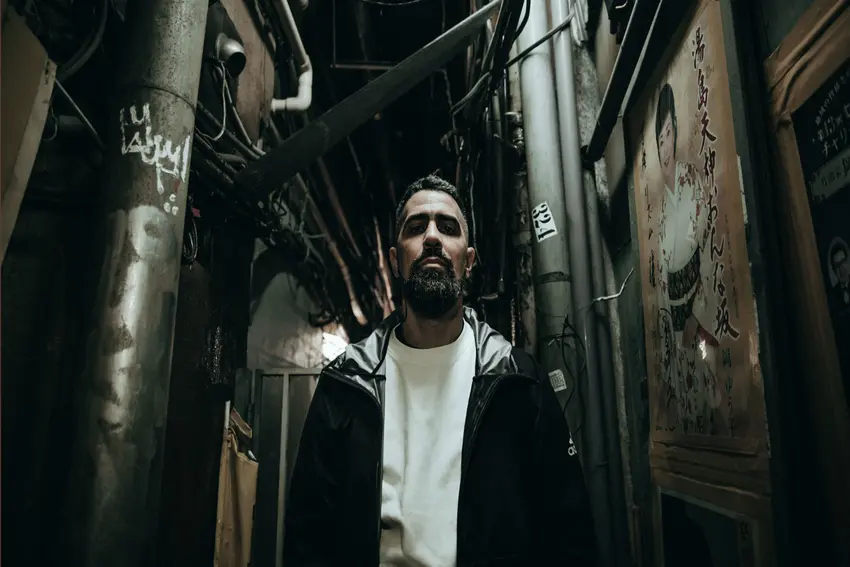
German hip hop made international headlines last year when rap duo Kollegah and Farid Bang won the award for best rap album at the 2018 Echo Music Awards. Their album ‘Jung, brutal, gutaussehend 3’ (Young, Brutal, Good Looking 3) contained the provocative line “my body is more defined than that of an Auschwitz inmate”.
Previous Echo winners handed back their awards in protest at lyrics which appeared to make fun of Holocaust victims. Not long after, the executive board of Germany’s Music Industry Association (BVMI) decided to discontinue the ceremony. Their music label BMG also cut ties with them.
The hype surrounding hip-hop continues, with the so-called 'Deutschrap' filled with figures known for the edgy lyrics and media-provaking statements. Sido played to a packed out audience in Berlin last December and Bushido’s personal life continues to fill headlines.
As Netflix gears up for SKYLINES, an Original Series about the German rap scene in Frankfurt and Berlin, it seems that Deutschrap is as popular as ever - even if it has taken a sharp turn from its more politically conscious origins.
Never far from controversy
German hip hop, also known as Deutschrap, has never shied away from controversy. From its enlightened beginnings to its current brand of braggadocious gangster rap, the genre has always been home to confrontational wordsmiths challenging the status quo.
As its popularity has grown, so has its audacious lyricism, often pushing the limits of political correctness. Looking at its evolution, it appears that courting controversy has been key to its success, particularly within a certain demographic.
“Rap is the most important genre for young people,” Fionn Birr, editor at German hip hop magazine JUICE, tells The Local. “There is no other genre with the kind of characters you find in hip hop and where kids can relate. Every teenager is listening to rap in some way”.
But this wasn’t always the case. It took over a decade of being underground before rap emerged as a mainstay in German popular culture.
Deutschrap is rooted in 1980s West Germany. Politically conscious groups in Heidelberg, Frankfurt, Hamburg and Stuttgart tackled wide-ranging topics, from racism and police violence to pollution and love.
Advanced Chemistry’s 1992 ‘Fremd im eigenen Land’ (Foreign in Your Own Country) tells the tale of three MC’s, born and raised in Heidelberg but sons of migrants, and the daily experience of alienation on account of their immigration background.
The three MC's of Advanced Chemistry, who come from Italian, Ghanaian, and Haitian backgrounds, in their official video 'Fremd im eigenen Land'.
“I hope the radio stations play this record, because I'm not an isolated case, but one of many. Not recognized, foreign in your own country. Not a foreigner and yet a stranger”.
Freundeskreis (Circle of Friends) sought to educate with tracks such as 1997’s ‘Leg dein Ohr auf die Schiene der Geschichte’ (Put Your Ear on the Tracks of History) whilst Stieber Twins would create what’s now considered the first classic conscious German rap album ‘Fenster zum Hof’ (Window to the Courtyard), a meticulous, jazz-infused and high-level production in 1996.
As in the US, disenfranchised German youths found in hip hop a vehicle to voice their struggles and daily observations.
Coming to age in a hip-hop era
Kvazi Kum of Beatman FU comes out of this tradition. The MC, born to Serbian parents in Berlin, was 14 when he met future rap partner Kai FU and began spitting. “I was fortunate enough to come of age during a pretty loaded decade of hip hop,” he tells The Local.
“We got together almost every weekend to write and create songs or put mixtapes together. All that was needed was a turntable, a tape deck and a Shure SM58 microphone”.
“We had to step our game up lyrically. Rhyme schemes became more intricate and we placed emphasis on word play. Hip hop really became a catalyst of my generation. Our raps captured what we felt and this is why hip hop became a cornerstone of my life”.
Beatman FU's first music video, recording largely around Berlin's Treptower Park. Photo: DPA
Berlin-based rapper Musa describes a similar journey. “I started in my teenage years more or less by accident. Back then, when we were young, we were setting the trends more or less”.
“The scene was still in the beginning somehow and wasn’t as big as it is now. You couldn’t blow up that quick, you had to have skills." A chance meeting with Megaloh, an established rapper, at a friend’s house would change the course of Musa’s career.
“Megaloh was already very evolved in his rapping skills, much more authentic and the best rapper I had met so far. I was always hanging around with him and after his ‘Regenmacher’ album (‘Rainmaker’, 2016), we just continued writing songs”.
Although 90s hip hop groups such as The Rödelheim Hartreim Project and Die Fantastischen Vier had enjoyed commercial success, it wasn’t until the early 2000s that Deutschrap got a strong foothold in popular culture.
Hamburg-based bands and acts like Fünf Sterne Deluxe, Absolute Beginner, Samy Deluxe, Fettes Brot, Deickind or even the aforementioned Freundeskreis or Massive Töne charted the way earlier but it was a different brand of hip hop, more funny, conscious and unifying.
An era of experimentation
Making records in the 90s was a costly experience but with the advent of more sophisticated and easy-to-use software, more and more hip hop enthusiasts began to experiment and produce.
“Suddenly everyone had the chance to make it big,” explains Kum. “You could produce and sell beats pretty easily. People bought home studios and launched labels”.
It was the era-defining record label Aggro Berlin, which took its name from the German slang for aggressive, that made gangster rap mainstream. Founded in 2001, the company signed artists such as SIDO – short for "Scheiße in dein Ohr" (Shit in Your Ear) – and other controversial acts like Bushido and Fler. The rapper frequently gave the explanation that SIDO also stands for "Super-intelligentes Drogenopfer" (super intelligent drugs victim).
Their music fused minimal, menacing beats with brash, confrontational lyrics celebrating violence and - when they later obtained it - wealth. The era of gangster rap – and all things politically incorrect – had arrived.
Yet acts like Bushido and SIDO were not met with appreciation when they came out. They were absolute misfits, their approach and their brand diametral to the values people previously knew hip hop to represent.
This is why Bushido was famously booed off stage when he just came out and he somehow was chosen to open up for the mighty Wu-Tang Clan. The crowd threw objects at him since he was not accepted at all in hip hop's traditional circles.
Looking to mirror the success of US gangster rap, Aggro label owners actively encouraged artists to use expletives and craft narratives of a crime-ridden urban life.
The official image of SKYLINES, a new Netflix series about German rap. Photo: DPA
This approach was summed up in Sido’s lyrics on the 2006 track ‘Verrückt wie krass’ (Crazy How Blatant): “You say I'm stupid, but you don't have to be much smarter, it's enough. I own two cars without a driver's license. Say fu%k here and there, exaggerate sometimes. You have to cross boundaries to make them write about you”. And the press did.
Fler was accused of promoting neo-Nazism on the release of his debut studio 2005 album, ‘Neue Deutsche Welle’ (New German Wave). A modified Hitler quote was used for the album’s promotion, the CD cover of which was decorated with the Nazi font-style, Fraktur.
Bushido was accused of promoting racist, sexist and homophobic lyrics, as well as flirting with fascism. In 2004’s ‘Electro Ghetto’ he raps the lines: “Salute stand to attention, I am the leader like A”. Many took A to mean Adolf.
These well-packaged anti-heroes marked a seismic shift in Deutschrap. Like its politically conscious forebears, gangster rap was pushing the bounds of public discourse, but for purely commercial ends, and they struck gold.
More and more young people began to buy into the lifestyle, resulting in a slew of number one hits, sold out concerts and tabloid fame. This tradition continues today.
“The flipside of the coin is that the content lacks any depth now,” says Kum. “The socially conscious aspect of hip hop is pretty much a thing of the past. The content has become irrelevant. Deutschrap has lost its soul to some degree”.
The official video for the 2015 single 'Neue Deutsche Welle'
Continuing to thrive
Although Aggro Berlin no longer exists as a record label – illegal downloading put an end to their model of music distribution – gangster rap continues to thrive.
Aggro graduates have been in the news for more than just their provocative lyrics. Fler was in the press most recently when he uploaded an Instagram story of his friend using the N-word and joking about black people. The artist was captured in the same film laughing, something for which he apologized days later.
Bushido made the headlines in 2013 when it was discovered that his former business partner and so-called clan boss, Arafat Abou-Chaker, was receiving 50% of the rapper’s earnings. This didn’t come as a shock to many in the rap community.
“There are gangs and power structures behind the rappers,” Musa explains. “They also control the rappers and the rap game, they have their interests”.
And alongside this, the bombastic rhapsody of early gangster rap also thrives, as shown in the works of Kollegah and Farid Bang.
The latest video from Berlin-based rapper Musa.
“They are children of this Aggro era,” Birr tells The Local. “They are provocative rappers, pushing boundaries in every way”.
“You could blame them for not taking responsibility for this, but on the other hand it’s a phenomenon of the whole of society. We are getting into a more questionable era”, thoughts echoed by Kum. “Young people identify with hip hop since it has no boundaries, just like society as a whole these days," he said.
“Artists like to provoke and shock to garner interest in their work, that’s part of the business. This might explain why Kollegah and Farid Bang made headlines with their antics, but maybe you shouldn’t overdo it. This is the opposite of hip hop’s core values, being open-minded and multicultural”.
Deutschrap, once a political outlet for frustrated and marginalized youth, has become a powerful force in mainstream entertainment. “There are different reasons for hip hop’s popularity,” explains Birr.
“One is that hip hop has become more popular across the world in general. The other is that kids are on the Internet and rappers know how to entertain”.
And perhaps it is this combination of devil-may-care lyricism and online media savvy that defines the current era of Deutschrap.
Comments (2)