
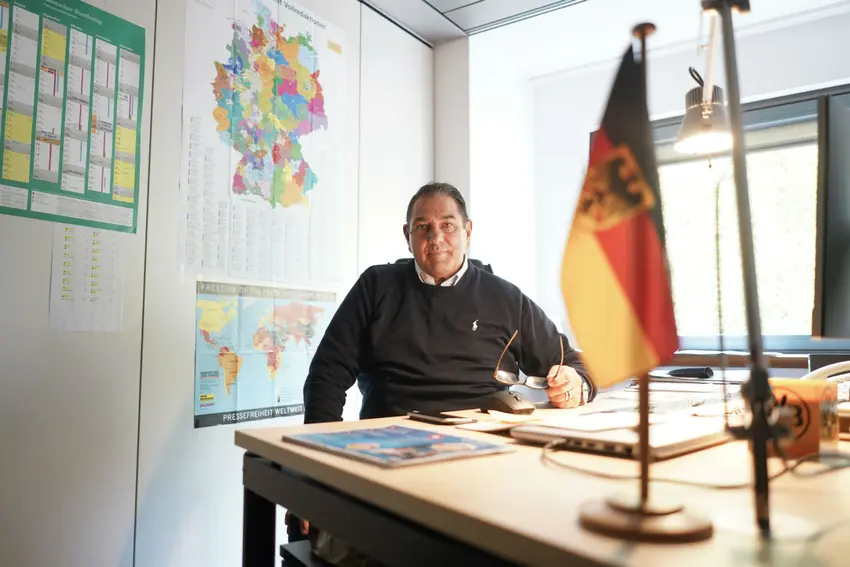
“Greetings from Berlin,” “There should only be the AfD”, smileys with hearts for eyes and cartoon stuffed animals: in the comment column running alongside an AfD livestream, their supporters are singing their praises. However, they aren’t only showing love. A visitor to the AfD Facebook page recently wrote “relinquish Merkel of her duties and send her to a Russian labor camp!!!!!”
The live stream with the parliamentary party leaders, Alexander Gauland and Alice Weidel, was published by the AFD’s media department, which is headed by Jürgen Braun, the party's parliamentary manager.
The department includes the press office, the PR team, a small research team and a very active social media unit, led by AfD member Mario Hau. "We don’t just have voters, we have fans," he says.
The young employees of the social media team shoot videos everyday and post AfD content on Facebook and Twitter. Their quote-queen is Alice Weidel. More than 430,000 users have ‘liked’ AfD on Facebook and the right-wing nationalist leader of the Thuringia AfD party, Björn Höcke, has garnered over 63,000 likes.
Two other employees of the social media unit work from home. They spend all day scouring the comment sections for extreme remarks. “Anybody who calls for violence or posts symbols of anti-constitutional organizations will be banned,” explains Hau. That’s an average of five to ten percent of the comments.
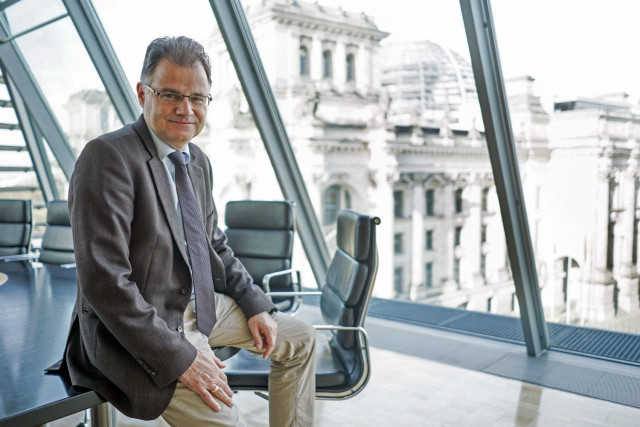
Jürgen Braun is pictured in the Bundestag in Berlin. Photo: DPA
The AfD has a complicated relationship with the media. On the one hand, their top politicians want to be invited to talk shows, but on the other hand, they like to criticize the “lying press” at their party conferences, as they feel they are put at a disadvantage by the media.
After the Hesse state election at the end of October, Gauland complained that nobody had wanted to speak to him and get his opinion on camera. However, the press conferences organized by the spokesperson for the AfD’s parliamentary party, Christian Lüth, are sometimes so well attended that not all journalists can find a free seat.
With its focus on direct channels where there is no potential for critical journalism, the AFD shows a similar mindset to that of the US President, Donald Trump, who prefers to let world politics play out on Twitter, rather than in lengthy conferences with multiple heads of state.
“Our followers want to see our point of view directly and unadulterated. They want to experience the AfD themselves,” explains Braun. “It is easier for us than for the established parties which have to restructure in order to fit changing habits when it comes to political engagement.” As a new party, the AfD has had a strong presence on social media from the outset.
A magnetic board hangs behind the desk of social media director Hau. It shows a daily plan which his team uses when there are no press conferences or AfD speeches in parliament lined up. It says: “10:00 Find a topic; 11:00 Text and Soundtrack; 12:00 Video!”
Under the heading “Merkel has to go!”, there is a newspaper clipping from Bild with the headline “Political earthquake in Berlin. Merkel at the end of her reign”. In addition, there is a list of arguments which the AfD wants to use to create growing hostility towards the UN Migration Pact, an agreement which the federal government promotes.
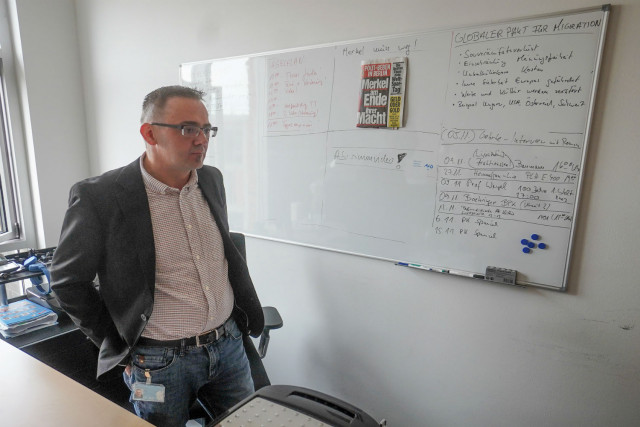
Mario Hau stands in his office, in front of his magnetic whiteboard. Photo: DPA
Braun has brought Holger Sitter to the AfD, a former sports journalist who now works as a ‘coordinator’ in the media department. Jörg Walter, who used to be a mainstream radio presenter, does the voice overs for short AfD videos in a small office in parliament. Two doors down, the AfD Citizens’ Office is housed; a friendly man with a headset answers emails and calls.
On the same hall there is a large room labelled ‘Newsroom’. However, behind the door there is not the hustle and bustle that you might expect. Apart from a few tables, the room is largely bare. Braun says an employee of the research team is currently on the way to Chemnitz to scout out more staff.
In general, it is difficult for the AfD to employ large numbers of good journalists. Of the 21 jobs in the media department, only 16 are currently occupied. Several potential candidates dropped out because they feared the social ostracism that working for the AfD could cause. Since Lüth left to become the parliamentary party’s spokesman in April, the federal party as a whole has not had a press spokesperson.
Comments